
Coherence (fairness)
 | This article needs additional citations for verification. (December 2021) |
Coherence,[1] also called uniformity[2]: Thm.8.3 or consistency, is a criterion for evaluating rules for fair division. Coherence requires that the outcome of a fairness rule is fair not only for the overall problem, but also for each sub-problem. Every part of a fair division should be fair.[2]
The coherence requirement was first studied in the context of apportionment. In this context, failure to satisfy coherence is called the new states paradox: when a new state enters the union, and the house size is enlarged to accommodate the number of seats allocated to this new state, some other unrelated states are affected. Coherence is also relevant to other fair division problems, such as bankruptcy problems.
Definition
There is a resource to allocate, denoted by . For example, it can be an integer representing the number of seats in a house of representatives. The resource should be allocated between some agents. For example, these can be federal states or political parties. The agents have different entitlements, denoted by a vector . For example, ti can be the fraction of votes won by party i. An allocation is a vector with . An allocation rule is a rule that, for any and entitlement vector , returns an allocation vector .


An allocation rule is called coherent (or uniform) if, for every subset S of agents, if the rule is activated on the subset of the resource , and on the entitlement vector , then the result is the allocation vector . That is: when the rule is activated on a subset of the agents, with the subset of resources they received, the result for them is the same.


Handling ties
In general, an allocation rule may return more than one allocation (in case of a tie). In this case, the definition should be updated. Denote the allocation rule by , and Denote by the set of allocation vectors returned by on the resource and entitlement vector . The rule is called coherent if the following holds for every allocation vector and any subset S of agents:[3]: Sec.4

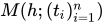

- . That is, every part of every possible solution to the grand problem, is a possible solution to the sub-problem.
- For every and , we have[ ( ) i ,( i) ] (h ;() = ) [({i \ S M 즉, 하위 문제에 대한 다른 (지연된) 해결책이 있다면, 하위 문제에 대한 원래 해결책 대신에 그것들을 넣는 것은 큰 문제에 대한 다른 (지연된) 해결책들을 산출한다.
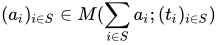
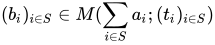
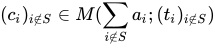
![{\displaystyle [(b_{i})_{i\in S},(c_{i})_{i\not \in S}]\in M(h;(t_{i})_{i=1}^{n})}](https://wikimedia.org/api/rest_v1/media/math/render/svg/cf3274c607826e6af4dbf3f256946a9d28220784)
Coherence in apportionment
In apportionment problems, the resource to allocate is discrete, for example, the seats in a parliament. Therefore, each agent must receive an integer allocation.
Non-coherent methods: the new state paradox
One of the most intuitive rules for apportionment of seats in a parliament is the largest remainder method (LRM). This method dictates that the entitlement vector should be normalized such that the sum of entitlements equals (the total number of seats to allocate). Then, each agent should get his normalized entitlement (often called quota) rounded down. If there are remaining seats, they should be allocated to the agents with the largest remainder - the largest fraction of the entitlement. Surprisingly, this rule is not coherent. As a simple example, suppose and the normalized entitlements of Alice, Bob and Chana are 0.4, 1.35, 3.25 respectively Then the unique allocation returned by LRM is 1,1,3 (the initial allocation is 0,1,3, and the extra seat goes to Alice since her remainder 0.4 is largest). Now, suppose we activate the same rule on Alice and Bob alone, with their combined allocation of 2. The normalized entitlements are now 0.4/1.75*2 ≈ 0.45 and 1.35/1.75*2 ≈ 1.54. Therefore, the unique allocation returned by LRM is 0,2 rather than 1,1. This means that, in the grand solution 1,1,3, the internal division between Alice and Bob does not follow the principle of largest remainders - it is not coherent.

Another way to look at this non-coherence is as follows. Suppose the house size is 2, and there are two states A, B with quotas 0.4, 1.35. Then the unique allocation given by LRM is 0,2. Now, a new state C joins the union, with quota 3.25. It is allocated 3 seats, and the house size is increased to 5 to accommodate these new seats. This change should not affect the existing states A and B. In fact, with the LRM, the existing states are affected: state A gains a seat while state B loses a seat. This is called the new state paradox.
새로운 주의 역설은 실제로 오클라호마 주가 된 1907년에 관찰되었다. 정당하게 5석을 배정받았고, 총 의석수는 386석에서 391석으로 늘어났다. 배분에 대한 재평가는 다른 주 때문에 좌석 수에 영향을 미쳤다. 메인이 한 자리를 얻은 동안 뉴욕은 한 자리를 잃었다.[4]: 232–233 [5]
일관성 있는 방법
모든 구분법에는 일관성이 있다. 이는 선택 시퀀스라는 설명에서 직접 따온 것이다. 각 반복마다 항목을 선택할 다음 에이전트는 비율이 가장 높은 에이전트(항목/분할)이다. 따라서 에이전트 간의 상대적 우선순위 순서는 에이전트의 하위 집합을 고려하더라도 동일하다.
일관성 있는 방법의 속성
일관성이 다른 자연적 요건과 결합될 때, 그것은 구조화된 분류의 배분 방법을 특징짓는다. 그러한 특징들은 다양한 작가들에 의해 증명되었다.[3]: Sec.1 모든 결과는 규칙이 동질적이라고 가정한다.
- 힐란드는[6]: Thm.3, 10 만약 일관성 있는 괜찮은 배분 규칙이 균형적이고 일치한다면, 그것은 분리수법과 양립할 수 있다는 것을 증명했다.
- 발린스키와 영은[2]: Thm.8.3 논리 정연한 점잖은 배분 규칙이 익명하고 균형을 이룬다면 그것은 순위 지수법(분수법의 슈퍼 클래스)이라는 것을 증명했다. 그 반대도 마찬가지인데, 익명적이고 균형잡힌 방법들 중에서 한 방법이 순위지수 방법일 경우에만 일관성이 있다.
- 발린스키와 영은[2]: Thm.8.4, p.147 만약 일관성 있는 괜찮은 배분 규칙이 익명이고, 일치하며, 약하게 정확하지 않다면, 그것은 차별적인 방법이라는 것을 증명했다.
- 발린스키와 라체프는[7][8]: Thm.2.2, p.8 만약 일관성 있는 괜찮은 배분 규칙이 익명이고, 질서를 지키고, 약하게 정확하고, 완전하다면, 그것은 구분법이라는 것을 증명했다.
- Palomares, Pukelsheim and Ramirez[3] proved that:
- Young proved that the unique apportionment method that is a coherent extension of the natural two-party apportionment rule of rounding to the nearest integer is the Webster method.[9]: 49–50, 190 [10]: Sub.9.10
Coherence in bankruptcy problems
In bankruptcy problems, the resource to allocate is continuous, for example, the amount of money left by a debtor. Each agent can get any fraction of the resource. However, the sum of entitlements is usually larger than the total remaining resource.
The most intuitive rule for solving such problems is the proportional rule, in which each agent gets a part of the resource proportional to his entitlement. This rule is definitely coherent. However, it is not the only coherent rule: the Talmudic rule of the contested garment can be extended to a coherent division rule.[1]: Sec.4
Coherence in organ allocation
In most countries, the number of patients waiting for an organ transplantation is much larger than the number of available organs. Therefore, most countries choose who to allocate an organ to by some priority-ordering. Surprisingly, some priority orderings used in practice are not coherent. For example, one rule used by UNOS in the past was as follows:[1]: Sec.6
- Each patient is assigned a personal score, based on some medical data.
- Each patient is assigned a bonus, which is 10 times the fraction of patients who waited less than him.
- The agents are prioritized by the sum of their score+bonus.
Suppose the personal scores of some four patients A,B,C,D are 16, 21, 20, 23. Suppose their waiting times are A>B>C>D. Accordingly, their bonuses are 10, 7.5, 5, 2.5. So their sums are 26, 28.5, 25, 25.5, and the priority order is B>A>D>C. Now, after B receives an organ, the personal scores of A,C,D remain the same, but the bonuses change to 10, 6.67, 3.33, so the sums are 26, 26.67, 26.33, and the priority order is C>D>A. The order between these three agents got inverted!
일관성 있는 우선순위 순서를 갖기 위해서는 개인의 특성에 의해서만 우선순위가 결정되어야 한다. 예를 들어 보너스는 환자의 분수가 아니라 줄에 있는 월 수로 계산할 수 있다.[11]
참고 항목
참조
- ^ a b c Balinski, Michel (2005-06-01). "What Is Just?". The American Mathematical Monthly. 112 (6): 502–511. doi:10.1080/00029890.2005.11920221. ISSN 0002-9890. S2CID 32125041.
- ^ a b c d Balinski, Michel L.; Young, H. Peyton (2001) [1982]. Fair Representation: Meeting the Ideal of One Man, One Vote. New Haven: Yale University Press. ISBN 0-300-02724-9.
- ^ a b c Palomares, Antonio; Pukelsheim, Friedrich; Ramírez, Victoriano (2016-09-01). "The whole and its parts: On the coherence theorem of Balinski and Young". Mathematical Social Sciences. 83: 11–19. doi:10.1016/j.mathsocsci.2016.06.001. ISSN 0165-4896.
- ^ Stein, James D. (2008). How Math Explains the World: A Guide to the Power of Numbers, from Car Repair to Modern Physics. New York: Smithsonian Books. ISBN 9780061241765.
- ^ Caulfield, Michael J. (November 2010). "Apportioning Representatives in the United States Congress - Paradoxes of Apportionment". Convergence. Mathematical Association of America. doi:10.4169/loci003163.
- ^ 힐랜드, 아누드. "배분방법: 분리할 수 없는 실체의 비례적 분배를 위한 절차" 1978.
- ^ Balinski, Michel L.; Rachev, Svetlozar T. (1993-01-01). "Rounding Proportions:Rules of Rounding". Numerical Functional Analysis and Optimization. 14 (5–6): 475–501. doi:10.1080/01630569308816535. ISSN 0163-0563.
- ^ Michel Balinsky and Svetlozar Rachev (1997). "Rounding proportions: methods of rounding". Mathematical Scientist, Volume 22, Issue 1, pages 1-26. Retrieved 2021-09-14.
- ^ Young, Peyton H. (1995). Equity: in theory and practice. Princeton University Press.
- ^ Pukelsheim, Friedrich (2017), Pukelsheim, Friedrich (ed.), "Securing System Consistency: Coherence and Paradoxes", Proportional Representation: Apportionment Methods and Their Applications, Cham: Springer International Publishing, pp. 159–183, doi:10.1007/978-3-319-64707-4_9, ISBN 978-3-319-64707-4, retrieved 2021-09-20
- ^ Fleurbaey, Marc (April 1997). "Equity: In Theory and Practice, H. Peyton Young. Princeton University Press, 1994, 238 + xv pages". Economics & Philosophy. 13 (1): 128–131. doi:10.1017/S0266267100004387. ISSN 1474-0028.