일반화된 선형 배열 모델 또는 GLAME은 2006년에 도입되었다.[1]이러한 모델은 일반화된 선형 모델 또는 GLM을 장착하기 위한 구조와 계산 절차를 제공하며, 모델 매트릭스는 Kronecker 제품으로 작성할 수 있고 데이터는 배열로 작성할 수 있다.대형 GLM에서 GLAM 접근방식은 일반적인 GLM 알고리즘에 비해 스토리지와 컴퓨팅 시간 모두에서 상당한 절감 효과를 제공한다.
Suppose that the data is arranged in a -dimensional array with size ; thus, the corresponding data vector 은(는) 1 3 d 1}2}을(를) 가지고 있으며설계 행렬이 형식이라고 가정하십시오.
데이터 벡터 과(와) 매트릭스X {\{X}을(를) 사용한 GLM의 표준 분석은 점수 알고리즘의 반복적인 평가를 통해 진행된다.
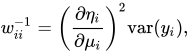
where represents the approximate solution of , and is the improved value of it; is the diagonal weight matrix분연히
그리고
작동 변수.
계산적으로, GLAM은 선형 예측 변수를 계산하기 위한 배열 알고리즘을 제공한다.
그리고 가중치 있는 내부 생산물
모델 행렬 . 의 평가 없이
예
In 2 dimensions, let , then the linear predictor is written 여기서 is the matrix of coefficients; the weighted inner product is obtained from and is the matrix of weights; here is the row tensor fun × 행렬 {이 제공됨[1]
GLAM은 데이터가 배열로 배열되어 있고 스무딩 매트릭스가 1차원 스무딩 매트릭스의 Kronecker 제품으로 구성된 d -차원 스무딩 문제에 사용하도록 설계되었다.
참조
^ abCurrie, I. D.; Durban, M.; Eilers, P. H. C. (2006). "Generalized linear array models with applications to multidimensional smoothing". Journal of the Royal Statistical Society. 68 (2): 259–280.







 (와)
(와) 













 , 1 {\


 면 분할 제품을