
키 패턴
Key pattern
키 패턴은 직선형 [1][2][3]나선형을 형성하기 위해 교차하는 직선 또는 막대로 만들어진 연동 기하학적 모티브의 총칭입니다.앨런과 앤더슨에 따르면, 키 패턴의 선이나 막대 사이의 음의 공간은 "L자 또는 T자형 슬롯을 일반적인 키로 만들어 자물쇠의 [4]워드를 통과할 수 있게 한다"고 한다.
주요 패턴은 인류 역사에서 많은 세계 문화들에 의해 발견되고 장식에서 사용되어 왔으며,[4][5] 대체로 서로 독립적으로 디자인되었다고 여겨진다.주요 무늬의 가장 초기의 예는 기원전 [5][6][7]23,000년 전 우크라이나 메진의 직물 장식품에서 볼 수 있다.신석기 시대에는 섬유와 도자기 장식에도 중요한 무늬가 존재했는데, 오늘날의 피지, 페루, 멕시코, 몰도바, 루마니아, 헝가리, 유고슬라비아, [4][5][6][7]그리스에서 고고학적 발견과 더불어 기독교 이전의 켈트 [1][2][3]미술에서도 찾아볼 수 있었다.오늘날 중국 서부의 약 1038년에서 926년 사이의 무덤에서 발견된 것으로 알려진 가장 오래된 바지인 양털 바지는 그 [8]안에 주요 무늬의 장식 띠가 짜여져 있다.또한 석조나 채광 원고 등 중세 초기 섬나라 미술의 현존 사례와 시대별 일본, 중국, 이슬람 장식 예술이 주요 [3][4][9][10]문양을 이루고 있다.
켈트족 미로, 그리스 프렛, 시칼콜리우키 등이 [2][4][11]주요 패턴으로 여겨지는 잘 알려진 디자인의 예이다.
갤러리

고고학 핸드북에서 볼 수 있듯이 디오스코리데스의 로마 모자이크 경계를 형성하는 주요 패턴, 이집트 - 그리스 - 에트루리아 - 로마(1867)

아테네 고고학 박물관 소장 기원전 8세기 그리스 그림 테라코타 암포라의 주요 패턴 상세

메트로폴리탄 미술관의 컬렉션에 있는 6세기 비잔틴 이집트의 로제트와 대각선 키 무늬가 있는 석회암 프리즈의 조각입니다.

상나라의 청동 중국 요리 그릇에서 볼 수 있는 직선의 열쇠 무늬.

메트로폴리탄 미술관 소장품 중 페이즐리와 그리스어의 주요 무늬가 18세기 이탈리아에서 부조된 장식용 종이 시트.

나바호족의 모직 러그 ca.1900-1920 얼리 크리스탈 스타일로 외연을 구성하는 키 무늬.
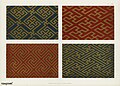
The Practical Decorator and Cornist by G의 키 패턴의 빈티지한 일본 디자인.A & M.A. 오즐리
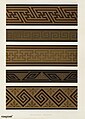
The Practical Decorator and Obstorist by G의 키 패턴을 사용한 빈티지한 일본식 테두리 디자인.A & M.A. 오즐리

골동품 그리스 테두리 디자인으로 키 패턴과 기타 장식품인 The Practical Decorator and Orchorist by G.A & M.A. 오즐리

장식 핸드북의 장식적 핵심 패턴의 변이; 실용적이고 이론적인 사용을 위한 모든 분야의 예술, 산업 및 건축 디자인 문법(1900)
_(14594774800).jpg)
.jpg)
_Terracotta_dipinta,_Anfora_del_Maestro_detto_di_Dipylon_(dettaglio),_opera_funebre_geometrica_con_salma_su_catafalco,_piangenti,_Kerameikos_Atene,_VIII_sec_a.C.jpg)


,_China,_Shang_dynasty,_1300-1046_BC,_bronze_-_Royal_Ontario_Museum_-_DSC03993.JPG)


_(14597695089).jpg)
레퍼런스
- ^ a b Hull, Derek (2003). Celtic and Anglo-Saxon art : geometric aspects. Liverpool: Liverpool University Press. ISBN 0-85323-549-X. OCLC 52695754.
- ^ a b c Bain, Iain (1994). Celtic key patterns. New York: Sterling Pub. Co. ISBN 0-8069-0740-1. OCLC 29428299.
- ^ a b c Thickpenney, Cynthia (2020). "Making Key pattern in Insular art: The Harley Golden Gospels and Kilmartin Cross". Peopling Insular Art: Practice, Performance, Perception. Cynthia Thickpenny, Katherine Forsyth, J. Geddes, Kate Mathis. Oxford, UK: Oxbow Books. ISBN 978-1-78925-455-6. OCLC 1180971230.
- ^ a b c d e Allen, J. Romilly; Anderson, Joseph; Society of Antiquaries of Scotland (1903). The early Christian monuments of Scotland. Edinburgh: Printed by Neill & co., limited. p. 308.
- ^ a b c Radovic, Ljilana; Jablan, Slavik (2001). "Antisymmetry and Modularity in Ornamental Art" (PDF). Bridges: Mathematical Connections in Art, Music, and Science [Conference Proceedings]: 55–65.
- ^ a b Jablan, Slavik (2005). "Modularity in Art". Modularity : understanding the development and evolution of natural complex systems. Werner Callebaut, Diego Rasskin-Gutman. Cambridge, Mass.: MIT Press. ISBN 978-0-262-26969-8. OCLC 62098419.
- ^ a b Jablan, Slavik; Radović, Ljiljana (2011-08-09). Glanville, Ranulph (ed.). "Do you like paleolithic op‐art?". Kybernetes. 40 (7/8): 1045–1054. doi:10.1108/03684921111160287. ISSN 0368-492X.
- ^ Beck, Ulrike; Wagner, Mayke; Li, Xiao; Durkin-Meisterernst, Desmond; Tarasov, Pavel E. (2014-10-20). "The invention of trousers and its likely affiliation with horseback riding and mobility: A case study of late 2nd millennium BC finds from Turfan in eastern Central Asia". Quaternary International. The Bridging Eurasia Research Initiative: Modes of mobility and sustainability in the palaeoenvironmental and archaeological archives from Eurasia. 348: 224–235. doi:10.1016/j.quaint.2014.04.056. ISSN 1040-6182.
- ^ Herringham, Christiana J. (1909). "Notes on Oriental Carpet Patterns-VI. Meander and Key Patterns". The Burlington Magazine for Connoisseurs. 15 (74): 98–104. ISSN 0951-0788. JSTOR 857910.
- ^ Wilson, Eva (1988). Islamic designs for artists and craftpeople. New York: Dover Publications. ISBN 0-486-25819-X. OCLC 18134247.
- ^ Özkar, Mine; Lefford, Nyssim (2006). "Modal relationships as stylistic features: Examples from Seljuk and Celtic patterns". Journal of the American Society for Information Science and Technology. 57 (11): 1551–1560. doi:10.1002/asi.20431. ISSN 1532-2890.