q-아날로그 이론에서 q {\displaystyle q} -감마 함수 또는 기본 감마 함수 는 이중 감마 함수 와 밀접하게 관련된 일반 감마 함수 의 일반화다.잭슨(1905 )에 의해 소개되었다. 그것은 에 의해 주어진다.
Γ q ( x ) = ( 1 − q ) 1 − x ∏ n = 0 ∞ 1 − q n + 1 1 − q n + x = ( 1 − q ) 1 − x ( q ; q ) ∞ ( q x ; q ) ∞ {\displaystyle \Gamma _{q}(x)=(1-q)^{1-x}\prod _{n=0}^{\infty }{\frac {1-q^{n+1}}{1-q^{n+x}}}=(1-q)^{1-x}\,{\frac {(q;q)_{\infty }}{(q^{x};q)_{\infty }}}} q {\displaystyle q 1 Γ q ( x ) = ( q − 1 ; q − 1 ) ∞ ( q − x ; q − 1 ) ∞ ( q − 1 ) 1 − x q ( x 2 ) {\displaystyle \Gamma_{q}(x)={\frac {(q^{-1};q^{-1})_{\inflt }}{{{}}{(q^{-x};q^{-1}}}}}}}{\inflott}}}}}}}} q 1 {\displaystyle q >1 ⋅; ⋅ ∞ {\ displaystyle (\cdot;\cdot )_{\infit }}}}} q-포하머 기호 다.q {\displaystyle q} Γ q ( x + 1 ) = 1 − q x 1 − q Γ q ( x ) = [ x ] q Γ q ( x ) {\displaystyle \Gamma _{q}(x+1)={\frac {1-q^{x}}}\Gamma _{q}=[x]_{q}\Gamma _{q}(x)} 또한 q {\displaystyle q} 리차드 아스키 (1978) 가 발견한 보어-몰러업 정리 의 q-아날로그를 만족시킨다. 음수가 아닌 정수 n 의 경우, Γ q ( n ) = [ n − 1 ] q ! {\displaystyle \Gamma _{q}(n)=[n-1]_{q}! } 여기서 [ ⋅ ] q {\ displaystyle [\cdot ]_{q}} q-message 함수다. 따라서 q {\displaystyle q}
일반 감마함수와의 관계는 한계에 명시되어 있다.
임이 있는 q → 1 ± Γ q ( x ) = Γ ( x ) . {\displaystyle \lim _{q\to 1\pm }\Gamma _{q}(x)=\Gamma(x). } 고스퍼에 의한 이 한계에 대한 간단한 증거가 있다. (Andrews (1986 )의 부록을 참조하십시오.
변환 속성 q {\displaystyle q} Gasper & Rahman(2004 )).
Γ q ( n x ) Γ r ( 1 / n ) Γ r ( 2 / n ) ⋯ Γ r ( ( n − 1 ) / n ) = ( 1 − q n 1 − q ) n x − 1 Γ r ( x ) Γ r ( x + 1 / n ) ⋯ Γ r ( x + ( n − 1 ) / n ) , r = q n . {\displaystyle \Gamma _{q}(nx)\Gamma _{r}(1/n)\Gamma _{r}(2/n)\cdots \Gamma _{r}((n-1)/n)=\left({\frac {1-q^{n}}{1-q}}\right)^{nx-1}\Gamma _{r}(x)\Gamma _{r}(x+1/n)\cdots \Gamma _{r}(x+(n-1)/n),\ r=q^{n}. }
적분표현 q {\displaystyle q} 함수 는 다음과 같은 적분 표현을 가지고 있다(1981 ):
1 Γ q ( z ) = 죄를 짓다 ( π z ) π ∫ 0 ∞ t − z d t ( − t ( 1 − q ) ; q ) ∞ . {\displaystyle {\frac{1}{\Gamma _{q}(z)}={\frac {\sin(\pi z)}{0}^{0}{0}{0}^{t^{-z}\mathrm {d} t}{-t(1-q;q)_{\py}}}}}}}}}}}}}}}}}}}}}}}}}}}}}}}}}}}}}}}}}}}}}}}}}}}}}}}}} }
스털링 공식 모악은 스털링 공식의 다음과 같은 q-아날로그를 얻었다(1984년) 참조:
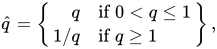
통나무를 하다 Γ q ( x ) ∼ ( x − 1 / 2 ) 통나무를 하다 [ x ] q + L i 2 ( 1 − q x ) 통나무를 하다 q + C q ^ + 1 2 H ( q − 1 ) 통나무를 하다 q + ∑ k = 1 ∞ B 2 k ( 2 k ) ! ( 통나무를 하다 q ^ q ^ x − 1 ) 2 k − 1 q ^ x p 2 k − 3 ( q ^ x ) , x → ∞ , {\displaystyle \log \Gamma _{q}(x)\sim (x-1/2)\log[x]_{q}+{\frac {\mathrm {Li} _{2}(1-q^{x})}{\log q}}+C_{\hat {q}}+{\frac {1}{2}}H(q-1)\log q+\sum _{k=1}^{\infty }{\frac {B_{2k}}{(2k)! }}\left({\frac {\hat{q}}{{\hat{q}^{x-1}\오른쪽)^{2k-1}{2k-1}{x}p_{2k-3}({\hat {q}^{x}),\x\to \inflot;}}}} q ^ = { q i f 0 < q ≤ 1 1 / q i f q ≥ 1 } , {\displaystyle {\q}=\left\{\regated}q\lift {if}\ &0<q\leq 1\\\1/q\light\}\mathrm {if} \&q\geq\ended}\right\},} C q = 1 2 통나무를 하다 ( 2 π ) + 1 2 통나무를 하다 ( q − 1 통나무를 하다 q ) − 1 24 통나무를 하다 q + 통나무를 하다 ∑ m = − ∞ ∞ ( r m ( 6 m + 1 ) − r ( 3 m + 1 ) ( 2 m + 1 ) ) , {\displaystyle C_{q}={\frac {1}{2}}\log(2\pi )+{\frac {1}{2}}\log \left({\frac {q-1}{\log q}}\right)-{\frac {1}{24}}\log q+\log \sum _{m=-\infty }^{\infty }\left(r^{m(6m+1)}-r^{(3m+1)(2m+1)}\right),} where r = exp ( 4 π 2 / log q ) {\displaystyle r=\exp(4\pi ^{2}/\log q)} H {\displaystyle H} Heaviside step function , B k {\displaystyle B_{k}} Bernoulli number , L i 2 ( z ) {\displaystyle \mathrm {Li} _{2}(z)} p k {\displaystyle p_{k} } 만족도 displaystyle k} p k ( z ) = z ( 1 − z ) p k − 1 ( z ) ′ ( z ) + ( k z + 1 ) p k − 1 ( z ) , p 0 = p − 1 = 1 , k = 1 , 2 , ⋯ . {\displaystyle p_{k}(z)=z(1-z)p_{k-1}(z)+(kz+1)p_{k-1}(z),p_{0}=p_{-1}=1,k=1,2,\codots.}}
RAABE형 공식 나 때문에. 적어도 q 1 {\displaystyle q > } 라베 공식 의 q-아날로그가 존재한다.
∫ 0 1 통나무를 하다 Γ q ( x ) d x = ζ ( 2 ) 통나무를 하다 q + 통나무를 하다 q − 1 q 6 + 통나무를 하다 ( q − 1 ; q − 1 ) ∞ ( q > 1 ) . {\displaystyle \int _{0}^{1}\log \Gamma _{q}(x)dx={\frac {\zeta (2)}{\log q}}+\log {\sqrt {\frac {q-1}{\sqrt[{6}]{q}}}}+\log(q^{-1};q^{-1})_{\infty }\quad (q>1). } 엘 바흐라우이는 그 사건을 0 q {\displaystyle 0<q<1}) ∫ 0 1 통나무를 하다 Γ q ( x ) d x = 1 2 통나무를 하다 ( 1 − q ) − ζ ( 2 ) 통나무를 하다 q + 통나무를 하다 ( q ; q ) ∞ ( 0 < q < 1 ) . {\displaystyle \int_{0}^{1}\log \Gamma_{q}(x)dx={\frac {1}{1}:{2}}:\log(1-q)-{\frac{\log q}+log(q;q)_{\flotty }\quad (0q<1). }
특수값 다음과 같은 특수 값이 알려져 있다.[1]
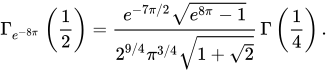
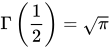
Γ e − π ( 1 2 ) = e − 7 π / 16 e π − 1 1 + 2 4 2 15 / 16 π 3 / 4 Γ ( 1 4 ) , {\displaystyle \Gamma _{e^{-\pi }}\left({\frac {1}{2}}\right)={\frac {e^{-7\pi /16}{\sqrt {e^{\pi }-1}}{\sqrt[{4}]{1+{\sqrt {2}}}}}{2^{15/16}\pi ^{3/4}}}\,\Gamma \left({\frac {1}{4}}\right),} Γ e − 2 π ( 1 2 ) = e − 7 π / 8 e 2 π − 1 2 9 / 8 π 3 / 4 Γ ( 1 4 ) , {\displaystyle \Gamma _{e^{-2\pi }}\left({\frac {1}{2}}\right)={\frac {e^{-7\pi /8}{\sqrt {e^{2\pi }-1}}}{2^{9/8}\pi ^{3/4}}}\,\Gamma \left({\frac {1}{4}}\right),} Γ e − 4 π ( 1 2 ) = e − 7 π / 4 e 4 π − 1 2 7 / 4 π 3 / 4 Γ ( 1 4 ) , {\displaystyle \Gamma _{e^{-4\pi }}\left({\frac {1}{2}}\right)={\frac {e^{-7\pi /4}{\sqrt {e^{4\pi }-1}}}{2^{7/4}\pi ^{3/4}}}\,\Gamma \left({\frac {1}{4}}\right),} Γ e − 8 π ( 1 2 ) = e − 7 π / 2 e 8 π − 1 2 9 / 4 π 3 / 4 1 + 2 Γ ( 1 4 ) . {\displaystyle \Gamma _{e^{-8\pi }}\left({\frac {1}{2}}\right)={\frac {e^{-7\pi /2}{\sqrt {e^{8\pi }-1}}}{2^{9/4}\pi ^{3/4}{\sqrt {1+{\sqrt {2}}}}}}\,\Gamma \left({\frac {1}{4}}\right). } 고전 공식 γ( 2 π {\ displaystyle \Gamma \left({\frac 1}{2}}\오른쪽)={\sqrt {\pi }}} .
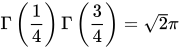
더욱이, 다음 1 1 3 3 2 \ displaystyle \Gamma \left frac {1 }}\right) \Gamma \left({\frac {3}{4}\오른쪽)={\sqrt{2}}\pi }
Γ e − 2 π ( 1 4 ) Γ e − 2 π ( 3 4 ) = e − 29 π / 16 ( e 2 π − 1 ) 1 + 2 4 2 33 / 16 π 3 / 2 Γ ( 1 4 ) 2 , {\displaystyle \Gamma _{e^{-2\pi }}\왼쪽({\frac {1}{4}}\오른쪽) \Gamma _{e^{-2\pi }}\left({\frac {3}{4}}\right)={\frac {e^{-29\pi /16}\left(e^{2\pi }-1\right){\sqrt[{4}]{1+{\sqrt {2}}}}}{2^{33/16}\pi ^{3/2}}}\,\Gamma \left({\frac {1}{4}}\right)^{2},} Γ e − 4 π ( 1 4 ) Γ e − 4 π ( 3 4 ) = e − 29 π / 8 ( e 4 π − 1 ) 2 23 / 8 π 3 / 2 Γ ( 1 4 ) 2 , {\displaystyle \Gamma _{e^{-4\pi }}\왼쪽({\frac {1}{4}}\오른쪽) \Gamma _{e^{-4\pi }}\left({\frac {3}{4}}\right)={\frac {e^{-29\pi /8}\left(e^{4\pi }-1\right)}{2^{23/8}\pi ^{3/2}}}\,\Gamma \left({\frac {1}{4}}\right)^{2},} Γ e − 8 π ( 1 4 ) Γ e − 8 π ( 3 4 ) = e − 29 π / 4 ( e 8 π − 1 ) 16 π 3 / 2 1 + 2 Γ ( 1 4 ) 2 . {\displaystyle \Gamma _{e^{-8\pi }}\왼쪽({\frac {1}{4}}\오른쪽) \Gamma _{e^{-8\pi }}\left({\frac {3}{4}}\right)={\frac {e^{-29\pi /4}\left(e^{8\pi }-1\right)}{16\pi ^{3/2}{\sqrt {1+{\sqrt {2}}}}}}\,\Gamma \left({\frac {1}{4}}\right)^{2}.}
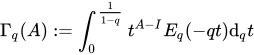
매트릭스 버전 A displaystyle A} 정의 행렬 로q-감마 행렬 함수는 q-integral로 정의할 수 있다.[2]
Γ q ( A ) := ∫ 0 1 1 − q t A − I E q ( − q t ) d q t {\displaystyle \Gamma _{q}(A): =\int _{0}^{0}^{1}\frac {1}{1-q}^{A-I}E_{q}(-qt)\mathrm {d} _{q}t} 여기서 E q {\ displaystyle E_{q} q-exponential 함수다.
기타 Q-감마 함수 기타 q-감마 기능은 야마사키 2006을 참조한다.[3]
수치 연산 q-감마 함수를 계산하기 위한 반복 알고리즘이 가부티와 알라시아에 의해 제안되었다.[4]
추가 읽기 Zhang, Ruiming (2007), "On asymptotics of q -gamma functions", Journal of Mathematical Analysis and Applications , 339 (2): 1313–1321, arXiv :0705.2802 Bibcode :2008JMAA..339.1313Z , doi :10.1016/j.jmaa.2007.08.006 , S2CID 115163047 Zhang, Ruiming (2010), "On asymptotics of Γq (z) as q approaching 1", arXiv :1011.0720 math.CA ] Ismail, Mourad E. H.; Muldoon, Martin E. (1994), "Inequalities and monotonicity properties for gamma and q -gamma functions", in Zahar, R. V. M. (ed.), Approximation and computation a festschrift in honor of Walter Gautschi: Proceedings of the Purdue conference, December 2-5, 1993 , vol. 119, Boston: Birkhäuser Verlag, pp. 309–323, arXiv :1301.1749 doi :10.1007/978-1-4684-7415-2_19 , ISBN 978-1-4684-7415-2 S2CID 118563435 참조 Jackson, F. H. (1905), "The Basic Gamma-Function and the Elliptic Functions", Proceedings of the Royal Society of London. Series A, Containing Papers of a Mathematical and Physical Character , The Royal Society, 76 (508): 127–144, Bibcode :1905RSPSA..76..127J , doi :10.1098/rspa.1905.0011 ISSN 0950-1207 , JSTOR 92601 Gasper, George; Rahman, Mizan (2004), Basic hypergeometric series , Encyclopedia of Mathematics and its Applications, vol. 96 (2nd ed.), Cambridge University Press , ISBN 978-0-521-83357-8 MR 2128719 Ismail, Mourad (1981), "The Basic Bessel Functions and Polynomials", SIAM Journal on Mathematical Analysis , 12 (3): 454–468, doi :10.1137/0512038 Moak, Daniel S. (1984), "The Q-analogue of Stirling's formula", Rocky Mountain J. Math. , 14 (2): 403–414, doi :10.1216/RMJ-1984-14-2-403 Mező, István (2012), "A q-Raabe formula and an integral of the fourth Jacobi theta function", Journal of Number Theory , 133 (2): 692–704, doi :10.1016/j.jnt.2012.08.025 El Bachraoui, Mohamed (2017), "Short proofs for q-Raabe formula and integrals for Jacobi theta functions", Journal of Number Theory , 173 (2): 614–620, doi :10.1016/j.jnt.2016.09.028 Askey, Richard (1978), "The q-gamma and q-beta functions.", Applicable Analysis , 8 (2): 125–141, doi :10.1080/00036817808839221 Andrews, George E. (1986), q-Series: Their development and application in analysis, number theory, combinatorics, physics, and computer algebra. , Regional Conference Series in Mathematics, vol. 66, American Mathematical Society 





 무한
무한 ![{\displaystyle \Gamma _{q}(x+1)={\frac {1-q^{x}}{1-q}}\Gamma _{q}(x)=[x]_{q}\Gamma _{q}(x)}](https://wikimedia.org/api/rest_v1/media/math/render/svg/1369d42adac73e85d50ce69ed4e83fe4d9432ce7)
![{\displaystyle \Gamma _{q}(n)=[n-1]_{q}!}](https://wikimedia.org/api/rest_v1/media/math/render/svg/4be916fb8ef9c2bb7a93ee692b3719d096150dbe)
![{\displaystyle [\cdot ]_{q}}](https://wikimedia.org/api/rest_v1/media/math/render/svg/e46774647e16db9db5cc5a224d1b2e41c74299a7) (는)
(는) 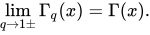


![{\displaystyle \log \Gamma _{q}(x)\sim (x-1/2)\log[x]_{q}+{\frac {\mathrm {Li} _{2}(1-q^{x})}{\log q}}+C_{\hat {q}}+{\frac {1}{2}}H(q-1)\log q+\sum _{k=1}^{\infty }{\frac {B_{2k}}{(2k)!}}\left({\frac {\log {\hat {q}}}{{\hat {q}}^{x}-1}}\right)^{2k-1}{\hat {q}}^{x}p_{2k-3}({\hat {q}}^{x}),\ x\to \infty ,}](https://wikimedia.org/api/rest_v1/media/math/render/svg/b053f1eb6b1d1d4955b9cd1dc622684208f62690)




 (는)
(는) 

![{\displaystyle \int _{0}^{1}\log \Gamma _{q}(x)dx={\frac {\zeta (2)}{\log q}}+\log {\sqrt {\frac {q-1}{\sqrt[{6}]{q}}}}+\log(q^{-1};q^{-1})_{\infty }\quad (q>1).}](https://wikimedia.org/api/rest_v1/media/math/render/svg/18dd5281744cfa39cf8031d498765542f51ae6b7)


![{\displaystyle \Gamma _{e^{-\pi }}\left({\frac {1}{2}}\right)={\frac {e^{-7\pi /16}{\sqrt {e^{\pi }-1}}{\sqrt[{4}]{1+{\sqrt {2}}}}}{2^{15/16}\pi ^{3/4}}}\,\Gamma \left({\frac {1}{4}}\right),}](https://wikimedia.org/api/rest_v1/media/math/render/svg/f71abb2b0db4f868e47ab53b290c91a3af628c63)


![{\displaystyle \Gamma _{e^{-2\pi }}\left({\frac {1}{4}}\right)\Gamma _{e^{-2\pi }}\left({\frac {3}{4}}\right)={\frac {e^{-29\pi /16}\left(e^{2\pi }-1\right){\sqrt[{4}]{1+{\sqrt {2}}}}}{2^{33/16}\pi ^{3/2}}}\,\Gamma \left({\frac {1}{4}}\right)^{2},}](https://wikimedia.org/api/rest_v1/media/math/render/svg/ea69d2a13e0234e013c8f9db64ae1d4978eba583)


 두십시오.q-감마 행렬 함수는 q-integral로 정의할 수 있다.