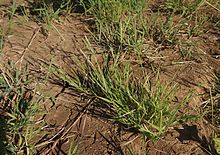
반전 반복 래킹 클래드
Inverted repeat-lacking clade| 반전 반복 래킹 클래드 | |
|---|---|
 | |
| 갈레가 주례 | |
| 과학적 분류 | |
| 킹덤: | |
| (랭킹되지 않음): | |
| (랭킹되지 않음): | |
| (랭킹되지 않음): | |
| 순서: | |
| 패밀리: | |
| 하위 패밀리: | |
| (랭킹되지 않음): | |
| (랭킹되지 않음): | 반전 반복 래킹 클래드 |
| 부족[1][4] | |
| 동의어 | |
| |
역반복 래핑클레이드(IRC)는 꽃식물 아과(Paboideae, 또는 파필리오나과)의 단극성 클레이드다. 파부이데아에는 대부분의 농경 재배 콩이 포함되어 있다. 대부분의 육지식물에서 발견되는 플라스티드 게놈에서 25kb의 역반복반복 2개 중 1개를 분실한 것이 특징이다.[5] 그것은 분자 계통에서 일관되게 해결된다.[1][2][4][5][6][7][8][9][10][11][12] 이 쇄골은 390±240만년 전 (Eocene에서) 다른 레구메 라인에서 갈라진 것으로 예측된다.[13] 아스트라갈루스 L, 헤디사룸 L, 메디카고 L, 옥시트로피스 DC, 스와인소나 살리스브, 트라이폴륨 L과 같은 몇몇 크고 온화한 제네랄을 포함한다.
설명
이 가락은 5개의 전통적인 부족(Cicereae Alef)으로 구성되어 있다. 1859년, 파베에 Rchb. 1832년, 게일게이 두모르트. 1827년, 헤디사레 DC. 1825년, 트라이폴리에엔들 1830년)과 전통 부족 밀레티아이(Afgekia Craib 1927년, Callerya Endl. 1843년, Endosamara R. 제싱크 1984년, 사코디움 루르 1790, Wisteria Nutt.1818, 그리고 아마도 Antheroporum Gagnep.15).[3] 이 클래드의 이름은 비공식적이며 ICBN 또는 ICPN에 의해 승인된 이름과 같은 특정 분류 체계 순위를 가지지 않는 것으로 가정한다.[3] 이 클래드는 다음과 같이 정의된다.
"[3]갈레가 오피시날리스 L. 1753년, 글리시리자 레피도타 뉴톨 1813년, 비시아 파바 L에서 발견된 것과 유사한 플라스티드 게놈의 구조적 돌연변이를 보여주는 가장 포괄적인 크라운 클라드.
참조
- ^ a b c Wojciechowski MF, Sanderson MJ, Steele KP, Liston A (2000). "Molecular phylogeny of the "temperate herbaceous tribes" of papilionoid legumes: A supertree approach" (PDF). In Herendeen PS, Bruneau A (eds.). Advances in Legume Systematics, Part 9. Kew, UK: Royal Botanic Gardens. pp. 277–298. ISBN 184246017X.
- ^ a b Wojciechowski MF, Lavin M, Sanderson MJ (2004). "A phylogeny of legumes (Leguminosae) based on analysis of the plastid matK gene resolves many well-supported subclades within the family". Am J Bot. 91 (11): 1846–1862. doi:10.3732/ajb.91.11.1846. PMID 21652332.
- ^ a b c d Wojciechowski MF. (2013). "Towards a new classification of Leguminosae: Naming clades using non-Linnaean phylogenetic nomenclature". S Afr J Bot. 89: 85–93. doi:10.1016/j.sajb.2013.06.017.
- ^ a b Cardoso D, Pennington RT, de Queiroz LP, Boatwright JS, Van Wyk BE, Wojciechowski MF, Lavin M (2013). "Reconstructing the deep-branching relationships of the papilionoid legumes". S Afr J Bot. 89: 58–75. doi:10.1016/j.sajb.2013.05.001.
- ^ a b Lavin M, Doyle JJ, Palmer JD (1990). "Evolutionary significance of the loss of the chloroplast-DNA inverted repeat in the Leguminosae subfamily Papilionoideae" (PDF). Evolution. 44 (2): 390–402. doi:10.2307/2409416. hdl:2027.42/137404. JSTOR 2409416. PMID 28564377.
- ^ Liston A. (1995). "Use of the polymerase chain reaction to survey for the loss of the inverted repeat in the legume chloroplast genome". In Crisp MD, Doyle JJ (eds.). Advances in Legume Systematics, Part 7: Phylogeny. Kew, UK: Royal Botanic Gardens. pp. 31–40. ISBN 0947643796.
- ^ Käss E, Wink M (1996). "Molecular evolution of the Leguminosae: Phylogeny of the three subfamilies based on rbcL-sequences". Biochem Syst Ecol. 24 (5): 365–378. doi:10.1016/0305-1978(96)00032-4.
- ^ Sanderson MJ, Wojciechowski MF (1996). "Diversification rates in a temperate legume clade: Are there "so many species" of Astragalus (Fabaceae)?". Am J Bot. 83 (11): 1488–1502. doi:10.2307/2446103. JSTOR 2446103.
- ^ Doyle JJ, Doyle JL, Ballenger JA, Dickson EE, Kajita T, Ohashi H (1997). "A phylogeny of the chloroplast gene rbcL in the Leguminosae: Taxonomic correlations and insights into the evolution of nodulation". Am J Bot. 84 (4): 541–554. doi:10.2307/2446030. JSTOR 2446030. PMID 21708606.
- ^ Pennington RT, Lavin M, Ireland H, Klitgaard B, Preston J, Hu JM (2001). "Phylogenetic relationships of basal papilionoid legumes based upon sequences of the chloroplast trnL intron". Syst Bot. 26 (3): 537–556. doi:10.1043/0363-6445-26.3.537 (inactive 31 October 2021).
{{cite journal}}: CS1 maint : 2021년 10월 현재 DOI 비활성화(링크) - ^ McMahon MM, Sanderson MJ (2006). "Phylogenetic supermatrix analysis of GenBank sequences from 2228 papilionoid legumes". Syst Biol. 55 (5): 818–836. doi:10.1080/10635150600999150. PMID 17060202.
- ^ Cardoso D, de Queiroz LP, Pennington RT, de Lima HC, Fonty É, Wojciechowski MF, Lavin M (2012). "Revisiting the phylogeny of papilionoid legumes: New insights from comprehensively sampled early-branching lineages". Am J Bot. 99 (12): 1991–2013. doi:10.3732/ajb.1200380. PMID 23221500.
- ^ Lavin M, Herendeen PS, Wojciechowski MF (2005). "Evolutionary rates analysis of Leguminosae implicates a rapid diversification of lineages during the tertiary". Syst Biol. 54 (4): 575–94. doi:10.1080/10635150590947131. PMID 16085576.