금속성
Metallicity
천문학에서, 금속성은 수소와 헬륨보다 무거운 물체에 존재하는 원소들의 풍부함이다.우주의 일반적인 물질 대부분은 수소나 헬륨이며, 천문학자들은 "수소와 헬륨을 제외한 모든 원소"를 뜻하는 편리한 짧은 용어로 "금속"이라는 단어를 사용합니다.이러한 용어의 사용은 금속을 전기 전도성 고체로 정의하는 기존의 화학적 또는 물리적 정의와는 다릅니다.무거운 원소가 상대적으로 많이 함유된 별과 성운은 비록 많은 원소들이 화학적으로 비금속임에도 불구하고 천체물리학 용어로 "금속 풍부"이라고 불립니다.
무거운 원소의 존재는 우주의 수소와 헬륨보다 무거운 원소(금속, 이하)의 대부분이 별의 중심에서 진화하면서 형성되는 항성 핵합성에 기인합니다.시간이 지남에 따라, 항성풍과 초신성은 금속을 주변 환경에 침전시켜 성간 매질을 풍부하게 하고 새로운 별의 탄생을 위한 재활용 물질을 제공한다.따라서 금속이 부족한 초기 우주에서 형성된 오래된 세대의 별들은 일반적으로 금속이 풍부한 우주에서 형성된 젊은 세대의 별들보다 금속성이 낮습니다.
1944년 천문학자 Walter Baade는 금속성에 기인한 스펙트럼 특성을 바탕으로 서로 다른 유형의 별들의 화학적 풍부성 변화를 관찰하여 두 개의 다른 [1]별 집단의 존재를 제안했습니다.이들은 일반적으로 종족 I(금속 농도가 높은) 별과 종족 II(금속 농도가 낮은) 별로 알려지게 되었다.1978년 세 번째 항성 집단이 생겨났는데, 이는 종족 III [2][3][4]별이라고 알려져 있다.이 극도로 금속이 부족한 별들은 우주에서 만들어진 "첫 번째로 태어난" 별들이었던 것으로 이론화된다.
일반적인 계산 방법
천문학자들은 사용 가능한 도구와 관심 물체에 따라 금속의 풍부함을 설명하고 대략적으로 추정하기 위해 몇 가지 다른 방법을 사용합니다.일부 방법에는 가스 대 금속에 기인하는 질량의 비율을 결정하거나 태양에서 발견된 비율과 비교하여 두 가지 다른 원소의 원자 수의 비율을 측정하는 것이 포함됩니다.
질량분율
별의 조성은 종종 X, Y 및 Z 매개변수에 의해 간단히 정의됩니다.여기서 X는 수소의 질량분율, Y는 헬륨의 질량분율, Z는 나머지 모든 화학원소의 질량분율이다.따라서

대부분의 별, 성운, H II 영역 및 다른 천문학적인 원천에서 수소와 헬륨이 두 가지 주요 원소입니다.수소 질량 분율은 일반적으로 X H X로 표현된다. 서M(\ M은 시스템의 총 질량이고 m(\은 그것이 함유하는 수소의 질량이다.마찬가지로 헬륨 질량 분율은 Y m /(\ Ytext})로 표시됩니다. 나머지 원소들은 집합적으로 "금속"이라고 불리며, 금속성(헬륨보다 무거운 원소들의 질량 비율)은 다음과 같이 계산될 수 있다.

 시스템의 총 질량이고 m
 그것이 함유하는 수소의 질량이다.마찬가지로 헬륨 질량 분율은 Y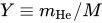
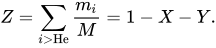
태양 표면의 경우 이러한 매개변수는 다음과 같은 [5]값을 가지도록 측정됩니다.
| 묘사 | 솔라 값 |
|---|---|
| 수소질량분율 | |
| 헬륨 질량 분율 | |
| 금속성 |



별의 진화의 영향으로 인해, 태양의 초기 구성이나 현재의 부피 구성 모두 현재의 표면 구성과 같지 않습니다.
화학적 존재비
전체적인 별의 금속성은 우주에서 상대적으로 일정하게 존재하기 때문에 총 수소 함량을 사용하여 정의됩니다. 즉,[6] 우주에서 일반적으로 시간이 지남에 따라 선형적으로 증가하는 풍부한 별의 철 함량을 가지고 있습니다.따라서 철은 핵합성의 연대순으로 사용할 수 있다.철은 별의 스펙트럼에 많은 철선이 있기 때문에 스펙트럼 관측으로 비교적 쉽게 측정할 수 있다(산소가 가장 풍부한 중원소임에도 불구하고 아래 HII 영역의 금속성 참조).풍성비는 태양과 비교하여 항성의 철분 풍성 비율에 대한 일반적인 로그이며 다음과 [7]같이 계산됩니다.
![{\displaystyle [{\text{Fe}}/{\text{H}}]=\log _{10}{\left({\frac {N_{\text{Fe}}}{N_{\text{H}}}}\right)_{\text{star}}}-\log _{10}{\left({\frac {N_{\text{Fe}}}{N_{\text{H}}}}\right)_{\text{sun}}},}](https://wikimedia.org/api/rest_v1/media/math/render/svg/41bd2fa4004fa3ecc9081f8ee204da018b9c4474)
서 NFE style})은 부피의 단위당 각각 철과 수소 원자의 수입니다.금속성에 자주 사용되는 단위는 "십진수 지수"의 덱스, 수축입니다.이 공식에 따르면, 태양보다 금속 함량이 높은 별들은 양의 공통 대수를 갖는 반면, 수소에 의해 지배되는 별들은 그에 상응하는 음의 값을 갖는다.예를 들어, [Fe/H] 값이 +1인 별은 태양(10)의1 10배의 금속성을 가지며, 반대로 [Fe/H] 값이 -1인 별은 다음과 같습니다.반면 [Fe/H] 값이 0인 것은 태양과 같은 금속성입니다.[8]젊은 종족 I 별들은 나이든 종족 II 별들보다 철 대 수소 비율이 상당히 높습니다.원시 종족 III 별들은 태양에 [9][10]있는 철분 함량의 100만분의 1인 -6보다 적은 금속성을 가지고 있는 것으로 추정됩니다.태양 비율과 비교하여 다른 개별 원소들 사이의 풍부함 변화를 나타내기 위해 같은 표기법이 사용된다.예를 들어, "O/Fe" 표기법은 태양과 비교하여 항성의 산소 농도와 철분 함량의 로그 차이를 나타냅니다.일반적으로 주어진 별의 핵합성 과정은 소수의 원소 또는 동위원소의 비율만 변경하므로 특정 [/Fe] 값을 가진 별 또는 가스 샘플은 관련 연구된 핵 과정을 나타낼 수 있다.

 부피의 단위당 각각 철과 수소 원자의 수입니다.금속성에 자주 사용되는 단위는 "십진수 지수"의
 측광색
천문학자들은 측광학적 측정과 분광학적 측정의 상관관계를 갖는 측정 및 보정된 시스템을 통해 금속성을 추정할 수 있습니다(분광도 측정 참조).예를 들어, Johnson UVB 필터를 사용하여 별의 자외선([11]UV) 초과를 탐지할 수 있습니다. UV 초과가 작을수록 UV 방사선을 흡수하는 금속이 더 많이 존재하므로 별이 "빨간색"[12][13][14]으로 보입니다.UV 초과량인 δ(U-B)는 히아데스 [15]성단에서 금속이 풍부한 별의 U와 B 밴드 등급의 차이와 비교하여 별의 U와 B 밴드 등급의 차이로 정의됩니다.불행히도 δ(U-B)는 금속성과 온도에 모두 민감합니다. 두 별이 금속이 같은 값이지만 다른 별보다 차가운 경우, δ(U-B) 값이[15] 다를 수 있습니다(포괄효과[16][17] 참조).이러한 퇴화를 완화하기 위해 별의 B-V 색상을 온도 지표로 사용할 수 있습니다.또, UV 과잉과 B-V색을 보정해, γ(U-B)치를 철분량과 [18][19][20]관련지을 수 있다.
특정 천체물리학적 물체의 금속성을 결정하기 위해 사용될 수 있는 다른 광도 측정 시스템으로는 Strmgmgren 시스템,[21][22] 제네바 시스템,[23][24] 워싱턴 시스템,[25][26][27][28] DDO 시스템이 있습니다.
다양한 천체물리 물체의 금속성
별들
주어진 질량과 나이에, 금속이 부족한 별은 약간 더 따뜻할 것입니다.종족 II별의 금속성은 태양의 약 1/1000 ~ 1/10([Z/H] = -3.0 ~ -1.0)이지만 무거운 종족 II별이 죽은 지 오래되었기 때문에 종족 I 전체보다 더 차가운 것으로 보인다.40 태양 질량을 넘으면 금속성은 별이 죽는 방법에 영향을 미칩니다. 쌍 불안정성 창 밖에서는 낮은 금속성 별들이 블랙홀로 직접 붕괴하는 반면, 높은 금속성 별들은 Ib/c형 초신성을 겪으며 중성자별을 남길 수 있습니다.
별의 금속성과 행성의 관계
항성의 금속성 측정은 항성에 거대한 행성이 있는지 여부를 결정하는 데 도움이 되는 매개 변수 중 하나입니다. 금속성과 거대 행성의 존재 사이에는 직접적인 상관관계가 있기 때문입니다.측정 결과, 별의 금속성과 목성과 토성과 같은 가스 거대 행성 사이의 연관성이 입증되었습니다.항성과 행성계에 금속이 많을수록 행성계에 가스 거대 행성이 존재할 가능성이 높아집니다.현재의 모형은 정확한 행성계 온도와 별로부터의 거리가 행성 및 미행성 형성에 핵심이라는 것을 보여준다.나이와 질량은 같지만 금속 함량이 다른 두 별의 경우 금속성이 적을수록 파란색입니다.같은 색의 별들 중에서 금속성이 적은 별들이 더 많은 자외선을 방출한다.태양은 8개의 행성과 5개의 알려진 왜성행성으로 구성되어 있으며 [Fe/H]는 0.[29][30][31][32][33]00입니다.
HII 지역
H II 영역의 젊고 질량이 크고 뜨거운 별(일반적으로 스펙트럼 타입 O와 B)은 지면 상태의 수소 원자를 이온화하는 UV 광자를 방출하여 전자와 양성자를 자유롭게 만듭니다. 이 과정을 광이온화라고 합니다.자유 전자는 근처의 다른 원자와 충돌할 수 있으며, 여기 결합 금속 전자는 결국 다시 접지 상태로 붕괴되어 금지된 선에 해당하는 에너지를 가진 광자를 방출합니다.이러한 변화를 통해 천문학자들은 분광학적 관측에서 금지된 선이 강할수록 금속 [34][35]함량이 높아지는 HII 영역의 금속 함량을 추정하기 위한 몇 가지 관측 방법을 개발했다.이러한 방법은 HII 영역 내의 다양한 비대칭 밀도, 내장된 별의 다양한 온도 및/또는 이온화 [36][37][38][39]영역 내의 전자 밀도에 따라 달라집니다.
이론적으로 HII 영역에서 단일 원소의 총 농도를 판단하려면 모든 전이선을 관찰하고 합해야 합니다.그러나 선 [40][41]강도의 변동으로 인해 관측적으로 어려울 수 있습니다.HII 영역에서 금속 함량을 측정하는 데 사용되는 가장 일반적인 금지선 중 일부는 산소(예: [OII] = (3727, 7318, 7324) [, [OII] = (4363, 4959, 5007) [), 질소(예: [NIIII] = 655 [)이다.λ = (52, 88) μm 및 [NII] λ = 57 μm 라인.산소는 HII 영역에 더 강하고 풍부한 선 중 일부를 가지고 있기 때문에 이러한 물체 내 금속성 추정의 주요 표적이 됩니다.산소 플럭스 측정을 사용하여 HII 영역의 금속 함량을 계산하기 위해 천문학자들은 종종 R 방법을23 사용합니다.
![{\displaystyle R_{23}={\frac {[{\text{O II}}]_{3727~\mathrm {\AA} }+[{\text{O III}}]_{4959~\mathrm {\AA} +5007~\mathrm {\AA} }}{{\text{H}}_{\beta }}},}](https://wikimedia.org/api/rest_v1/media/math/render/svg/382a2b4bcb84669d0134a5e586f5db12b701d2cc)
서[ + [ + { II{\m}}}}}은 정지범위 = (3727, 4959, 5007) å 파장에서 측정한 산소배출라인의 플럭스를 정지범위 = 4861 48 [42]파장에서 H방출라인의β 플럭스로 나눈 값이다.이 비율은 모델과 관찰 [43][44][45]연구를 통해 잘 정의되지만, 이 비율은 종종 퇴화되기 때문에 추가 라인 [46]측정으로 깨질 수 있는 낮은 금속성과 높은 금속성 솔루션을 모두 제공할 수 있으므로 주의해야 합니다.마찬가지로, 다른 강력한 금지선 비율을 사용할 수 있다. 예를 들어, 유황의 경우, 다음과[47] 같은 경우
![{\displaystyle [{\text{O II}}]_{3727~\mathrm {\AA} }+[{\text{O III}}]_{4959~\mathrm {\AA} +5007~\mathrm {\AA} }}](https://wikimedia.org/api/rest_v1/media/math/render/svg/227beb0bae9d1a662956b84341a354ac58dd9acd)
![{\displaystyle S_{23}={\frac {[{\text{S II}}]_{6716~\mathrm {\AA} +6731~\mathrm {\AA} }+[{\text{S III}}]_{9069~\mathrm {\AA} +9532~\mathrm {\AA} }}{{\text{H}}_{\beta }}}.}](https://wikimedia.org/api/rest_v1/media/math/render/svg/28d1263d77e71ad861598be690c740f6350b9dff)
HII 영역 내의 금속 함량은 일반적으로 1% 미만이며, 은하 [40][48][49][50][51]중심과의 거리에 따라 평균적으로 감소합니다.
「 」를 참조해 주세요.
- 화학 원소의 풍부함
- 종족 III별을 포함하고 있는 것으로 알려진 은하인 Cosmos Redshift 7
- 은하 형성과 진화
- GRB 090423, 가장 멀리 보이는, 아마도 저금속성 전구체로부터
- 금속성 분포 함수
- 항성 분류
- 별의 진화
- 항성종족
레퍼런스
- ^ Baade, Walter (1944). "The Resolution of Messier 32, NGC 205, and the central region of the Andromeda Nebula". Astrophysical Journal. 100: 121–146. Bibcode:1944ApJ...100..137B. doi:10.1086/144650.
- ^ Rees, M.J. (1978). "Origin of pregalactic microwave background". Nature. 275 (5675): 35–37. Bibcode:1978Natur.275...35R. doi:10.1038/275035a0. S2CID 121250998.
- ^ White, S.D.M.; Rees, M.J. (1978). "Core condensation in heavy halos - A two-stage theory for galaxy formation and clustering". Monthly Notices of the Royal Astronomical Society. 183 (3): 341–358. Bibcode:1978MNRAS.183..341W. doi:10.1093/mnras/183.3.341.
- ^ J. L. Puget; J. Heyvaerts (1980). "Population III stars and the shape of the cosmological black body radiation". Astronomy and Astrophysics. 83 (3): L10–L12. Bibcode:1980A&A....83L..10P.
- ^ Asplund, Martin; Grevesse, Nicolas; Sauval, A. Jacques; Scott, Pat (2009). "The Chemical Composition of the Sun". Annual Review of Astronomy & Astrophysics. 47 (1): 481–522. arXiv:0909.0948. Bibcode:2009ARA&A..47..481A. doi:10.1146/annurev.astro.46.060407.145222. S2CID 17921922.
- ^ Hinkel, Natalie; Timmes, Frank; Young, Patrick; Pagano, Michael; Turnbull, Maggie (September 2014). "Stellar Abundances in the Solar Neighborhood: The Hypatia Catalog". Astronomical Journal. 148 (3): 33. arXiv:1405.6719. doi:10.1088/0004-6256/148/3/54. S2CID 119221402.
- ^ Matteucci, Francesca (2001). The Chemical Evolution of the Galaxy. Astrophysics and Space Science Library. Vol. 253. Springer Science & Business Media. p. 7. ISBN 978-0792365525.
- ^ John C. Martin. "What we learn from a star's metal content". New Analysis RR Lyrae Kinematics in the Solar Neighborhood. Archived from the original on June 29, 2016. Retrieved September 7, 2005.
- ^ Sobral, David; Matthee, Jorryt; Darvish, Behnam; Schaerer, Daniel; Mobasher, Bahram; Röttgering, Huub J. A.; Santos, Sérgio; Hemmati, Shoubaneh (4 June 2015). "Evidence for Pop III-like stellar populations in the most luminous Lyman-α emitters at the epoch of re-ionisation: Spectroscopic confirmation". The Astrophysical Journal. 808 (2): 139. arXiv:1504.01734. Bibcode:2015ApJ...808..139S. doi:10.1088/0004-637x/808/2/139. S2CID 18471887.
- ^ Overbye, Dennis (17 June 2015). "Astronomers report finding earliest stars that enriched the cosmos". New York Times. Retrieved 17 June 2015.
- ^ Johnson, H. L.; Morgan, W. W. (May 1953). "Fundamental stellar photometry for standards of spectral type on the revised system of the Yerkes spectral atlas". The Astrophysical Journal. 117: 313. Bibcode:1953ApJ...117..313J. doi:10.1086/145697. ISSN 0004-637X.
- ^ Roman, Nancy G. (December 1955). "A Catalogue of High-Velocity Stars". The Astrophysical Journal Supplement Series. 2: 195. Bibcode:1955ApJS....2..195R. doi:10.1086/190021. ISSN 0067-0049.
- ^ Sandage, A. R.; Eggen, O. J. (1959-06-01). "On the Existence of Subdwarfs in the (MBol, log Te)-Diagram". Monthly Notices of the Royal Astronomical Society. 119 (3): 278–296. Bibcode:1959MNRAS.119..278S. doi:10.1093/mnras/119.3.278. ISSN 0035-8711.
- ^ Wallerstein, George; Carlson, Maurice (September 1960). "Letter to the Editor: on the Ultraviolet Excess in G Dwarfs". The Astrophysical Journal. 132: 276. Bibcode:1960ApJ...132..276W. doi:10.1086/146926. ISSN 0004-637X.
- ^ a b Wildey, R. L.; Burbidge, E. M.; Sandage, A. R.; Burbidge, G. R. (January 1962). "On the Effect of Fraunhofer Lines on u, b, V Measurements". The Astrophysical Journal. 135: 94. Bibcode:1962ApJ...135...94W. doi:10.1086/147251. ISSN 0004-637X.
- ^ Schwarzschild, M.; Searle, L.; Howard, R. (September 1955). "On the Colors of Subdwarfs". The Astrophysical Journal. 122: 353. Bibcode:1955ApJ...122..353S. doi:10.1086/146094. ISSN 0004-637X.
- ^ M., Cameron, L. (June 1985). "Metallicities and Distances of Galactic Clusters as Determined from UBV Data – Part Three – Ages and Abundance Gradients of Open Clusters". Astronomy and Astrophysics. 147: 47. Bibcode:1985A&A...147...47C. ISSN 0004-6361.
- ^ Sandage, A. (December 1969). "New subdwarfs. II. Radial velocities, photometry, and preliminary space motions for 112 stars with large proper motion". The Astrophysical Journal. 158: 1115. Bibcode:1969ApJ...158.1115S. doi:10.1086/150271. ISSN 0004-637X.
- ^ Carney, B. W. (October 1979). "Subdwarf ultraviolet excesses and metal abundances". The Astrophysical Journal. 233: 211. Bibcode:1979ApJ...233..211C. doi:10.1086/157383. ISSN 0004-637X.
- ^ Laird, John B.; Carney, Bruce W.; Latham, David W. (June 1988). "A survey of proper-motion stars. III - Reddenings, distances, and metallicities". The Astronomical Journal. 95: 1843. Bibcode:1988AJ.....95.1843L. doi:10.1086/114782. ISSN 0004-6256.
- ^ Strömgren; Bengt (1963). "Quantitative Classification Methods". Basic Astronomical Data: Stars and Stellar Systems: 123. Bibcode:1963bad..book..123S.
- ^ L., Crawford, D. (1966). "Photo-Electric Hbeta and U V B Y Photometry". Spectral Classification and Multicolour Photometry. 24: 170. Bibcode:1966IAUS...24..170C.
- ^ N., Cramer; A., Maeder (October 1979). "Luminosity and T EFF determinations for B-type stars". Astronomy and Astrophysics. 78: 305. Bibcode:1979A&A....78..305C. ISSN 0004-6361.
- ^ D., Kobi; P., North (November 1990). "A new calibration of the Geneva photometry in terms of Te, log g, (Fe/H) and mass for main sequence A4 to G5 stars". Astronomy and Astrophysics Supplement Series. 85: 999. Bibcode:1990A&AS...85..999K. ISSN 0365-0138.
- ^ Geisler, D. (1986). "The empirical abundance calibrations for Washington photometry of population II giants". Publications of the Astronomical Society of the Pacific. 98 (606): 762. Bibcode:1986PASP...98..762G. doi:10.1086/131822. ISSN 1538-3873.
- ^ Geisler, Doug; Claria, Juan J.; Minniti, Dante (November 1991). "An improved metal abundance calibration for the Washington system". The Astronomical Journal. 102: 1836. Bibcode:1991AJ....102.1836G. doi:10.1086/116008. ISSN 0004-6256.
- ^ Claria, Juan J.; Piatti, Andres E.; Lapasset, Emilio (May 1994). "A revised effective-temperature calibration for the DDO photometric system". Publications of the Astronomical Society of the Pacific. 106: 436. Bibcode:1994PASP..106..436C. doi:10.1086/133398. ISSN 0004-6280.
- ^ James, K. A. (May 1975). "Cyanogen Strengths, Luminosities, and Kinematics of K Giant Stars". The Astrophysical Journal Supplement Series. 29: 161. Bibcode:1975ApJS...29..161J. doi:10.1086/190339. ISSN 0067-0049.
- ^ Ji Wang. "Planet-Metallicity Correlation - The Rich Get Richer". Caltech.
- ^ Fischer, Debra A.; Valenti, Jeff (2005). "The Planet‐Metallicity Correlation". The Astrophysical Journal. 622 (2): 1102. Bibcode:2005ApJ...622.1102F. doi:10.1086/428383.
- ^ Wang, Ji; Fischer, Debra A. (2013). "Revealing a Universal Planet-Metallicity Correlation for Planets of Different Sizes Around Solar-Type Stars". The Astronomical Journal. 149 (1): 14. arXiv:1310.7830. Bibcode:2015AJ....149...14W. doi:10.1088/0004-6256/149/1/14. S2CID 118415186.
- ^ Ray Sanders (9 April 2012). "When Stellar Metallicity Sparks Planet Formation". Astrobiology Magazine.
- ^ Vanessa Hill; Patrick François; Francesca Primas (eds.). "The G star problem". From Lithium to Uranium: Elemental Tracers of Early Cosmic Evolution. pp. 509–511. (국제천문연맹 심포지엄 및 토론회 진행, IAU S228)
- ^ Kewley, L. J.; Dopita, M. A. (September 2002). "Using Strong Lines to Estimate Abundances in Extragalactic HiiRegions and Starburst Galaxies". The Astrophysical Journal Supplement Series. 142 (1): 35–52. arXiv:astro-ph/0206495. Bibcode:2002ApJS..142...35K. doi:10.1086/341326. ISSN 0067-0049. S2CID 16655590.
- ^ Nagao, T.; Maiolino, R.; Marconi, A. (2006-09-12). "Gas metallicity diagnostics in star-forming galaxies". Astronomy & Astrophysics. 459 (1): 85–101. arXiv:astro-ph/0603580. Bibcode:2006A&A...459...85N. doi:10.1051/0004-6361:20065216. ISSN 0004-6361. S2CID 16220272.
- ^ Peimbert, Manuel (December 1967). "Temperature Determinations of H II Regions". The Astrophysical Journal. 150: 825. Bibcode:1967ApJ...150..825P. doi:10.1086/149385. ISSN 0004-637X.
- ^ Pagel, B. E. J. (1986). "Nebulae and abundances in galaxies". Publications of the Astronomical Society of the Pacific. 98 (608): 1009. Bibcode:1986PASP...98.1009P. doi:10.1086/131863. ISSN 1538-3873.
- ^ Henry, R. B. C.; Worthey, Guy (August 1999). "The Distribution of Heavy Elements in Spiral and Elliptical Galaxies". Publications of the Astronomical Society of the Pacific. 111 (762): 919–945. arXiv:astro-ph/9904017. Bibcode:1999PASP..111..919H. doi:10.1086/316403. ISSN 0004-6280. S2CID 17106463.
- ^ Kobulnicky, Henry A.; Kennicutt, Jr., Robert C.; Pizagno, James L. (April 1999). "On Measuring Nebular Chemical Abundances in Distant Galaxies Using Global Emission‐Line Spectra". The Astrophysical Journal. 514 (2): 544–557. arXiv:astro-ph/9811006. Bibcode:1999ApJ...514..544K. doi:10.1086/306987. ISSN 0004-637X. S2CID 14643540.
- ^ a b Grazyna, Stasinska (2004). "Abundance determinations in HII regions and planetary nebulae". In C. Esteban; R. J. Garcia Lopez; A. Herrero; F. Sanchez (eds.). Cosmochemistry. The melting pot of the elements. Cambridge Contemporary Astrophysics. Cambridge University Press. pp. 115–170. arXiv:astro-ph/0207500. Bibcode:2002astro.ph..7500S.
- ^ Peimbert, Antonio; Peimbert, Manuel; Ruiz, Maria Teresa (December 2005). "Chemical Composition of Two HII Regions in NGC 6822 Based on VLT Spectroscopy". The Astrophysical Journal. 634 (2): 1056–1066. arXiv:astro-ph/0507084. Bibcode:2005ApJ...634.1056P. doi:10.1086/444557. ISSN 0004-637X. S2CID 17086551.
- ^ Pagel, B. E. J.; Edmunds, M. G.; Blackwell, D. E.; Chun, M. S.; Smith, G. (1979-11-01). "On the composition of H II regions in southern galaxies – I. NGC 300 and 1365". Monthly Notices of the Royal Astronomical Society. 189 (1): 95–113. Bibcode:1979MNRAS.189...95P. doi:10.1093/mnras/189.1.95. ISSN 0035-8711.
- ^ Dopita, M. A.; Evans, I. N. (August 1986). "Theoretical models for H II regions. II - The extragalactic H II region abundance sequence". The Astrophysical Journal. 307: 431. Bibcode:1986ApJ...307..431D. doi:10.1086/164432. ISSN 0004-637X.
- ^ McGaugh, Stacy S. (October 1991). "H II region abundances - Model oxygen line ratios". The Astrophysical Journal. 380: 140. Bibcode:1991ApJ...380..140M. doi:10.1086/170569. ISSN 0004-637X.
- ^ Pilyugin, L. S. (April 2001). "On the oxygen abundance determination in HII regions". Astronomy & Astrophysics. 369 (2): 594–604. arXiv:astro-ph/0101446. Bibcode:2001A&A...369..594P. doi:10.1051/0004-6361:20010079. ISSN 0004-6361. S2CID 54527173.
- ^ Kobulnicky, Henry A.; Zaritsky, Dennis (1999-01-20). "Chemical Properties of Star‐forming Emission‐Line Galaxies atz=0.1–0.5". The Astrophysical Journal. 511 (1): 118–135. arXiv:astro-ph/9808081. Bibcode:1999ApJ...511..118K. doi:10.1086/306673. ISSN 0004-637X. S2CID 13094276.
- ^ Diaz, A. I.; Perez-Montero, E. (2000-02-11). "An empirical calibration of nebular abundances based on the sulphur emission lines". Monthly Notices of the Royal Astronomical Society. 312 (1): 130–138. arXiv:astro-ph/9909492. Bibcode:2000MNRAS.312..130D. doi:10.1046/j.1365-8711.2000.03117.x. ISSN 0035-8711. S2CID 119504048.
- ^ Shaver, P. A.; McGee, R. X.; Newton, L. M.; Danks, A. C.; Pottasch, S. R. (1983-09-01). "The galactic abundance gradient". Monthly Notices of the Royal Astronomical Society. 204 (1): 53–112. Bibcode:1983MNRAS.204...53S. doi:10.1093/mnras/204.1.53. ISSN 0035-8711.
- ^ Afflerbach, A.; Churchwell, E.; Werner, M. W. (1997-03-20). "Galactic Abundance Gradients from Infrared Fine‐Structure Lines in Compact HiiRegions". The Astrophysical Journal. 478 (1): 190–205. Bibcode:1997ApJ...478..190A. doi:10.1086/303771. ISSN 0004-637X.
- ^ Pagel, J.; Bernard, E. (1997). Nucleosynthesis and Chemical Evolution of Galaxies. Cambridge University Press. p. 392. Bibcode:1997nceg.book.....P. ISBN 978-0521550611.
- ^ Balser, Dana S.; Rood, Robert T.; Bania, T. M.; Anderson, L. D. (2011-08-10). "H Ii Region Metallicity Distribution in the Milky Way Disk". The Astrophysical Journal. 738 (1): 27. arXiv:1106.1660. Bibcode:2011ApJ...738...27B. doi:10.1088/0004-637X/738/1/27. ISSN 0004-637X. S2CID 119252119.
- Salvaterra, R.; Ferrara, A.; Schneider, R. (2004). "Induced formation of primordial low-mass stars". New Astronomy. 10 (2): 113–120. arXiv:astro-ph/0304074. Bibcode:2004NewA...10..113S. CiteSeerX 10.1.1.258.923. doi:10.1016/j.newast.2004.06.003. S2CID 15085880.
- A. Heger; S. E. Woosley (2002). "The Nucleosynthetic Signature of Population III". Astrophysical Journal. 567 (1): 532–543. arXiv:astro-ph/0107037. Bibcode:2002ApJ...567..532H. doi:10.1086/338487. S2CID 16050642.
추가 정보
- 593페이지-In Quest of the Universe 제4판 Karl F.쿤테오 쿠펠리스.존스와 바틀렛 출판사 캐나다.2004. ISBN 0-7637-0810-0
- Bromm, Volker; Larson, Richard B. (2004). "The First Stars". Annual Review of Astronomy and Astrophysics. 42 (1): 79–118. arXiv:astro-ph/0311019. Bibcode:2004ARA&A..42...79B. doi:10.1146/annurev.astro.42.053102.134034. S2CID 119371063.