
규칙의 조합
Combining rules컴퓨터 화학과 분자 역학에서 결합 규칙 또는 결합 규칙은 보통 판데르발스 [1]상호작용을 나타내는 전위의 일부에 대해 두 개의 서로 다른 결합되지 않은 원자 사이의 상호작용 에너지를 제공하는 방정식입니다.혼합물의 시뮬레이션에서 규칙을 결합하는 선택은 [2]때때로 시뮬레이션의 결과에 영향을 미칠 수 있다.
Lennard-Jones 잠재력에 대한 규칙 결합
Lennard-Jones 잠재력은 수학적으로 한 쌍의 원자 또는 분자 사이의 상호작용에 대한 단순한 모델이다.가장 일반적인 형태 중 하나는
![{\displaystyle V_{LJ}=4\varepsilon \left[\left({\frac {\sigma }{r}}\right)^{12}-\left({\frac {\sigma }{r}}\right)^{6}\right]}](https://wikimedia.org/api/rest_v1/media/math/render/svg/d72ab40d235dc1e8c67fcc07afd7136ad05b18a5)
여기서 θ는 퍼텐셜 웰의 깊이, θ는 퍼텐셜 간 퍼텐셜이 0인 유한 거리, r은 입자 사이의 거리입니다.전위는 r = 21/6 1 1.1 ≈일 때 최소 깊이 ,에 도달한다.
로렌츠-베르트헬로 법칙
로렌츠 법칙은 1881년 [3]H. A. 로렌츠에 의해 제안되었다.
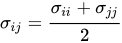
로렌츠 규칙은 단단한 구체 시스템에 대해서만 분석적으로 정확합니다.직관적으로 j \ _ _는 각각 입자 i, j의 반지름을 느슨하게 반영하므로 이들의 평균은 반발 상호작용이 심해지는 두 입자 사이의 유효 반지름이라고 할 수 있다.
 각각 입자 i, j의 반지름을 느슨하게 반영하므로 이들의 평균은 반발 상호작용이 심해지는 두 입자 사이의 유효 반지름이라고 할 수 있다.
 Berthelot 규칙(Daniel Berthelot, 1898)은 [4]다음과 같이 주어진다.
- j= j j j j j j j j j j j j j j j j j j j { \ _ {snapsilon 。

이는 물리적으로가 두 입자 사이의 유도 쌍극자 상호작용과 관련이 있다는 사실에서 발생한다.순간 j \μ j\ _ mu _의 곱에 각각 대응하는 2개의 입자는 μ j\ _의 산술 평균이다. 그러나 두 쌍극자 생성물의 평균이 되지는 않지만 로그의 평균은 다음과 같습니다.
 두 입자 사이의 유도 쌍극자 상호작용과 관련이 있다는 사실에서 발생한다.순간
 산술 평균이다.
이러한 규칙은 가장 널리 사용되며 많은 분자 시뮬레이션 패키지의 기본값이지만 오류가 [5][6][7]없는 것은 아닙니다.
발트만-해글러의 법칙
Waldman-Hagler 규칙은 [8]다음과 같습니다.
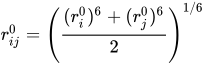
그리고.
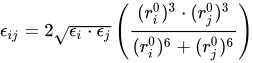
펜더-할시
Fender-Halsey 결합 규칙은 다음과 같습니다.
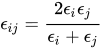
콩 규칙
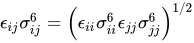
Lennard-Jones 잠재력에 대한 홍콩 규칙은 [10]다음과 같습니다.
![{\displaystyle \epsilon _{ij}\sigma _{ij}^{12}=\left[{\frac {(\epsilon _{ii}\sigma _{ii}^{12})^{1/13}+(\epsilon _{jj}\sigma _{jj}^{12})^{1/13}}{2}}\right]^{13}}](https://wikimedia.org/api/rest_v1/media/math/render/svg/b0ecd99671fea39a893ae33114fc4fb6f061579d)
다른이들
Tang and Toennies[11] Pena,[12][13] Hudson, McCoubrey와[14] Sikora(1970)[15]를 포함한 많은 다른 제안들이 제시되었다.
다른 잠재력에 대한 규칙 결합
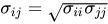
굿호프 룰
미에-레나르-존스 또는 버킹엄 잠재력에 대한 Good-Hope 규칙은 다음과 [16]같이 주어진다.
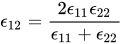
호거보스트 규칙
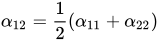
Exp-6 잠재력에 대한 Hogervorst 규칙은 다음과 같습니다.[17]
그리고.
콩차크라바티 규칙
Exp-6 잠재력에 대한 Kong-Chakrabarty 규칙은 다음과 같습니다.[18]
![{\displaystyle \left[{\frac {\epsilon _{12}\alpha _{12}e^{\alpha _{12}}}{(\alpha _{12}-6)\sigma _{12}}}\right]^{2\sigma _{12}/\alpha _{12}}=\left[{\frac {\epsilon _{11}\alpha _{11}e^{\alpha _{11}}}{(\alpha _{11}-6)\sigma _{11}}}\right]^{\sigma _{11}/\alpha _{11}}\left[{\frac {\epsilon _{22}\alpha _{22}e^{\alpha _{22}}}{(\alpha _{22}-6)\sigma _{22}}}\right]^{\sigma _{22}/\alpha _{22}}}](https://wikimedia.org/api/rest_v1/media/math/render/svg/58b941220d1085c8bed2bef305e829cd1171dfd6)
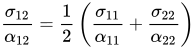
그리고.
![{\displaystyle {\frac {\epsilon _{12}\alpha _{12}\sigma _{12}^{6}}{(\alpha _{12}-6)}}=\left[{\frac {\epsilon _{11}\alpha _{11}\sigma _{11}^{6}}{(\alpha _{11}-6)}}{\frac {\epsilon _{22}\alpha _{22}\sigma _{22}^{6}}{(\alpha _{22}-6)}}\right]^{\frac {1}{2}}}](https://wikimedia.org/api/rest_v1/media/math/render/svg/22dcb4eeb49e2bc11aee0fca6fb03074b13573fe)
Exp-6 잠재력에 대해 제안된 다른 규칙은 메이슨 라이스[19] 규칙과 스리바스타바 및 스리바스타바 규칙(1956)[20]이다.
상태 방정식
산업 상태 방정식은 유사한 혼합 및 결합 규칙을 가지고 있습니다.여기에는 반데르발스 단유체 혼합 규칙이 포함됩니다.
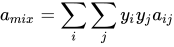
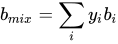
및 van der Waals 결합 규칙(binary interaction j을 도입합니다.

- j ( - i ) { _ { } = { { ii }_ { sqrt } ( 1 - _ { )

또한 Huron-Vidal 혼합 규칙과 더 복잡한 Wong-Sandler 혼합 규칙이 있는데, 이것은 상태 방정식과 활동 계수 모델(따라서 액체의 과잉 Gibbs 자유 에너지) 사이의 무한 압력에서의 과잉 헬름홀츠 자유 에너지를 동일시한다.
레퍼런스
- ^ Halgren, Thomas A. (September 1992). "The representation of van der Waals (vdW) interactions in molecular mechanics force fields: potential form, combination rules, and vdW parameters". Journal of the American Chemical Society. 114 (20): 7827–7843. doi:10.1021/ja00046a032.
- ^ Desgranges, Caroline; Delhommelle, Jerome (14 March 2014). "Evaluation of the grand-canonical partition function using expanded Wang-Landau simulations. III. Impact of combining rules on mixtures properties". The Journal of Chemical Physics. 140 (10): 104109. Bibcode:2014JChPh.140j4109D. doi:10.1063/1.4867498. PMID 24628154.
- ^ Lorentz, H. A. (1881). "Ueber die Anwendung des Satzes vom Virial in der kinetischen Theorie der Gase". Annalen der Physik. 248 (1): 127–136. Bibcode:1881AnP...248..127L. doi:10.1002/andp.18812480110.
- ^ Daniel Berthelot "Sur mélange des gaz", Comptes rendus hebdomadaires des séances de l'l Academie des Sciences, 126p. 1703-1855 (1898)
- ^ DELHOMMELLE, JÉRÔME; MILLIÉ, PHILIPPE (20 April 2001). "Inadequacy of the Lorentz-Berthelot combining rules for accurate predictions of equilibrium properties by molecular simulation". Molecular Physics. 99 (8): 619–625. Bibcode:2001MolPh..99..619D. doi:10.1080/00268970010020041. S2CID 94931352.
- ^ Boda, Dezső; Henderson, Douglas (20 October 2008). "The effects of deviations from Lorentz–Berthelot rules on the properties of a simple mixture". Molecular Physics. 106 (20): 2367–2370. Bibcode:2008MolPh.106.2367B. doi:10.1080/00268970802471137. S2CID 94289505.
- ^ Song, W.; Rossky, P. J.; Maroncelli, M. (2003). "Modeling alkane+perfluoroalkane interactions using all-atom potentials: Failure of the usual combining rules". The Journal of Chemical Physics. 119 (17): 9145–9162. Bibcode:2003JChPh.119.9145S. doi:10.1063/1.1610435.
- ^ Waldman, Marvin; Hagler, A.T. (September 1993). "New combining rules for rare gas van der waals parameters". Journal of Computational Chemistry. 14 (9): 1077–1084. doi:10.1002/jcc.540140909. S2CID 16732612.
- ^ Fender, B. E. F.; Halsey, G. D. (1962). "Second Virial Coefficients of Argon, Krypton, and Argon‐Krypton Mixtures at Low Temperatures". The Journal of Chemical Physics. 36 (7): 1881–1888. Bibcode:1962JChPh..36.1881F. doi:10.1063/1.1701284.
- ^ Kong, Chang Lyoul (1973). "Combining rules for intermolecular potential parameters. II. Rules for the Lennard-Jones (12–6) potential and the Morse potential". The Journal of Chemical Physics. 59 (5): 2464–2467. Bibcode:1973JChPh..59.2464K. doi:10.1063/1.1680358.
- ^ Tang, K. T.; Toennies, J. Peter (March 1986). "New combining rules for well parameters and shapes of the van der Waals potential of mixed rare gas systems". Zeitschrift für Physik D. 1 (1): 91–101. Bibcode:1986ZPhyD...1...91T. doi:10.1007/BF01384663. S2CID 122224768.
- ^ Diaz Peña, M. (1982). "Combination rules for intermolecular potential parameters. I. Rules based on approximations for the long-range dispersion energy". The Journal of Chemical Physics. 76 (1): 325–332. Bibcode:1982JChPh..76..325D. doi:10.1063/1.442726.
- ^ Diaz Peña, M. (1982). "Combination rules for intermolecular potential parameters. II. Rules based on approximations for the long-range dispersion energy and an atomic distortion model for the repulsive interactions". The Journal of Chemical Physics. 76 (1): 333–339. Bibcode:1982JChPh..76..333D. doi:10.1063/1.442727.
- ^ Hudson, G. H.; McCoubrey, J. C. (1960). "Intermolecular forces between unlike molecules. A more complete form of the combining rules". Transactions of the Faraday Society. 56: 761. doi:10.1039/TF9605600761.
- ^ Sikora, P T (November 1970). "Combining rules for spherically symmetric intermolecular potentials". Journal of Physics B. 3 (11): 1475–1482. Bibcode:1970JPhB....3.1475S. doi:10.1088/0022-3700/3/11/008.
- ^ Good, Robert J. (1970). "New Combining Rule for Intermolecular Distances in Intermolecular Potential Functions". The Journal of Chemical Physics. 53 (2): 540–543. Bibcode:1970JChPh..53..540G. doi:10.1063/1.1674022.
- ^ Hogervorst, W. (January 1971). "Transport and equilibrium properties of simple gases and forces between like and unlike atoms". Physica. 51 (1): 77–89. Bibcode:1971Phy....51...77H. doi:10.1016/0031-8914(71)90138-8.
- ^ Kong, Chang Lyoul; Chakrabarty, Manoj R. (October 1973). "Combining rules for intermolecular potential parameters. III. Application to the exp 6 potential". The Journal of Physical Chemistry. 77 (22): 2668–2670. doi:10.1021/j100640a019.
- ^ Mason, Edward A.; Rice, William E. (1954). "The Intermolecular Potentials of Helium and Hydrogen". The Journal of Chemical Physics. 22 (3): 522. Bibcode:1954JChPh..22..522M. doi:10.1063/1.1740100.
- ^ Srivastava, B. N.; Srivastava, K. P. (1956). "Combination Rules for Potential Parameters of Unlike Molecules on Exp-Six Model". The Journal of Chemical Physics. 24 (6): 1275. Bibcode:1956JChPh..24.1275S. doi:10.1063/1.1742786.


