
리더센법
Lydersen methodLydersen 방법은[1] 임계 속성 온도(Tc), 압력(Pc) 및 부피(Vc)를 추정하기 위한 집단 기여 방법이다.Lydersen 방법은 Joback,[2] Klincewicz,[3] Ambrose,[4] Gani-Constantinou와[5] 같은 많은 새로운 모델들의 원형이자 조상이다.
Lydersen 방법은 정상 비등점과 임계 온도 사이의 관계를 설정하는 Guldberg 규칙에 대한 임계 온도의 경우에 기초한다.
방정식
임계 온도
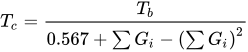
Guldberg는 켈빈으로 표현되었을 때 정상 비등점 T의b 대략적인 추정치가 임계 온도 T의c 약 3분의 2라는 것을 발견했다.Lydersen은 이 기본적인 생각을 사용하지만 더 정확한 값을 계산한다.
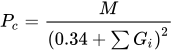
임계 압력
임계 볼륨
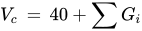
M은 어금니 질량이고 G는i 분자의 기능 그룹에 대한 그룹 기여(세 가지 특성 모두에 대해 다름)이다.
단체기여금
| 그룹 | Gi(Tc) | Gi(Pc) | Gi(Vc) | 그룹 | Gi(Tc) | Gi(Pc) | Gi(Vc) |
|---|---|---|---|---|---|---|---|
| -CH3,-CH2- | 0.020 | 0.227 | 55.0 | >CH | 0.012 | 0.210 | 51.0 |
| -C< | - | 0,210 | 41.0 | =CH2,#CH | 0.018 | 0,198 | 45.0 |
| =C<,=C= | - | 0.198 | 36.0 | =C-H,#C- | 0.005 | 0.153 | 36.0 |
| -CH2-(링) | 0.013 | 0.184 | 44.5 | >CH-(링) | 0.012 | 0.192 | 46.0 |
| >C<(링) | -0.007 | 0.154 | 31.0 | =CH-,=C<,=C=(링) | 0.011 | 0.154 | 37.0 |
| -F | 0.018 | 0.224 | 18.0 | -Cl | 0.017 | 0.320 | 49.0 |
| -Br | 0.010 | 0.500 | 70.0 | -I | 0.012 | 0.830 | 95.0 |
| -OH | 0.082 | 0.060 | 18.0 | -OH(아로마트) | 0.031 | -0.020 | 3.0 |
| -O- | 0.021 | 0.160 | 20.0 | -O-(링) | 0.014 | 0.120 | 8.0 |
| >C=O | 0.040 | 0.290 | 60.0 | >C=O(링) | 0.033 | 0.200 | 50.0 |
| HC=O- | 0.048 | 0.330 | 73.0 | -COOH | 0.085 | 0.400 | 80.0 |
| -COO- | 0.047 | 0.470 | 80.0 | -NH2 | 0.031 | 0.095 | 28.0 |
| >NH | 0.031 | 0.135 | 37.0 | >NH(링) | 0.024 | 0.090 | 27.0 |
| >N | 0.014 | 0.170 | 42.0 | >N-(링) | 0.007 | 0.130 | 32.0 |
| -CN | 0.060 | 0.360 | 80.0 | -NO2 | 0.055 | 0.420 | 78.0 |
| -SH,-S- | 0.015 | 0.270 | 55.0 | -S-(링) | 0.008 | 0.240 | 45.0 |
| =S | 0.003 | 0.240 | 47.0 | >Si< | 0.030 | 0.540 | - |
| -B< | 0.030 | - | - |
계산 예시

아세톤은 카보닐 그룹 하나와 메틸 그룹 두 개의 서로 다른 그룹으로 나뉘어 있다.임계 볼륨의 경우 다음과 같은 계산 결과가 나온다.
Vc = 40 + 60.0 + 2 * 55.0 = 210cm3
문헌(도르트문트 데이터 뱅크 등)에는 215.90cm3,[6] 230.5cm3, 209.0cm의3 값이 발표된다.
참조
- ^ Lydersen, a.L. "Estimation of Critical Properties of Organic Compounds". Engineering Experiment Station Report. Madison, Wisconsin: University of Wisconsin College Engineering. 3.
- ^ Joback, K.G.; Reid, R.C. (1987). "Estimation of pure-component properties from group-contributions". Chemical Engineering Communications. Informa UK Limited. 57 (1–6): 233–243. doi:10.1080/00986448708960487. ISSN 0098-6445.
- ^ Klincewicz, K. M.; Reid, R. C. (1984). "Estimation of critical properties with group contribution methods". AIChE Journal. Wiley. 30 (1): 137–142. doi:10.1002/aic.690300119. ISSN 0001-1541.
- ^ Ambrose, D. (1978). Correlation and Estimation of Vapour-Liquid Critical Properties. I. Critical Temperatures of Organic Compounds. National Physical Laboratory Reports Chemistry. Vol. 92. p. 1-35.
- ^ Constantinou, Leonidas; Gani, Rafiqul (1994). "New group contribution method for estimating properties of pure compounds". AIChE Journal. Wiley. 40 (10): 1697–1710. doi:10.1002/aic.690401011. ISSN 0001-1541.
- ^ Campbell, A. N.; Chatterjee, R. M. (1969-10-15). "The critical constants and orthobaric densities of acetone, chloroform, benzene, and carbon tetrachloride". Canadian Journal of Chemistry. Canadian Science Publishing. 47 (20): 3893–3898. doi:10.1139/v69-646. ISSN 0008-4042.
- ^ Herz, W.; Neukirch, E. (1923). Z.Phys.Chem.(Leipzig). 104: S.433-450.
{{cite journal}}:누락 또는 비어 있음title=(도움말) - ^ Kobe, Kenneth A.; Crawford, Horace R.; Stephenson, Robert W. (1955). "Industrial Design Data—Critical Properties and Vapor Presesures of Some Ketones". Industrial & Engineering Chemistry. American Chemical Society (ACS). 47 (9): 1767–1772. doi:10.1021/ie50549a025. ISSN 0019-7866.