모든 유한 차원 행렬은 순위 분해를 가진다.을(를) n 행렬로 두십시오(열는r {\Therefore, there are linearly independent columns in ; equivalently, the dimension of the column space of is . Let be any basis for the column space of and place them as column vectors to form the matrix .C{C\textstyle}의 기둥 그러므로, A{A\textstyle}의 매 칼럼 벡터는 일차 결합. 만약 A={\textstyle A={\begin{bmatrix}\mathbf{를}_{1}&[1는 2n⋯], 정확히 말하자면;\mathbf{를}_{2}&, \cdots &, \mathbf{를}_{n}\end{bmatrix}}}은 m×n{\texts.tyle m\time를 -th 열로 표시한 다음
여기서 i s는 1,,의 계수다이는 = 을(를) 의미하며 여기서 는F의 j 요소 입니다.
고유하지 않음
If is rank factorization, taking and gives another rank factorization for any invertible matrix of compatible dimensions.
Conversely, if are two rank factorizations of , then there exists an invertible matrix such that and .[1]
건설
축소된 행 에셀론 폼에서 순위 요인 지정
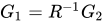
실제로, 우리는 다음과 같은 특정한 순위 요소를 구성할 수 있다: 우리는 의 축소된 행 에셀론 형식인 B 을를) 계산할 수 있다 그러면 에서 모든비-피봇 열(에서 열 검색으로 결정할 수 있음)을 제거하여 C {\textstyleanization을 얻는다.피벗을 포함하지 않는과(와 {\은(는) {\의 0행 전체를 제거하여 얻는다
참고: 전체 순위제곱 행렬(: = = r )의 경우 이 절차는 사소한 결과 = 및 = 를 산출한다. n매트릭스).
예
행렬 고려
은(는) 축소된 에셀론 형식이다.
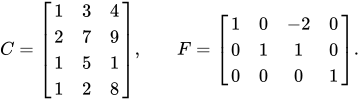
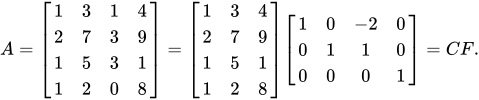
다음 C{\은(는 피벗 열이 아닌 A {\ A의 세 번째 열과 B 에서 0의 마지막 행을 제거하여
는 것을 확인하는 것은 간단하다.
증명
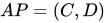
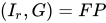
Let be an permutation matrix such that in block partitioned form, where the columns of are the pivot columns of . Every column of is a linear c 열의 옴부즈먼트 때문에 = CG과 같은 G G이(가) 있으며, 여기서 의 열에는 이러한 각 선형 조합의 계수가 포함되어 있다따라서 =( , G)= C( , ) CG는 r 행렬이다.이제(, )= 라는 것을 보여 주겠다..
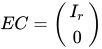
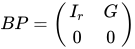
Transforming into its reduced row echelon form amounts to left-multiplying by a matrix which is a product of elementary matrices, so , where 그러면 =( r 라고 쓸 수 있다.을를) 식별할 수 있는(, G)= P , i.e. the nonzero rows of the reduced echelon form, with the same permutation on the columns as we did for . We thus have , and since is invertible this implies , and the proof is complete.
Since is a full column rank matrix and is a full row rank matrix, we can take and .
결과들
계급(A) = 계급(AT)
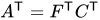
An immediate consequence of rank factorization is that the rank of is equal to the rank of its transpose . Since the columns of are the rows of , the column rank of equals its row rank.[2]
증명: 왜 이것이 사실인지 알아보려면 먼저 평균 열 순위에 대한 순위를 정의해 봅시다.Since , it follows that . From the definition of matrix multiplication, this means that each column of is a linear combination of the columns of . Therefore, the column space of is contained within the column space of and, hence,
Now, is , so there are columns in and, hence, .로써 랭크 () ((A \leq \operatorname}\좌(A\right) }).
Now apply the result to to obtain the reverse inequality: since , we can write {\ref.로써 랭크 ) T)rank {( T )\\reck} \..
^Piziak, R.; Odell, P. L. (1 June 1999). "Full Rank Factorization of Matrices". Mathematics Magazine. 72 (3): 193. doi:10.2307/2690882. JSTOR2690882.
^Banerjee, Sudipto; Roy, Anindya (2014), Linear Algebra and Matrix Analysis for Statistics, Texts in Statistical Science (1st ed.), Chapman and Hall/CRC, ISBN978-1420095388
참조
Banerjee, Sudipto; Roy, Anindya (2014), Linear Algebra and Matrix Analysis for Statistics, Texts in Statistical Science (1st ed.), Chapman and Hall/CRC, ISBN978-1420095388
Lay, David C. (2005), Linear Algebra and its Applications (3rd ed.), Addison Wesley, ISBN978-0-201-70970-4
Golub, Gene H.; Van Loan, Charles F. (1996), Matrix Computations, Johns Hopkins Studies in Mathematical Sciences (3rd ed.), The Johns Hopkins University Press, ISBN978-0-8018-5414-9
Stewart, Gilbert W. (1998), Matrix Algorithms. I. Basic Decompositions, SIAM, ISBN978-0-89871-414-2
Piziak, R.; Odell, P. L. (1 June 1999). "Full Rank Factorization of Matrices". Mathematics Magazine. 72 (3): 193. doi:10.2307/2690882. JSTOR2690882.