대수구조 유형별 기초
수학에서 표준적 기초 는 정확한 문맥에 따라 달라지는 의미에서 표준적인 대수적 구조의 기초가 된다.
좌표 공간에서, 그리고 보다 일반적으로 자유 모듈에서, 크론커 델타 에 의해 정의된 표준 기준을 가리킨다 . 다항식 링에서 단항식 ( i i {\ displaystyle (X^{i}_{i}}) . 유한 확장 필드의 경우 다항식 기준 을 의미한다. 선형대수학 에서 집합이 완전히 요르단 체인 으로 구성된 경우, n ×n A 선형 독립 일반화된 고유 벡터 집합을 가리킨다. [1] 대표이론 에서 루슈티그가 도입한 양자집단의 기초 를 가리킨다.표현 이론 타입 A D displaystyle ADE} 매개변수 displaystyle q} q 1 {\displaystyle q=1 ( . 매개 변수 displaystyle q} q {\displaystyle q=0} 되돌릴 수 없는 표현의 경우에 대한 이 그림자(근거 자체는 아님)는 가시와라(Kashiwara)에 의해 독자적으로 검토되었다.[3] 때로는 수정근거 라고 불린다. 표준기반의 정의는 가시와라(대수법에 의한)와 루스츠틱(위상학적 방법에 의한)에 의해 카크무디 설정까지 확장되었다.
이러한 근거에는 다음과 같은 일반적인 개념이 깔려 있다.
Consider the ring of integral Laurent polynomials Z := Z [ v , v − 1 ] {\displaystyle {\mathcal {Z}}:=\mathbb {Z} \left[v,v^{-1}\right]} Z ± := Z [ v ± 1 ] {\displaystyle {\mathcal {Z}}^{\pm }:=\mathbb {Z} \left[v^{\pm 1}\right]} ⋅ ¯ {\displaystyle {\ v overline {\cdot }}:= v 1 {\ displaystyle {\verline{v}:=v^{-1
자유 Z {\ displaystyle {\mathcal{Z}} F {\displaystyle F} 초기 구조물 은 다음과 같이 구성된다
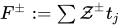
표준 ( t i ∈ I {\displaystyle (t_{i})_{i\in I}, I {\displaystyle I} 구간 부분 순서 , 즉 ∞ ] := j ∈ I ∣ j ≤ displaystyle(-\fty ,i]): =\\{j\in I\mid j\leq \}} ) i 유한 . 이원화 작업, 즉 순서 2의편향 F {\displaystyle F\to }({\ displaystyle {\cdot }) , {\ {\cdot ilin {\ displaystystyle }). 만약 사전론적 구조가 주어진다면 displaystyle mathcal{Z}^{\ pm }} := ∑ Z j {\ textstyle F^{\matcal}^{\\ }^{}}}{\pm}t_{j}}}}}}}}} .
사전공학적 구조의 표준적 기반은 다음 사항을 만족 하는{\ displaystyle {\mathcal{Z}} -basis (c I {\ displaystyle (c_{i}_{i\in }) displaystyf}:
c i "c i {\ displaystyle {\overline {c_{i}}=c_ {i}} c i ∈ ∑ j ≤ i Z + t j 그리고 c i ≡ t i 모드의 v F + {\displaystyle c_{i}\in \sum _{j\leq i}{\mathcal {Z}^{+}t_{j}{\c_{i}\equiv t_{i}\mod vF^{+}}}}} 모든 I ∈ I {\displaystyle i\in I} .
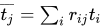
각 사전론적 구조에 대해 최대 하나의 표준적 기초가 존재한다는 것을 보여줄 수 있다.[6] A sufficient condition for existence is that the polynomials r i j ∈ Z {\displaystyle r_{ij}\in {\mathcal {Z}}} t j ¯ = ∑ i r i j t i {\textstyle {\overline {t_{j}}}=\sum _{i}r_{ij}t_{i}} r i i = 1 {\displaystyle r_{ii}=1} r i j ≠ 0 ⟹ i ≤ j {\displaystyle r_ {ij}\neq \buffer i\leq }.
A canonical basis induces an isomorphism from F + ∩ F + ¯ = ∑ i Z c i {\displaystyle \textstyle F^{+}\cap {\overline {F^{+}}}=\sum _{i}\mathbb {Z} c_{i}} F + / v F + {\displaystyle F^{+}/vF^{+}}
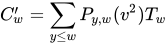
헤케 알헤브라스 Let W {\displaystyle (W,S)} Coxeter 그룹 으로 한다 The corresponding Iwahori-Hecke algebra H {\displaystyle H} ( T w ) w ∈ W {\displaystyle (T_{w})_{w\in W}} Bruhat order which is interval finite and has a dualization operation defined by T w ¯ := T w − 1 − 1 {\displaystyle {\overline {T_{ w}}}:T_{w^{-1}^{-1 이것은 위의 충분한 조건을 만족하는H {\displaystyle H} 표준 {\displaystyle H} Kazhdan-Lusztig 기반 이다.
C w ′ = ∑ y ≤ w P y , w ( v 2 ) T w {\displaystyle C_{w}=\sum _{y\leq w}P_{y,w}(v^{2}) T_{w}} P y w {\ displaystyle P_{y,w} Kazhdan-Lusztig 다항식 인 경우
선형대수학 만약 우리에게 n × n 매트릭스 {\displaystyle A} displaystyle } 와 유사 한 displaystyle } 행렬 조던 보통 형태 의 일반화된고유 벡터 집합에만 관심이 있다. 요르단 정규 형태의 행렬은 "대각 행렬" 즉, 가능한 대각선에 가까운 행렬이다. 대각 행렬 D {\displaystyle D} 일반 고유 벡터 는 일반화된 고유 벡터의 특별한 경우다.
매 n × n 매트릭스 A {\displaystyle A} 독립 일반화된 고유 벡터가 있다 구별되는 고유값 에 해당하는 일반화된 고유 벡터는 선형적으로 독립적이다. λ {\displaystyle \lambda } 대수 다중성 μ[\displaystyle \mu } A {\displaystyle \lambda } A {\displaystystyle mu } μ {\\\\\\\\\\ .
주어진 n × n 행렬 A {\displaystyle A} , 독립적 인 일반화된 고유 벡터를 선택하는 방법은 무한히 많다. 만약 그것들이 특히 신중하게 선택된다면, 우리는 이 벡터를 사용하여 A {\displaystyle } 특히.
정의: 전체적으로 요르단 체인으로 구성된 경우 n개 의 선형 독립형 일반화된 고유 벡터 세트가 표준적인 기반 이다.
Thus, once we have determined that a generalized eigenvector of rank m is in a canonical basis, it follows that the m − 1 vectors x m − 1 , x m − 2 , … , x 1 {\displaystyle \mathbf {x} _{m-1},\mathbf {x} _{m-2},\ldots ,\mathbf {x} _{1}} x m {\displaystyle \mathbf {x} _{ m}} [7]
연산 Let λ i {\displaystyle \lambda _{i}} A {\displaystyle A} μ i {\displaystyle \mu _{i}} ranks (matrix ranks) of the matrices ( A − λ i I ) , ( A − λ i I ) 2 , … , ( A − λ i I ) m i {\displaystyle (A-\lambda _{i}I),(A-\lambda _ {i}I)^{2},\ldots ,(A-\lambda _{i}I)^{m_{i The integer m i {\displaystyle m_{i}} first integer for which ( A − λ i I ) m i {\displaystyle (A-\lambda _{i}I)^{m_{i}}} n − μ i {\displaystyle n-\mu _{i}} n being the number of rows or columns of A {\displaystyle A} A {\displaystyle A} n × n ).
이제 정의
ρ k = 등수를 매기다 ( A − λ i I ) k − 1 − 등수를 매기다 ( A − λ i I ) k ( k = 1 , 2 , … , m i ) . {\displaystyle \rho _{k}=\operatorname {rank}(A-\lambda _{I}I)^{k-1-\operatorname {rank}(A-\lambda _{i}I) ^{k}\qquad (k=1,2,\ldots ,m_{i}). } 변수 ρk {\ displaystyle \rho_{k} λ {\ displaystyle \lambda_{i} 순위 k(일반화된 고유 벡터, 일반화된 고유 벡터 참조)의 선형 독립 고유 벡터의 수를 지정하며값 {\displaystystyle A} . 저것
등수를 매기다 ( A − λ i I ) 0 = 등수를 매기다 ( I ) = n . {\displaystyle \operatorname {rank}(A-\lambda _{I}I)^{0}=\operatorname {rank}(I)=n). } 표준적인 기초가 가지고 있는 각 등급의 일반화된 고유 벡터의 수를 결정하면 벡터를 명시적으로 얻을 수 있다(일반화된 고유 벡터 참조).[8]
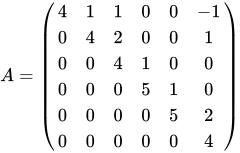
예 이 예는 두 개의 요르단 사슬을 가진 표준적인 기초를 보여준다. 불행하게도, 낮은 질서의 흥미로운 예를 만드는 것은 조금 어렵다.[9] 행렬
A = ( 4 1 1 0 0 − 1 0 4 2 0 0 1 0 0 4 1 0 0 0 0 0 5 1 0 0 0 0 0 5 2 0 0 0 0 0 4 ) {\displaystyle A={\begin{pmatrix}4&1&1&0&0&-1\\0&4&2&0&0&1\\0&0&4&1&0&0\\0&0&0&5&1&0\\0&0&0&0&5&2\\0&0&0&0&0&4\end{pmatrix}}} has eigenvalues λ 1 = 4 {\displaystyle \lambda _{1}=4} λ 2 = 5 {\displaystyle \lambda _{2}=5} μ 1 = 4 {\displaystyle \mu _{1}=4} μ 2 = 2 {\displaystyle \mu _{2}=2} geometric multiplicities γ 1 = 1 {\displaystyle \gamma _{1}=1} γ 2 = 1 {\displaystyle \property _ }=1
λ 1 {\displaystyle \lambda _{1}=4,} n μ 6 4 2 {\displaystyle n-\mu _{1}=6-4=2,}
( A 4 I {\displaystyle A-4I)} ( A 4 I {\ displaystyle (A-4I)^{2 , ( A 4 I 3 {\ displaystyle (A-4I)^{3}} ( A I 4 {\ displaystyle (A-4I)^{4}} 따라서 m 1 . {\displaystyle m_{1}=4. }
ρ 4 = 등수를 매기다 ( A − 4 I ) 3 − 등수를 매기다 ( A − 4 I ) 4 = 3 − 2 = 1 , {\displaystyle \rho_{4}=\operatorname {rank}(A-4I)^{3}-\operatorname {rank}(A-4I)^{4}=3-2=1,} ρ 3 = 등수를 매기다 ( A − 4 I ) 2 − 등수를 매기다 ( A − 4 I ) 3 = 4 − 3 = 1 , {\displaystyle \rho _{3}=\operatorname {rank}(A-4I)^{2}-\operatorname {rank}(A-4I)^{3}=4-3=1,} ρ 2 = 등수를 매기다 ( A − 4 I ) 1 − 등수를 매기다 ( A − 4 I ) 2 = 5 − 4 = 1 , {\displaystyle \rho _{2}=\operatorname {rank}(A-4I)^{1}-\operatorname {rank}(A-4I)^{2}=5-4=1,} ρ 1 = 등수를 매기다 ( A − 4 I ) 0 − 등수를 매기다 ( A − 4 I ) 1 = 6 − 5 = 1. {\displaystyle \rho _{1}=\operatorname {rank}(A-4I)^{0}-\operatorname {rank}(A-4I)^{1}=6-5=1.} 따라서 A {\displaystyle A} λ 4 {\displaystyle \lambda _{1}=4,}
λ 2 5 {\displaystyle \lambda _{2}=5,} n μ 2 6 2 4 {\displaystyle n-\mu _{2}=6-2=4,}
( A 5 I {\displaystyle A-5I)} ( A 5 I 2 {\ displaystyle A-5I)^{2}} 따라서 m 2 . {\displaystyle m_{2}=2. }
ρ 2 = 등수를 매기다 ( A − 5 I ) 1 − 등수를 매기다 ( A − 5 I ) 2 = 5 − 4 = 1 , {\displaystyle \rho _{2}=\operatorname {rank}(A-5I)^{1}-\operatorname {rank}(A-5I)^{2}=5-4=1,} ρ 1 = 등수를 매기다 ( A − 5 I ) 0 − 등수를 매기다 ( A − 5 I ) 1 = 6 − 5 = 1. {\displaystyle \rho _{1}=\operatorname {rank}(A-5I)^{0}-\operatorname {rank}(A-5I)^{1}=6-5=1.} 따라서 A {\displaystyle A} λ displaystyle \lambda _{2}=5,}
A {\displaystyle A}
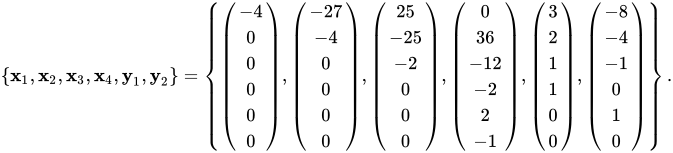
{ x 1 , x 2 , x 3 , x 4 , y 1 , y 2 } = { ( − 4 0 0 0 0 0 ) , ( − 27 − 4 0 0 0 0 ) , ( 25 − 25 − 2 0 0 0 ) , ( 0 36 − 12 − 2 2 − 1 ) , ( 3 2 1 1 0 0 ) , ( − 8 − 4 − 1 0 1 0 ) } . {\displaystyle \left\{\mathbf {x} _{1},\mathbf {x} _{2},\mathbf {x} _{3},\mathbf {x} _{4},\mathbf {y} _{1},\mathbf {y} _{2}\right\}=\left\{{\begin{pmatrix}-4\\0\\0\\0\\0\\0\end{pmatrix}},{\begin{pmatrix}-27\\-4\\0\\0\\0\\0\end{pmatrix}},{\begin{pmatrix}25\\-25\\-2\\0\\0\\0\end{pmatrix}},{\begin{pmatrix}0\\36\\-12\\-2\\2\\-1\end{pmatrix}},{\begin{pm atrix}3\\\2\\1\\\0\end{pmatrix},{\\\pmatrix}-8\-\-4\-\-\1\\0\end{pmatrix}\right\}. } x 1 {\displaystyle \mathbf {x} _{1}} λ 1 {\displaystyle \lambda _{1}} x 2 , x 3 {\displaystyle \mathbf {x} _{2},\mathbf {x} _{3}} x 4 {\displaystyle \mathbf {x} _{4}} λ 1 {\displaystyl e \lambda _{1 1 {\ displaystyle \mathbf {y} _{1}{1 λ 2 {\ displaystyle \lambda _{2 2 {\ displaystyle \mathbf {y} _{2 }}.} .
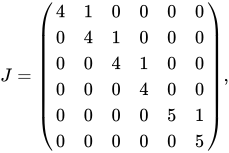
A displaystyle A} ) {\displaystyle J} 행렬
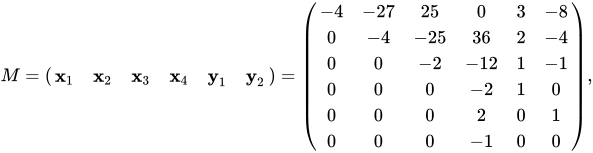
M = ( x 1 x 2 x 3 x 4 y 1 y 2 ) = ( − 4 − 27 25 0 3 − 8 0 − 4 − 25 36 2 − 4 0 0 − 2 − 12 1 − 1 0 0 0 − 2 1 0 0 0 0 2 0 1 0 0 0 − 1 0 0 ) , {\displaystyle M={\begin{pmatrix}\mathbf{)}_{1}&,\mathbf{)}_{2}&,\mathbf{)}_{3}&,\mathbf{)}_{4}&,\mathbf{y}_{1}&, \mathbf{y}_{2}\end{pmatrix}}={\begin{pmatrix}-4&, -27&, 25&, 0&, 3&, -8\\0&, -4&, -25&, 36&, 2&, -4\\0&, 0&, -2&, -12&, 1&, -1\\0&, 0&, 0&, -2&, 1&, 0\\0&, 0&, 0&을 말한다.2&, 0&, 1\\0&, 0&, 0&, -1&, 0&, 0\end{pmatrix}},} J = ( 4 1 0 0 0 0 0 4 1 0 0 0 0 0 4 1 0 0 0 0 0 4 0 0 0 0 0 0 5 1 0 0 0 0 0 5 ) , {\displaystyle J={\begin{pmatrix}4&1&0&0&0&0\\0&4&1&0&0&0\\0&0&4&1&0&0\\0&0&0&4&0&0\\0&0&0&0&5&1\\0&0&0&0&0&5\end{pmatrix}},} 여기서 행렬 M {\displaystyle M} A {\displaystyle A} A M J {\displaystyle AM= } 일반화된 모달 행렬 이다. [10]
참고 항목 메모들 참조 Bronson, Richard (1970), Matrix Methods: An Introduction , New York: Academic Press , LCCN 70097490 Deng, Bangming; Ju, Jie; Parshall, Brian; Wang, Jianpan (2008), Finite Dimensional Algebras and Quantum Groups American Mathematical Society , ISBN 9780821875315 Nering, Evar D. (1970), Linear Algebra and Matrix Theory (2nd ed.), New York: Wiley , LCCN 76091646 


![{\displaystyle {\mathcal {Z}}:=\mathbb {Z} \left[v,v^{-1}\right]}](https://wikimedia.org/api/rest_v1/media/math/render/svg/ec43f9c3cbcce9b959eba04180c61eca7909df42)
![{\displaystyle {\mathcal {Z}}^{\pm }:=\mathbb {Z} \left[v^{\pm 1}\right]}](https://wikimedia.org/api/rest_v1/media/math/render/svg/3e7e1e095dc9809b86c2e2d5daea178b3a320fc7)


![{\displaystyle (-\infty ,i]:=\{j\in I\mid j\leq i\}}](https://wikimedia.org/api/rest_v1/media/math/render/svg/2a1e58f24f88091b9748382c5bac37fae4498424) (는
(는


 Z ±
Z ± Z {\
Z {\




















 경우
경우  (는) 5위,
 (는) 3위,





 경우
경우  (는) 5위,





 (는)
(는) 


