
Stochastic oscillator
In technical analysis of securities trading, the stochastic oscillator is a momentum indicator that uses support and resistance levels. George Lane developed this indicator in the late 1950s.[1] The term stochastic refers to the point of a current price in relation to its price range over a period of time.[2] This method attempts to predict price turning points by comparing the closing price of a security to its price range.
The 5-period stochastic oscillator in a daily timeframe is defined as follows:
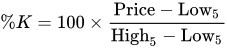

where and are the highest and lowest prices in the last 5 days respectively, while %D is the N-day moving average of %K (the last N values of %K). Usually this is a simple moving average, but can be an exponential moving average for a less standardized weighting for more recent values. There is only one valid signal in working with %D alone — a divergence between %D and the analyzed security.[3]


Definition
The calculation above finds the range between an asset's high and low price during a given period of time. The current security's price is then expressed as a percentage of this range with 0% indicating the bottom of the range and 100% indicating the upper limits of the range over the time period covered.[citation needed] The idea behind this indicator is that prices tend to close near the extremes of the recent range before turning points. The Stochastic oscillator is calculated:



 (는) 지난 N 기간에 대한 최저 가격이다.
 (는) 지난 N 기간에 비해 가장 높은 가격이다.


3행 Stochastics는 %K에서 예상신호를, %D는 바닥에서 또는 그 이전에, %D 회전의 신호는 %D-Slow에서 회전을 확인한다.[4] N의 일반적인 값은 5, 9 또는 14 주기입니다. 3개 기간에 걸쳐 지표를 평활화하는 것이 표준이다.
조지 레인에 따르면 스토카스틱스 지표는 사이클, 엘리엇 웨이브 이론, 피보나치 재추적과 함께 타이밍을 위해 사용된다. 낮은 마진에서, 캘린더 선물은, 사람들은 스토커틱스 입력이 끝난 후, 후행 중지로서 와일더스 포물선을 이용할 수 있다. 그의 가르침의 중심은 가격 주기에 그려진 추세선으로 전환/전환하면서 스토커스틱스에 그려진 추세선의 다양성과 융합이다. 마차스틱은 상단과 하단을 예측한다.
해석
작용하는 신호는 극한 영역에서 사이클 하단의 우측 크로스오버가 있는 발산-융합이 있을 때입니다.[3] 일반 크로스오버가 자주 발생할 수 있기 때문에 일반적으로 %D 라인에서 피크 또는 수조 후 극단적인 풀백과 함께 크로스오버가 발생할 때까지 기다린다. 가격 변동성이 클 경우, %D 지표의 지수 이동 평균을 취할 수 있으며, 이는 가격의 급격한 변동을 완화하는 경향이 있다.
스토카스테틱스는 유가증권 종가를 가격대 대비 비교함으로써 전환점을 예측하려고 한다. 물가는 전환점 직전에 최근 범위의 극한에 근접하는 경향이 있다. 상승세의 경우 물가는 더 높은 고점을 만드는 경향이 있고, 정산은 보통 그 기간 거래대상의 상한선에 있는 경향이 있다. 모멘텀이 둔화되기 시작하면 정산이격이 상한선에서 후퇴하기 시작해 최종 가격 고점 또는 그 이전에 확률적 지표가 하락세로 돌아선다.[5]

%D 라인이 극한 영역에 있고 가격 조치에서 벗어나면 경고 또는 설정이 나타난다. 실제 신호는 고속 % K 라인이 % D 라인을 통과할 때 발생한다.[6]
다이버전스-융합은 시장의 모멘텀이 약화되고 있으며 반전이 만들어질 수 있음을 시사하는 것이다. 아래 도표는 가격 대비 확률의 차이가 가격 방향의 반전을 예측하는 예를 보여준다.
"스토스테틱 팝"이라고 알려진 이벤트는 가격이 발생하고 계속 진행될 때 발생한다. 이는 현재 위치를 늘리거나 방향이 현재 위치에 반할 경우 청산하라는 신호로 해석된다.[7]
참고 항목
- MACD
- 상대강도지수(RSI)
- Williams %R – %K에 해당하며, 0% 축 주위에 미러링됨
- 디트렌드 가격 오실레이터
참조
- ^ "Stochastic Indicator [ChartSchool]". Retrieved 6 October 2014.
- ^ 머피, 존 J(1999년). "John Murphy's Ten Law of Technical Trade, 2012-04-23 Wayback Machine에 보관"
- ^ a b 레인, 조지 M.D. (1984년 5월/6월) 「레인의 스토카스틱스」, 「주식 및 물품의 기술적 분석」 제2호. 87-90 페이지
- ^ 레인, 조지 C. & Caire(1998) "Stochastics로 시작하기" 페이지 3
- ^ Person, John L (2004). A Complete Guide to Technical Trading Tactics: How to Profit Using Pivot Points, Candlesticks & Other Indicators. Hoboken, NJ: Wiley. pp. 144–145. ISBN 0-471-58455-X.
- ^ Murphy, John J (1999). Technical Analysis of the Financial Markets: A Comprehensive Guide to Trading Methods and Applications. New York: New York Institute of Finance. p. 247. ISBN 0-7352-0066-1.
- ^ Bernstein, Jake (1995). The Complete Day Trader. New York: McGraw Hill. ISBN 0-07-009251-6.