확률 이론 과 통계 에서 복합 무작위 벡터는 일반적으로 복합적 으로 가치가 있는 랜덤 변수 의 튜플이며, 일반적으로 복잡한 숫자의 필드 위에 벡터 공간 에서 값을 취하는 랜덤 변수다. Z 1 n {\ displaystyle Z_{1},\ldots ,Z_{n}} (Z 1 n {\ displaystyle \left(Z_{1},\ldots ,Z_{n}\rig ) 복잡한 랜덤 변수는 항상 실제 랜덤 벡터의 쌍, 즉 실제와 가상의 부분으로 간주될 수 있다.
실제 무작위 벡터의 일부 개념은 복잡한 무작위 벡터에 대한 간단한 일반화를 가지고 있다. 예를 들어, 복합 랜덤 벡터의 평균 정의. 다른 개념들은 복잡한 무작위 벡터에 독특하다.
복잡한 무작위 벡터의 적용은 디지털 신호 처리 에서 찾을 수 있다.
정의 복합 벡터 1 n {\ displaystyle \mathbf {Z} =(Z_{1},\ldots ,Z_{n } T}} probability space ( Ω , F , P ) {\displaystyle (\Omega ,{\mathcal {F}},P)} function Z : Ω → C n {\displaystyle \mathbf {Z} \colon \Omega \rightarrow \mathbb {C} ^{n}} ( ℜ ( Z 1 ) , ℑ ( Z 1 ) , … , ℜ ( Z n ) , ℑ ( Z n ) ) T {\displaystyle (\Re {(Z_{1 }}},\Im {(Z_{1}}),\ldots ,\Re {(Z_{n}}}},\Im {(Z_{n}}})^ {T}} real random vector on ( Ω , F , P ) {\displaystyle (\Omega ,{\mathcal {F}},P)} ℜ ( z ) {\displaystyle \Re {(z)}} z {\displaystyle z} ℑ ( z ) {\displaystyle \Im {(z)}} z {\displaystyle z} [1] : p. 292
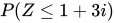
누적분포함수 P( Z ≤ 1 3 ){\displaystyle P(Z\leq 1+3i)} 그러나 ( ℜ (Z ≤ 1 , Z 3 \displaystyle P(\Re )}\leq 1,\Im {(Z)}\leq 형식 Therefore, the cumulative distribution function F Z : C n ↦ [ 0 , 1 ] {\displaystyle F_{\mathbf {Z} }:\mathbb {C} ^{n}\mapsto [0,1]} Z = ( Z 1 , . . . , Z n ) T {\displaystyle \mathbf {Z} =(Z_{1},...,Z_{n})^{ T}
F Z ( z ) = P ( ℜ ( Z 1 ) ≤ ℜ ( z 1 ) , ℑ ( Z 1 ) ≤ ℑ ( z 1 ) , … , ℜ ( Z n ) ≤ ℜ ( z n ) , ℑ ( Z n ) ≤ ℑ ( z n ) ) {\displaystyle F_{\mathbf {Z} }(\mathbf {z} )=\operatorname {P} (\Re {(Z_{1})}\leq \Re {(z_{1})},\Im {(Z_{1})}\leq \Im {(z_{1})},\ldots ,\Re {(Z_{n})}\leq \Re {(z_{n})},\Im {(Z_{n})}\leq \Im {(z_{n})})} (Eq.1 )
여기서 z z n T {\ displaystyle \mathbf {z} =(z_{1 ...,z_{n})^ { T}.
기대 실제 사례에서와 같이 복잡한 무작위 벡터 의 기대치(기대값이라고 도 함)는 구성요소별로 취해진다.[1] : p. 293
E [ Z ] = ( E [ Z 1 ] , … , E [ Z n ] ) T {\displaystyle \operatorname {E} [\mathbf {Z} ]=(\operatorname {E}),\ldots ,\operatorname {E} [Z_{n}])) ^{T}} (Eq.2 )
공분산 행렬 및 유사 공분산 행렬 공분산 행렬 제2의 중심 모멘트 라고도 함) K Z {\ displaystyle \operatorname {K} _{\mathbf {Z} \mathbf{Z}}}}}}} n × 1 {\displaystyle n\times 1} n × {\displaystyle n\times } 행렬 이며, i , {\displaystyle (i,j)} th i와 j 랜덤 변수 사이 의 th th 공분산 이다.[2] : p.372 실제 랜덤 변수의 경우와 달리, 두 변수의 공분산은 둘 중 하나의 복잡한 결합을 포함 한다. 따라서 공분산 행렬은 은둔의 행렬 이다.[1] : p. 293
K Z Z = 코브를 틀다 [ Z , Z ] = E [ ( Z − E [ Z ] ) ( Z − E [ Z ] ) H ] = E [ Z Z H ] − E [ Z ] E [ Z H ] {\displaystyle {\begin{aligned}&\operatorname {K} _{\mathbf {Z} \mathbf {Z} }=\operatorname {cov} [\mathbf {Z} ,\mathbf {Z} ]=\operatorname {E} [(\mathbf {Z} -\operatorname {E} [\mathbf {Z} ]){(\mathbf {Z} -\operatorname {E} [\mathbf {Z} ])}^{ H}]=\mathbf {Z} [\mathbf {Z} \mathbf {Z}-\operatorname {E} [\mathbf {Z} ]\mathbf {Z}\operatorname {E}[\mathbf {Z}]\[12pt]\end{liged}}}}}}}}}}}}}}}}}}}}"
(Eq.3 )
K Z Z = [ E [ ( Z 1 − E [ Z 1 ] ) ( Z 1 − E [ Z 1 ] ) ¯ ] E [ ( Z 1 − E [ Z 1 ] ) ( Z 2 − E [ Z 2 ] ) ¯ ] ⋯ E [ ( Z 1 − E [ Z 1 ] ) ( Z n − E [ Z n ] ) ¯ ] E [ ( Z 2 − E [ Z 2 ] ) ( Z 1 − E [ Z 1 ] ) ¯ ] E [ ( Z 2 − E [ Z 2 ] ) ( Z 2 − E [ Z 2 ] ) ¯ ] ⋯ E [ ( Z 2 − E [ Z 2 ] ) ( Z n − E [ Z n ] ) ¯ ] ⋮ ⋮ ⋱ ⋮ E [ ( Z n − E [ Z n ] ) ( Z 1 − E [ Z 1 ] ) ¯ ] E [ ( Z n − E [ Z n ] ) ( Z 2 − E [ Z 2 ] ) ¯ ] ⋯ E [ ( Z n − E [ Z n ] ) ( Z n − E [ Z n ] ) ¯ ] ] {\displaystyle \operatorname {K} _{\mathbf {Z} \mathbf {Z}={\begin{bmatrix}\mathrm {E} [(Z_{1}-\operatorname {E} [Z_{1}])) {\overline {(Z_{1}-\operatorname {E} [Z_{1}])}]&\mathrm {E}[(Z_{1}-\operatorname {E} [Z_{1}]) {\overline {(Z_{2}-\operatorname {E} [Z_{2}]) }}}]&\cdots &\mathrm {E} [(Z_{1}-\operatorname {E} [Z_{1}]) {\overline {(Z_{n}-\operatorname {E} [Z_{n}]) }}}]\\\\\mathrm {E} [(Z_{2}-\operatorname {E} [Z_{2}]) {\overline {(Z_{1}-\operatorname {E} [Z_{1}])}]&\mathrm {E}[(Z_{2}-\operatorname {E} [Z_{2}]) {\overline {(Z_{2}-\operatorname {E} [Z_{2}]) }}}]&\cdots &\mathrm {E} [(Z_{2}-\operatorname {E} [Z_{2}]) {\overline {(Z_{n}-\operatorname {E} [Z_{n}]) }}]\\\\\vdots &\vdots &\\ddots &\\\vdots \\\\mathrm {E}[(Z_{n}-\operatorname {E}]]) {\overline {(Z_{1}-\operatorname {E} [Z_{1}])}]&\mathrm {E}[(Z_{n}-\operatorname {E} [Z_{n}])) {\overline {(Z_{2}-\operatorname {E} [Z_{2}]) }}}]&\cdots &\mathrm {E} [(Z_{n}-\operatorname {E} [Z_{n}]) {\overline {(Z_{n}-\operatorname {E} [Z_{n}]) }}}]\end{bmatrix}} 유사 공분산 행렬 관계 행렬이라고 도 함)은 위 정의에서 전위치 에 의해 은둔자 전위치를 대체 하는 것으로 정의된다.
J Z Z = 코브를 틀다 [ Z , Z ¯ ] = E [ ( Z − E [ Z ] ) ( Z − E [ Z ] ) T ] = E [ Z Z T ] − E [ Z ] E [ Z T ] {\displaystyle \operatorname {J} _{\mathbf {Z} \mathbf {Z} }=\operatorname {cov} [\mathbf {Z} ,{\overline {\mathbf {Z} }}]=\operatorname {E} [(\mathbf {Z} -\operatorname {E} [\mathbf {Z} ]){(\mathbf {Z} -\operatorname {E} [\mathbf {Z} ])}^{ T}]=\mathbf {Z} [\mathbf {Z} \mathbf {Z} ^{T}-\operatorname {E} [\mathbf {Z} ]\mathbf {Z} ^{T}]}
(Eq.4 )
J Z Z = [ E [ ( Z 1 − E [ Z 1 ] ) ( Z 1 − E [ Z 1 ] ) ] E [ ( Z 1 − E [ Z 1 ] ) ( Z 2 − E [ Z 2 ] ) ] ⋯ E [ ( Z 1 − E [ Z 1 ] ) ( Z n − E [ Z n ] ) ] E [ ( Z 2 − E [ Z 2 ] ) ( Z 1 − E [ Z 1 ] ) ] E [ ( Z 2 − E [ Z 2 ] ) ( Z 2 − E [ Z 2 ] ) ] ⋯ E [ ( Z 2 − E [ Z 2 ] ) ( Z n − E [ Z n ] ) ] ⋮ ⋮ ⋱ ⋮ E [ ( Z n − E [ Z n ] ) ( Z 1 − E [ Z 1 ] ) ] E [ ( Z n − E [ Z n ] ) ( Z 2 − E [ Z 2 ] ) ] ⋯ E [ ( Z n − E [ Z n ] ) ( Z n − E [ Z n ] ) ] ] {\displaystyle \operatorname {J} _{\mathbf {Z} \mathbf {Z} }={\begin{bmatrix}\mathrm {E} [(Z_{1}-\operatorname {E} [Z_{1}])(Z_{1}-\operatorname {E} [Z_{1}])]&\mathrm {E} [(Z_{1}-\operatorname {E} [Z_{1}])(Z_{2}-\operatorname {E} [Z_{2}])]&\cdots &\mathrm {E} [(Z_{1}-\operatorname {E} [Z_{1}])(Z_{n}-\operatorname {E} [Z_{n}])]\ \\\\mathrm {E} [(Z_{2}-\operatorname {E} [Z_{2}])(Z_{1}-\operatorname {E} [Z_{1}])]&\mathrm {E} [(Z_{2}-\operatorname {E} [Z_{2}])(Z_{2}-\operatorname {E} [Z_{2}])]&\cdots &\mathrm {E} [(Z_{2}-\operatorname {E} [Z_{2}])(Z_{n}-\operatorname {E} [Z_{n}])]\ \\\\vdots &\vdots &\ddots &\vdots \\\\\mathrm {E} [(Z_{n}-\operatorname {E} [Z_{n}])(Z_{1}-\operatorname {E} [Z_{1}])]&\mathrm {E} [(Z_{n}-\operatorname {E} [Z_{n}])(Z_{2}-\operatorname {E} [Z_{2}])]&\cdots &\mathrm {E} [(Z_{n}-\operatorname {E} [Z_{n}])(Z_{n}-\operatorname {E} [Z_{n}])]\end{bmatrix}}} 특성. 공분산 행렬은 은둔자 행렬 , 즉 은둔자 행렬이다.[1] : p. 293
K Z H K Z Z {\ displaystyle \operatorname {K} _{\mathbf {Z}^{H operatorname {K} _{\mathbf {Z} \ mathbf {Z 사이비 공분산 행렬은 대칭 행렬 , 즉 대칭 행렬이다.
J Z Z J Z {\ displaystyle \operatorname {J} _{\mathbf {Z} \mathbf {Z}^{T}=\operatorname J} Z} \mathbf {Z}} \ }}}}}}}}}}}}}}}}}}}}}}}}}}}}}}}}}}}}}}}}}}}}}}}}}}}}}. 공분산 행렬은 양의 세미데마인 행렬 이다.
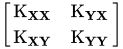
a H K Z Z a ≥ 0 for all a ∈ C n {\displaystyle \mathbf {a} ^{H}\operatorname {K} _{\mathbf {Z} \mathbf {Z} }\mathbf {a} \geq 0\quad {\text{for all }}\mathbf {a} \in \mathbb {C} ^{n}} 실제 부품과 가상 부품의 공분산 행렬 By decomposing the random vector Z {\displaystyle \mathbf {Z} } X = ℜ ( Z ) {\displaystyle \mathbf {X} =\Re {(\mathbf {Z} )}} Y = ℑ ( Z ) {\displaystyle \mathbf {Y} =\Im {(\mathbf {Z} )}} Z = X + i Y {\displaystyle \mathbf {Z} =\mathbf {X} +i\mathbf {Y} } (X Y {\displaystyle(\mathbf {X},\mathbf {Y}) 공분산 행렬 이 있다
[ K X X K Y X K X Y K Y Y ] {\displaystyle {\begin{bmatrix}\operatorname {K} _{\mathbf {X} \mathbf {X} }&\operatorname {K} _{\mathbf {Y} \mathbf {X} }\\\operatorname {K} _{\mathbf {X} \mathbf {Y} }&\operatorname {K} _{\mathbf {Y} \mathbf {Y} }\end{bmatrix}}} The matrices K Z Z {\displaystyle \operatorname {K} _{\mathbf {Z} \mathbf {Z} }} J Z Z {\displaystyle \operatorname {J} _{\mathbf {Z} \mathbf {Z} }} X {\displaystyle \mathbf {X} } Y {\displaystyle \mathbf {Y} }
K X X = E [ ( X − E [ X ] ) ( X − E [ X ] ) T ] = 1 2 레 ( K Z Z + J Z Z ) K Y Y = E [ ( Y − E [ Y ] ) ( Y − E [ Y ] ) T ] = 1 2 레 ( K Z Z − J Z Z ) K Y X = E [ ( Y − E [ Y ] ) ( X − E [ X ] ) T ] = 1 2 임 ( J Z Z + K Z Z ) K X Y = E [ ( X − E [ X ] ) ( Y − E [ Y ] ) T ] = 1 2 임 ( J Z Z − K Z Z ) {\displaystyle{\begin{정렬}&,\operatorname{K}_{\mathbf{X}\mathbf{X}}=\operatorname{E}[(\mathbf{X}-\operatorname{E}경우 \mathbf{X}])(\mathbf{X}-\operatorname{E}[\mathbf{X}])^{\mathrm{T}}]={\tfrac{1}{2}}\operatorname{리}(\operatorname{K}_{\mathbf{Z}\mathbf{Z}}+\operatorname{J}_{\mathbf{Z}\mathbf{Z}})\\&, \ope.ratornam E}]_{\mathbf{Y}\mathbf{Y}}=\operatorname{E}[(\mathbf{Y}-\operatorname{E}-LSB- \mathbf{Y}])(\mathbf{Y}-\operatorname{E}[\mathbf{Y}])^{\mathrm{T}={\tfrac{1}{2}}\operatorname{리}(\operatorname{K}_{\mathbf{Z}\mathbf{Z}}-\operatorname{J}_{\mathbf{Z}\mathbf{Z}})\\&,\operatorname{K}_{\mathbf{Y}\mathbf{X}}=\opera{K}.찢어지 Ame{E}[(\mathbf{Y}-\operatorname{E}-LSB- \mathbf{Y}])(\mathbf{X}-\operatorname{E}[\mathbf{X}])^{\mathrm{T}}]={\tfrac{1}{2}}\operatorname{나는}(\operatorname{J}_{\mathbf{Z}\mathbf{Z}}+\operatorname{K}_{\mathbf{Z}\mathbf{Z}})\\&,\operatorname{K}_{\mathbf{X}\mathbf{Y}}=\operatorname{E}는 경우(\mathbf{X}-\operatorname{E}.-LSB- \m athbf {X} ])(\mathbf {Y} -\operatorname {E} [\mathbf {Y} ])^{\mathrm {T} }]={\tfrac {1}{2}}\operatorname {Im} (\operatorname {J} _{\mathbf {Z} \mathbf {Z} }-\operatorname {K} _{\mathbf {Z} \mathbf {Z} })\\\end{aligned}}} 반대로:
K Z Z = K X X + K Y Y + i ( K Y X − K X Y ) J Z Z = K X X − K Y Y + i ( K Y X + K X Y ) {\displaystyle{\begin{정렬}&,\operatorname{K}_{\mathbf{Z}\mathbf{Z}}=\operatorname{K}_{\mathbf{X}\mathbf{X}}+\operatorname{K}_{\mathbf{Y}\mathbf{Y}}+i(\operatorname{K}_{\mathbf{Y}\mathbf{X}}-\operatorname{K}_{\mathbf{X}\mathbf{Y}})\\&,\operatorname{J}_{\mathbf{Z}\mathbf{Z}}=\operatorname{K}_{\mathbf{.X}\math bf {X} }-\operatorname {K} _{\mathbf {Y} \mathbf {Y} }+i(\operatorname {K} _{\mathbf {Y} \mathbf {X} }+\operatorname {K} _{\mathbf {X} \mathbf {Y} })\end{aligned}}} 교차 공분산 행렬 및 유사 교차 공분산 행렬 두 개의 복잡한 랜덤 벡터 W {\ displaystyle \mathbf {Z},\mathbf {W} 공분산 행렬 은 다음과 같이 정의된다
K Z W = 코브를 틀다 [ Z , W ] = E [ ( Z − E [ Z ] ) ( W − E [ W ] ) H ] = E [ Z W H ] − E [ Z ] E [ W H ] {\displaystyle \operatorname {K} _{\mathbf {Z} \mathbf {W} }=\operatorname {cov} [\mathbf {Z} ,\mathbf {W} ]=\operatorname {E} [(\mathbf {Z} -\operatorname {E} [\mathbf {Z} ]){(\mathbf {W} -\operatorname {E} [\mathbf {W} ])}^{ H}]=\mathbf {Z} [\mathbf {W} \mathbf {} ^{H}-\operatorname {E} [\mathbf {Z} ]\operatorname {E} [\mathbf {W} ^{H}]}} (Eq.5 )
K Z W = [ E [ ( Z 1 − E [ Z 1 ] ) ( W 1 − E [ W 1 ] ) ¯ ] E [ ( Z 1 − E [ Z 1 ] ) ( W 2 − E [ W 2 ] ) ¯ ] ⋯ E [ ( Z 1 − E [ Z 1 ] ) ( W n − E [ W n ] ) ¯ ] E [ ( Z 2 − E [ Z 2 ] ) ( W 1 − E [ W 1 ] ) ¯ ] E [ ( Z 2 − E [ Z 2 ] ) ( W 2 − E [ W 2 ] ) ¯ ] ⋯ E [ ( Z 2 − E [ Z 2 ] ) ( W n − E [ W n ] ) ¯ ] ⋮ ⋮ ⋱ ⋮ E [ ( Z n − E [ Z n ] ) ( W 1 − E [ W 1 ] ) ¯ ] E [ ( Z n − E [ Z n ] ) ( W 2 − E [ W 2 ] ) ¯ ] ⋯ E [ ( Z n − E [ Z n ] ) ( W n − E [ W n ] ) ¯ ] ] {\displaystyle \operatorname {K} _{\mathbf {Z} \mathbf {W}={\begin{bmatrix}\mathrm {E} [(Z_{1}-\operatorname {E} [Z_{1}])) {\overline {(W_{1}-\operatorname {E} [W_{1}])}]&\mathrm {E}[(Z_{1}-\operatorname {E} [Z_{1}]) {\overline {(W_{2}-\operatorname {E} [W_{2}]) }}}]&\cdots &\mathrm {E} [(Z_{1}-\operatorname {E} [Z_{1}]) {\overline {(W_{n}-\operatorname {E} [W_{n}]) }}}]\\\\\mathrm {E} [(Z_{2}-\operatorname {E} [Z_{2}]) {\overline {(W_{1}-\operatorname {E} [W_{1}])}]&\mathrm {E}[(Z_{2}-\operatorname {E} [Z_{2}]) {\overline {(W_{2}-\operatorname {E} [W_{2}]) }}}]&\cdots &\mathrm {E} [(Z_{2}-\operatorname {E} [Z_{2}]) {\overline {(W_{n}-\operatorname {E} [W_{n}]) }}]\\\\\vdots &\vdots &\\ddots &\\\vdots \\\\mathrm {E}[(Z_{n}-\operatorname {E}]]) {\overline {(W_{1}-\operatorname {E}[W_{1}])}]&\mathrm {E}[(Z_{n}-\operatorname {E} [Z_{n}])) {\overline {(W_{2}-\operatorname {E} [W_{2}]) }}}]&\cdots &\mathrm {E} [(Z_{n}-\operatorname {E} [Z_{n}]) {\overline {(W_{n}-\operatorname {E} [W_{n}]) }}}]\end{bmatrix}} 그리고 의사 교차 공분산 행렬 은 다음과 같이 정의된다.
J Z W = 코브를 틀다 [ Z , W ¯ ] = E [ ( Z − E [ Z ] ) ( W − E [ W ] ) T ] = E [ Z W T ] − E [ Z ] E [ W T ] {\displaystyle \operatorname {J} _{\mathbf {Z} \mathbf {W} }=\operatorname {cov} [\mathbf {Z} ,{\overline {\mathbf {W} }}]=\operatorname {E} [(\mathbf {Z} -\operatorname {E} [\mathbf {Z} ]){(\mathbf {W} -\operatorname {E} [\mathbf {W} ])}^{ T}]=\mathbf {Z} [\mathbf {W} \mathbf {W} ^{T}-\operatorname {E} [\mathbf {Z} ]\operatorname {E} [\mathbf {W} ^{T}]}} (Eq.6 )
J Z W = [ E [ ( Z 1 − E [ Z 1 ] ) ( W 1 − E [ W 1 ] ) ] E [ ( Z 1 − E [ Z 1 ] ) ( W 2 − E [ W 2 ] ) ] ⋯ E [ ( Z 1 − E [ Z 1 ] ) ( W n − E [ W n ] ) ] E [ ( Z 2 − E [ Z 2 ] ) ( W 1 − E [ W 1 ] ) ] E [ ( Z 2 − E [ Z 2 ] ) ( W 2 − E [ W 2 ] ) ] ⋯ E [ ( Z 2 − E [ Z 2 ] ) ( W n − E [ W n ] ) ] ⋮ ⋮ ⋱ ⋮ E [ ( Z n − E [ Z n ] ) ( W 1 − E [ W 1 ] ) ] E [ ( Z n − E [ Z n ] ) ( W 2 − E [ W 2 ] ) ] ⋯ E [ ( Z n − E [ Z n ] ) ( W n − E [ W n ] ) ] ] {\displaystyle \operatorname {J} _{\mathbf {Z} \mathbf {W} }={\begin{bmatrix}\mathrm {E} [(Z_{1}-\operatorname {E} [Z_{1}])(W_{1}-\operatorname {E} [W_{1}])]&\mathrm {E} [(Z_{1}-\operatorname {E} [Z_{1}])(W_{2}-\operatorname {E} [W_{2}])]&\cdots &\mathrm {E} [(Z_{1}-\operatorname {E} [Z_{1}])(W_{n}-\operatorname {E} [W_{n}])]\ \\\\mathrm {E} [(Z_{2}-\operatorname {E} [Z_{2}])(W_{1}-\operatorname {E} [W_{1}])]&\mathrm {E} [(Z_{2}-\operatorname {E} [Z_{2}])(W_{2}-\operatorname {E} [W_{2}])]&\cdots &\mathrm {E} [(Z_{2}-\operatorname {E} [Z_{2}])(W_{n}-\operatorname {E} [W_{n}])]\ \\\\vdots &\vdots &\ddots &\vdots \\\\\mathrm {E} [(Z_{n}-\operatorname {E} [Z_{n}])(W_{1}-\operatorname {E} [W_{1}])]&\mathrm {E} [(Z_{n}-\operatorname {E} [Z_{n}])(W_{2}-\operatorname {E} [W_{2}])]&\cdots &\mathrm {E} [(Z_{n}-\operatorname {E} [Z_{n}])(W_{n}-\operatorname {E} [W_{n}])]\end{bmatrix}}} 두 Z {\ displaystyle \mathbf {Z} {\ displaystyle \mathbf {W}은( 관계 가 없는 것으로 호출된다
K Z J Z W 0 {\displaystyle \operatorname {K} _{\mathbf {W} }=\mathbf J} _{\mathbf {Z} \mathbf W} 0 독립 두 1 Z m T {\ displaystyle \mathbf {Z} (Z_{1 ..., Z_{m})^{{}{{}}}{{}}}}{\\ T} W W 1 W n T {\ displaystyle \mathbf {W} (W_{1},..., W_{n}^{ T}} 독립 이라고 한다.
F Z , W ( z , w ) = F Z ( z ) ⋅ F W ( w ) 대체적으로 z , w {\displaystyle F_{\mathbf {Z,W} }(\mathbf {z,w} )=F_{\mathbf {Z} }(\mathbf {z} )\cdot F_{\mathbf {W} }(\mathbf {w} )\quad {\text{for all }}\mathbf {z} ,\mathbf {w} } (Eq.7 )
where F Z ( z ) {\displaystyle F_{\mathbf {Z} }(\mathbf {z} )} F W ( w ) {\displaystyle F_{\mathbf {W} }(\mathbf {w} )} Z {\displaystyle \mathbf {Z} } W {\displaystyle \mathbf {W} } Eq.1 F Z , W ( z , w ) {\dis Playstyle F_{\mathbf {Z,W} }}(\mathbf {z,w} ) Z {\ displaystyle \mathbf {Z} W {\ displaystyle \mathbf {W} often W {\ displaystyle \mathbf Z} \perp \! \!\perp \mathbf {W 작성 {\ displaystyle \mathbf {Z} W {\ displaystyle \mathbf {W} (
F Z 1 , … , Z m , W 1 , … , W n ( z 1 , … , z m , w 1 , … , w n ) = F Z 1 , … , Z m ( z 1 , … , z m ) ⋅ F W 1 , … , W n ( w 1 , … , w n ) for all z 1 , … , z m , w 1 , … , w n {\displaystyle F_{Z_{1},\ldots ,Z_{m}, W_{1},\ldots,W_{n}}(z_{1},\ldots,z_{m},w_{1},\ldots,w_{n}) =F_{Z_{1},\ldots ,Z_{m}}(z_{1},\ldots ,z_{m})\cdot F_{W_{1},\ldots ,W_{n}}(w_{1},\ldots ,w_{n})\quad {\text{for all }}z_{1},\ldots ,z_{m},w_{1},\ldots ,w_{n}} 원형대칭 A complex random vector Z {\displaystyle \mathbf {Z} } φ ∈ [ − π , π ) {\displaystyle \varphi \in [-\pi ,\pi )} e i φ Z {\displaystyle e^{\mathrm {i} \varphi }\mathbf {Z} } Z {\displaystyle \mathbf {Z} } [3] : pp. 500–501
특성. 원형 대칭 복합 랜덤 벡터의 기대치는 0이거나 정의되지 않는다.[3] : p. 500 원형 대칭 복합 랜덤 벡터의 유사 공분산 행렬은 0이다.[3] : p. 584 적절한 복합 랜덤 벡터 다음과 같은 세 가지 조건이 모두 충족되면 복합 랜덤 벡터 {\ displaystyle \mathbf {Z} 적절하게 호출된다[1] : p. 293
E Z ] {\displaystyle \operatorname {E} [\mathbf {Z} ]=0}( var Z ] ∞ var [ Z ] ∞ {\displaystyle \operatorname {var} [Z_{1}]<\ldots ,\operatorname {var}[Z_{n}]<\fulty }( E [ Z Z T ] = 0 {\displaystyle \operatorname {E} [\mathbf {Z} \mathbf {Z} ^{T}]=0} Two complex random vectors Z , W {\displaystyle \mathbf {Z} ,\mathbf {W} } jointly proper is the composite random vector ( Z 1 , Z 2 , … , Z m , W 1 , W 2 , … , W n ) T {\displaystyle (Z_{1},Z_{2},\ldots ,Z_{m}, W_{1},W_{2},\ldots,W_{n}^{{ n} T}}
특성. A complex random vector Z {\displaystyle \mathbf {Z} } c ∈ C n {\displaystyle \mathbf {c} \in \mathbb {C} ^{n}} c T Z {\displaystyle \mathbf {c} ^{T}\mathbf {Z} } [1] : p. 293 적절한 복합 랜덤 벡터의 선형 변환이 적절함. 즉, Z {\ displaystyle \mathbf {Z}} n {\displaystyle n} A {\displaystystyle } 가 결정론적 × n {\displaystypertor A {\ matescompatescompatescompeter hbf {Z} } [1] : p. 295 모든 성분의 분산이 유한한 모든 원형 대칭 복합 랜덤 벡터는 적절하다.[1] : p. 295 원형 대칭이 아닌 적절한 복잡한 무작위 벡터가 있다.[1] : p. 504 진짜 무작위 벡터는 일정한 경우에만 적절하다. 공변량 행렬이 0 Z W {\displaystyle \operatorname {K} _{\mathbf {Z} \mathbf W} }=0} . 카우치-슈바르츠 불평등 복잡한 무작위 벡터에 대한 Cauchy-Schwarz 불평등은
E [ Z H W ] 2 ≤ E [ Z H Z ] E [ W H W ] {\displaystyle \left \operatorname {E} [\mathbf {Z} ^{H}\mathbf {W} ]\right ^{2}\leq \operatorname {E} [\mathbf {Z} ^{H}\mathbf {Z} ]\operatorname {E} [ \mathbf {W} ^{H}\mathbf {W} ]} 특성함수 n {\displaystyle n} 벡터 {\ displaystyle \mathbf {Z} 특성 함수 는 다음과 같이 정의된Cn C {\ displaystyle \mathb {C} ^{n}\to \mathb {C} [1] : p. 295
φ Z ( ω ) = E [ e i ℜ ( ω H Z ) ] = E [ e i ( ℜ ( ω 1 ) ℜ ( Z 1 ) + ℑ ( ω 1 ) ℑ ( Z 1 ) + ⋯ + ℜ ( ω n ) ℜ ( Z n ) + ℑ ( ω n ) ℑ ( Z n ) ) ] {\displaystyle \varphi _{\mathbf {Z} }(\mathbf {\omega } )=\operatorname {E} \left[e^{i\Re {(\mathbf {\omega } ^{H}\mathbf {Z} )}}\right]=\operatorname {E} \left[e^{i(\Re {(\omega _{1})}\Re {(Z_{1})}+\Im {(\omega _{1})}\Im {(Z_{1})}+\cdots +\Re {(\omega _{n})}\Re {(Z_{n})}+\Im {(\omega _{n})} \Im {(Z_{n}}}}}\right]} 참고 항목 참조 ^ a b c d e f g h i j Lapidoth, Amos (2009). A Foundation in Digital Communication . Cambridge University Press. ISBN 978-0-521-19395-5 ^ Gubner, John A. (2006). Probability and Random Processes for Electrical and Computer Engineers . Cambridge University Press. ISBN 978-0-521-86470-1 ^ a b c Tse, David (2005). Fundamentals of Wireless Communication . Cambridge University Press. 

 복합 랜덤 벡터다. 복잡한 랜덤 변수는 항상 실제 랜덤 벡터의 쌍, 즉 실제와 가상의 부분으로 간주될 수 있다.







![{\displaystyle F_{\mathbf {Z} }:\mathbb {C} ^{n}\mapsto [0,1]}](https://wikimedia.org/api/rest_v1/media/math/render/svg/8661e6d29a4d779324e5c3978506838f8c244b65)



![{\displaystyle \operatorname {E} [\mathbf {Z} ]=(\operatorname {E} [Z_{1}],\ldots ,\operatorname {E} [Z_{n}])^{T}}](https://wikimedia.org/api/rest_v1/media/math/render/svg/9bad8687a134b34189596765316018f79fdca495)


![{\displaystyle {\begin{aligned}&\operatorname {K} _{\mathbf {Z} \mathbf {Z} }=\operatorname {cov} [\mathbf {Z} ,\mathbf {Z} ]=\operatorname {E} [(\mathbf {Z} -\operatorname {E} [\mathbf {Z} ]){(\mathbf {Z} -\operatorname {E} [\mathbf {Z} ])}^{H}]=\operatorname {E} [\mathbf {Z} \mathbf {Z} ^{H}]-\operatorname {E} [\mathbf {Z} ]\operatorname {E} [\mathbf {Z} ^{H}]\\[12pt]\end{aligned}}}](https://wikimedia.org/api/rest_v1/media/math/render/svg/ebd5472da7a2129480754c26bf1527c36e0e1aef)
![{\displaystyle \operatorname {K} _{\mathbf {Z} \mathbf {Z} }={\begin{bmatrix}\mathrm {E} [(Z_{1}-\operatorname {E} [Z_{1}]){\overline {(Z_{1}-\operatorname {E} [Z_{1}])}}]&\mathrm {E} [(Z_{1}-\operatorname {E} [Z_{1}]){\overline {(Z_{2}-\operatorname {E} [Z_{2}])}}]&\cdots &\mathrm {E} [(Z_{1}-\operatorname {E} [Z_{1}]){\overline {(Z_{n}-\operatorname {E} [Z_{n}])}}]\\\\\mathrm {E} [(Z_{2}-\operatorname {E} [Z_{2}]){\overline {(Z_{1}-\operatorname {E} [Z_{1}])}}]&\mathrm {E} [(Z_{2}-\operatorname {E} [Z_{2}]){\overline {(Z_{2}-\operatorname {E} [Z_{2}])}}]&\cdots &\mathrm {E} [(Z_{2}-\operatorname {E} [Z_{2}]){\overline {(Z_{n}-\operatorname {E} [Z_{n}])}}]\\\\\vdots &\vdots &\ddots &\vdots \\\\\mathrm {E} [(Z_{n}-\operatorname {E} [Z_{n}]){\overline {(Z_{1}-\operatorname {E} [Z_{1}])}}]&\mathrm {E} [(Z_{n}-\operatorname {E} [Z_{n}]){\overline {(Z_{2}-\operatorname {E} [Z_{2}])}}]&\cdots &\mathrm {E} [(Z_{n}-\operatorname {E} [Z_{n}]){\overline {(Z_{n}-\operatorname {E} [Z_{n}])}}]\end{bmatrix}}}](https://wikimedia.org/api/rest_v1/media/math/render/svg/445eafa0ab8d1d761c1c34d3bb993b4598ec4b15)
![{\displaystyle \operatorname {J} _{\mathbf {Z} \mathbf {Z} }=\operatorname {cov} [\mathbf {Z} ,{\overline {\mathbf {Z} }}]=\operatorname {E} [(\mathbf {Z} -\operatorname {E} [\mathbf {Z} ]){(\mathbf {Z} -\operatorname {E} [\mathbf {Z} ])}^{T}]=\operatorname {E} [\mathbf {Z} \mathbf {Z} ^{T}]-\operatorname {E} [\mathbf {Z} ]\operatorname {E} [\mathbf {Z} ^{T}]}](https://wikimedia.org/api/rest_v1/media/math/render/svg/073e290548d019170600567c2a29b7feaaf98a51)
![{\displaystyle \operatorname {J} _{\mathbf {Z} \mathbf {Z} }={\begin{bmatrix}\mathrm {E} [(Z_{1}-\operatorname {E} [Z_{1}])(Z_{1}-\operatorname {E} [Z_{1}])]&\mathrm {E} [(Z_{1}-\operatorname {E} [Z_{1}])(Z_{2}-\operatorname {E} [Z_{2}])]&\cdots &\mathrm {E} [(Z_{1}-\operatorname {E} [Z_{1}])(Z_{n}-\operatorname {E} [Z_{n}])]\\\\\mathrm {E} [(Z_{2}-\operatorname {E} [Z_{2}])(Z_{1}-\operatorname {E} [Z_{1}])]&\mathrm {E} [(Z_{2}-\operatorname {E} [Z_{2}])(Z_{2}-\operatorname {E} [Z_{2}])]&\cdots &\mathrm {E} [(Z_{2}-\operatorname {E} [Z_{2}])(Z_{n}-\operatorname {E} [Z_{n}])]\\\\\vdots &\vdots &\ddots &\vdots \\\\\mathrm {E} [(Z_{n}-\operatorname {E} [Z_{n}])(Z_{1}-\operatorname {E} [Z_{1}])]&\mathrm {E} [(Z_{n}-\operatorname {E} [Z_{n}])(Z_{2}-\operatorname {E} [Z_{2}])]&\cdots &\mathrm {E} [(Z_{n}-\operatorname {E} [Z_{n}])(Z_{n}-\operatorname {E} [Z_{n}])]\end{bmatrix}}}](https://wikimedia.org/api/rest_v1/media/math/render/svg/50248ec68758163e693b5fa474537f0d953110ee)







![{\displaystyle {\begin{aligned}&\operatorname {K} _{\mathbf {X} \mathbf {X} }=\operatorname {E} [(\mathbf {X} -\operatorname {E} [\mathbf {X} ])(\mathbf {X} -\operatorname {E} [\mathbf {X} ])^{\mathrm {T} }]={\tfrac {1}{2}}\operatorname {Re} (\operatorname {K} _{\mathbf {Z} \mathbf {Z} }+\operatorname {J} _{\mathbf {Z} \mathbf {Z} })\\&\operatorname {K} _{\mathbf {Y} \mathbf {Y} }=\operatorname {E} [(\mathbf {Y} -\operatorname {E} [\mathbf {Y} ])(\mathbf {Y} -\operatorname {E} [\mathbf {Y} ])^{\mathrm {T} }]={\tfrac {1}{2}}\operatorname {Re} (\operatorname {K} _{\mathbf {Z} \mathbf {Z} }-\operatorname {J} _{\mathbf {Z} \mathbf {Z} })\\&\operatorname {K} _{\mathbf {Y} \mathbf {X} }=\operatorname {E} [(\mathbf {Y} -\operatorname {E} [\mathbf {Y} ])(\mathbf {X} -\operatorname {E} [\mathbf {X} ])^{\mathrm {T} }]={\tfrac {1}{2}}\operatorname {Im} (\operatorname {J} _{\mathbf {Z} \mathbf {Z} }+\operatorname {K} _{\mathbf {Z} \mathbf {Z} })\\&\operatorname {K} _{\mathbf {X} \mathbf {Y} }=\operatorname {E} [(\mathbf {X} -\operatorname {E} [\mathbf {X} ])(\mathbf {Y} -\operatorname {E} [\mathbf {Y} ])^{\mathrm {T} }]={\tfrac {1}{2}}\operatorname {Im} (\operatorname {J} _{\mathbf {Z} \mathbf {Z} }-\operatorname {K} _{\mathbf {Z} \mathbf {Z} })\\\end{aligned}}}](https://wikimedia.org/api/rest_v1/media/math/render/svg/02b2d81c9eb40be718176122b197e7384c6ca81c)


![{\displaystyle \operatorname {K} _{\mathbf {Z} \mathbf {W} }=\operatorname {cov} [\mathbf {Z} ,\mathbf {W} ]=\operatorname {E} [(\mathbf {Z} -\operatorname {E} [\mathbf {Z} ]){(\mathbf {W} -\operatorname {E} [\mathbf {W} ])}^{H}]=\operatorname {E} [\mathbf {Z} \mathbf {W} ^{H}]-\operatorname {E} [\mathbf {Z} ]\operatorname {E} [\mathbf {W} ^{H}]}](https://wikimedia.org/api/rest_v1/media/math/render/svg/9844313bcca0b6e7e67e2c61bae3559a8714b4e4)
![{\displaystyle \operatorname {K} _{\mathbf {Z} \mathbf {W} }={\begin{bmatrix}\mathrm {E} [(Z_{1}-\operatorname {E} [Z_{1}]){\overline {(W_{1}-\operatorname {E} [W_{1}])}}]&\mathrm {E} [(Z_{1}-\operatorname {E} [Z_{1}]){\overline {(W_{2}-\operatorname {E} [W_{2}])}}]&\cdots &\mathrm {E} [(Z_{1}-\operatorname {E} [Z_{1}]){\overline {(W_{n}-\operatorname {E} [W_{n}])}}]\\\\\mathrm {E} [(Z_{2}-\operatorname {E} [Z_{2}]){\overline {(W_{1}-\operatorname {E} [W_{1}])}}]&\mathrm {E} [(Z_{2}-\operatorname {E} [Z_{2}]){\overline {(W_{2}-\operatorname {E} [W_{2}])}}]&\cdots &\mathrm {E} [(Z_{2}-\operatorname {E} [Z_{2}]){\overline {(W_{n}-\operatorname {E} [W_{n}])}}]\\\\\vdots &\vdots &\ddots &\vdots \\\\\mathrm {E} [(Z_{n}-\operatorname {E} [Z_{n}]){\overline {(W_{1}-\operatorname {E} [W_{1}])}}]&\mathrm {E} [(Z_{n}-\operatorname {E} [Z_{n}]){\overline {(W_{2}-\operatorname {E} [W_{2}])}}]&\cdots &\mathrm {E} [(Z_{n}-\operatorname {E} [Z_{n}]){\overline {(W_{n}-\operatorname {E} [W_{n}])}}]\end{bmatrix}}}](https://wikimedia.org/api/rest_v1/media/math/render/svg/9941690a38b08ff9f3b9be4bd1de0bb2fb9a67b5)
![{\displaystyle \operatorname {J} _{\mathbf {Z} \mathbf {W} }=\operatorname {cov} [\mathbf {Z} ,{\overline {\mathbf {W} }}]=\operatorname {E} [(\mathbf {Z} -\operatorname {E} [\mathbf {Z} ]){(\mathbf {W} -\operatorname {E} [\mathbf {W} ])}^{T}]=\operatorname {E} [\mathbf {Z} \mathbf {W} ^{T}]-\operatorname {E} [\mathbf {Z} ]\operatorname {E} [\mathbf {W} ^{T}]}](https://wikimedia.org/api/rest_v1/media/math/render/svg/3e6a151a8db17da379cb32babce0e737bca9a8b9)
![{\displaystyle \operatorname {J} _{\mathbf {Z} \mathbf {W} }={\begin{bmatrix}\mathrm {E} [(Z_{1}-\operatorname {E} [Z_{1}])(W_{1}-\operatorname {E} [W_{1}])]&\mathrm {E} [(Z_{1}-\operatorname {E} [Z_{1}])(W_{2}-\operatorname {E} [W_{2}])]&\cdots &\mathrm {E} [(Z_{1}-\operatorname {E} [Z_{1}])(W_{n}-\operatorname {E} [W_{n}])]\\\\\mathrm {E} [(Z_{2}-\operatorname {E} [Z_{2}])(W_{1}-\operatorname {E} [W_{1}])]&\mathrm {E} [(Z_{2}-\operatorname {E} [Z_{2}])(W_{2}-\operatorname {E} [W_{2}])]&\cdots &\mathrm {E} [(Z_{2}-\operatorname {E} [Z_{2}])(W_{n}-\operatorname {E} [W_{n}])]\\\\\vdots &\vdots &\ddots &\vdots \\\\\mathrm {E} [(Z_{n}-\operatorname {E} [Z_{n}])(W_{1}-\operatorname {E} [W_{1}])]&\mathrm {E} [(Z_{n}-\operatorname {E} [Z_{n}])(W_{2}-\operatorname {E} [W_{2}])]&\cdots &\mathrm {E} [(Z_{n}-\operatorname {E} [Z_{n}])(W_{n}-\operatorname {E} [W_{n}])]\end{bmatrix}}}](https://wikimedia.org/api/rest_v1/media/math/render/svg/240fc2c9717f84911d95a271d7ca87595b185cc5)



 (를) 독립이라고 한다.





![{\displaystyle \operatorname {E} [\mathbf {Z} ]=0}](https://wikimedia.org/api/rest_v1/media/math/render/svg/d136e6dc4d72ba213940846421b1f8c00160bc8d)
![{\displaystyle \operatorname {var} [Z_{1}]<\infty ,\ldots ,\operatorname {var} [Z_{n}]<\infty }](https://wikimedia.org/api/rest_v1/media/math/render/svg/ca262a1fa11c0e897e89da432119076df0575dc4)
![{\displaystyle \operatorname {E} [\mathbf {Z} \mathbf {Z} ^{T}]=0}](https://wikimedia.org/api/rest_v1/media/math/render/svg/e567ff4fa3785973cc8d53106ec6a0e075d969e9)



![{\displaystyle \left|\operatorname {E} [\mathbf {Z} ^{H}\mathbf {W} ]\right|^{2}\leq \operatorname {E} [\mathbf {Z} ^{H}\mathbf {Z} ]\operatorname {E} [|\mathbf {W} ^{H}\mathbf {W} |]}](https://wikimedia.org/api/rest_v1/media/math/render/svg/e6675b4efe08db65ef119042110564db71520472)

![{\displaystyle \varphi _{\mathbf {Z} }(\mathbf {\omega } )=\operatorname {E} \left[e^{i\Re {(\mathbf {\omega } ^{H}\mathbf {Z} )}}\right]=\operatorname {E} \left[e^{i(\Re {(\omega _{1})}\Re {(Z_{1})}+\Im {(\omega _{1})}\Im {(Z_{1})}+\cdots +\Re {(\omega _{n})}\Re {(Z_{n})}+\Im {(\omega _{n})}\Im {(Z_{n})})}\right]}](https://wikimedia.org/api/rest_v1/media/math/render/svg/55ef4b68890cb6b51eea0081d9a757a4c9f88849)