행렬에 대한 기호 함수의 일반화
수학 에서 행렬 부호 함수 는 복합 부호 함수 와 유사한 제곱 행렬 의 행렬 함수 다.[1]
1971년 케임브리지 대학 의 기술보고서에 소개되었으며, 이후 1980년 학술지에 발표되었다.[2] [3]
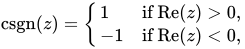
정의 행렬 부호 함수는 복합 부호 함수 의 일반화다.
csgn ( z ) = { 1 만일 R e ( z ) > 0 , − 1 만일 R e ( z ) < 0 , {\displaystyle \operatorname {csgn}(z)={\begin{case}1&{\text{}}\mathrm {Re}(z)0,\-1&{\text{}}}}}}}}
매트릭스 평가 아날로그 csgn A ) {\displaystyle \operatorname {csgn} (A 함수 는 분석적 이지 않지만, 가상 축 에 고유값 이 없는 모든 행렬에 대해 잘 정의되어 있다(예: Jordan-form-based 정의(파생물이 모두 0인 경우).
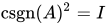
특성. 정리: A ∈ n n {\ displaystyle A\in \mathb {C} ^{n\times }, csgn A ) 2 displaystyle \operatorname {csgn}^{2}=I [1]
정리: A ∈ C n {\ displaystyle A\in \mathb {C} ^{n\times }, csgn A ) displaysty \operatorname {csgn} A)} 대각선 으로 가능하며 고유값 {\displaysty \pm1} . [1]
정리: Let A ∈ C n × n {\displaystyle A\in \mathbb {C} ^{n\times n}} ( I + csgn ( A ) ) / 2 {\displaystyle (I+\operatorname {csgn} (A))/2} projector onto the invariant subspace associated with the eigenvalues in the right-half plane , and analogously for ( I − csgn ( A ) ) / 2 {\displaystyle (I-\operatorname {csgn}(A)/2} 절반 .[1]
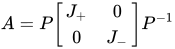
정리: A ∈ C n {\ displaystyle A\in \mathb {C} ^{n\times n A P J 0 J P 1 {\ displaystyle A=P{\begin{bmatrix} J_{+}&0\\0& J_{-}\end{bmatrix}{bmatrix P^{-1} {\ displaystyle J_{+} displaysty J_{-} 요르단 분해물 이다그러면 csgn A I 0 I ]P 1 {\ displaystyle \operatorname {csgn} (A)= P{\begin{bmatrix} I_{+}&0\\0&-I_{-}\end{bmatrix}}P^{-1}} I + {\displaystyle I_{+}} I − {\displaystyle I_{-}} identity matrices of sizes corresponding to J + {\displaystyle J_{+}} J − {\displaystyle J_{-}} [1]
계산 방법 함수는 매트릭스 함수 에 대한 일반적인 방법으로 계산할 수 있지만, 전문화된 방법도 있다.
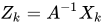
뉴턴 반복 뉴턴 반복 은 csgn ( x x 2 {\displaystyle \operatorname {csgn}(x)={\sqrt{x^{2}}/x csgn (( A A 1 {\ displaystylease \operatorname coratorname A) . A^{-1}{\sqrt{A^{2}}: 매트릭스 제곱근 을 사용하는 곳. If we apply the Babylonian method to compute the square root of the matrix A 2 {\displaystyle A^{2}} X k + 1 = 1 2 ( X k + A X k − 1 ) {\textstyle X_{k+1}={\frac {1}{2}}\left(X_{k}+AX_{k}^{-1}\right)} Z k = A − 1 X k {\displaystyle Z_{k} =A^{-1}X_{k
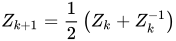
Z k 1 2 k Z k 1 {\ displaystyle Z_{k+1}={\frac {1}{ 2}}\좌측(Z_{k}+Z_{k}^{-1}\오른쪽
여기서 일반적으로 Z 0 A {\displaystyle Z_{0}=A [1] [2]
뉴턴 반복은 반복체 Z k {\ displaystyle Z_{k}} .
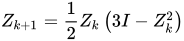
뉴턴-슐츠 반복 To avoid the need of an explicit inverse used in the Newton iteration, the inverse can be approximated with one step of the Newton iteration for the inverse , Z k − 1 ≈ Z k ( 2 I − Z k 2 ) {\displaystyle Z_{k}^{-1}\approx Z_{k}\left(2I-Z_{k}^{2}\right)} Schulz (de ) in 1933.[4] 이 근사치를 이전 방법으로 대체하면, 새로운 방법은
Z k 1 Z k 3 I k 2 {\ displaystyle Z_{k+1}={\frac {1}{1}{ Z_{k}\왼쪽(3I-Z_{k}^{2}\오른쪽)}
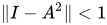
수렴은 (여전히) 이차적이지만, 국부적( I A 2 < 1 displaystyle I-A^{2}\ [1]
적용들 실베스터 방정식의 해법 정리:[2] [3] Let A , B , C ∈ R n × n {\displaystyle A,B,C\in \mathbb {R} ^{n\times n}} A {\displaystyle A} B {\displaystyle B} stable , then the unique solution to the Sylvester equation , A X + X B = C {\displaystyle AX+XB=C} X {\displaystyle X}
[ − I 2 X 0 I ] = csgn ( [ A − C 0 − B ] ) . {\displaystyle {\begin{bmatrix}-I&2X\\0> I\end{bmatrix}=\operatorname {csgn}\좌측({\begin{bmatrix}A&-C\\0&-B\end{bmatrix}}오른쪽). }
교정 스케치: 결과는 유사성 변환에서 나온다.
[ A − C 0 − B ] = [ I X 0 I ] [ A 0 0 − B ] [ I X 0 I ] − 1 , {\displaystyle {\begin{bmatrix}A&-C\0&-B\end{bmatrix}={\begin{bmatrix} I&X\\0&I\end{bmatrix}{\begin{bmatrix} A&0\\0&-B\end{bmatrix}{\begin{bmatrix} I&X\\0&I\end{bmatrix}^{-1}
그 이후
csgn ( [ A − C 0 − B ] ) = [ I X 0 I ] [ I 0 0 − I ] [ I − X 0 I ] , {\displaystyle \operatorname {csgn} \left({\begin{bmatrix}A&-C\\0&-B\end{bmatrix}\right)={\begin{bmatrix} I&X\\0&I\end{bmatrix}{\begin{bmatrix} I&0\\0&I\end{bmatrix}{\begin{bmatrix} I&-X\\0& I\end{bmatrix},}
A {\displaystyle A} B {\displaystyle B} .
그 정리는 자연스레 랴푸노프 방정식에도 적용할 수 있다. 그러나 {\displaystyle A} A T {\ displaystyle ^{T} .
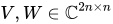
대수 리카티 방정식의 해법 There is a similar result applicable to the algebraic Riccati equation , A H P + P A − P F P + Q = 0 {\displaystyle A^{H}P+PA-PFP+Q=0} [1] [2] V , W ∈ C 2 n × n {\displaystyle V,W\in \mathbb {C} ^{2n\times n}}
[ V W ] = csgn ( [ A H Q F − A ] ) − [ I 0 0 I ] . {\displaystyle {\begin{bmatrix}V& W\end{bmatrix}=\operatorname {csgn}\좌측({\begin{bmatrix}A^{ H}&Q\\F&-A\end{bmatrix}\right)-{\begin{bmatrix} I&0\\0&I\end{bmatrix}. }
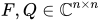
F Q ∈ C × {\ displaystyle F,Q\in \mathb {C} ^{n\timesn n }}} 에르미트인 이며 , A-FP} 과 의 결정적이지만 일관성 이 있다.
V P = − W . {\displaystyle VP=-W.}
교정 스케치: 유사성 변환
[ A H Q F − A ] = [ P − I I 0 ] [ ( − A − F P ) − F 0 ( A − F P ) ] [ P − I I 0 ] − 1 , {\displaystyle {\begin{bmatrix}A^{ H}&Q\\F&-A\end{bmatrix}={\begin{bmatrix}P&-I\\ I&0\end{bmatrix}{\begin{bmatrix}(-A-FP)&-F\\0&(A-FP)\end{bmatrix}{begin{bmatrix}P&-I\\\\\\ I&0\end{bmatrix}^{-1}
A F P {\displaystyle A-FP}
( csgn ( [ A H Q F − A ] ) − [ I 0 0 I ] ) [ X − I I 0 ] = [ X − I I 0 ] [ 0 Y 0 − 2 I ] , {\displaystyle \left(\operatorname {csgn}) \left({\begin{bmatrix}A^{ H}&Q\\F&-A\end{bmatrix}\right)-{\begin{bmatrix} I&0\\0&I\end{bmatrix}\right){\begin{bmatrix}X&-I\\ I&0\end{bmatrix}={\begin{bmatrix}X&-I\\ I&0\end{bmatrix}{\begin{bmatrix}0&& Y\\\0&-2I\end{bmatrix},}
일부 행렬 Y matrix n n displaystyle Y\in \mathb {C} n\time }} .
행렬 제곱근 계산 매트릭스의 제곱근에 대한 Denman-Bevers 반복 P P 0 [\displaystyle =0} 대수 리카티 [3] 솔루션 {\displaystyle P} A {\style A
참조 ^ a b c d e f g h Higham, Nicholas J. (2008). Functions of matrices : theory and computation ISBN 978-0-89871-777-8 OCLC 693957820 .^ a b c d Roberts, J. D. "Linear model reduction and solution of the algebraic Riccati equation by use of the sign function" . International Journal of Control . 32 (4): 677–687. doi :10.1080/00207178008922881 . ISSN 0020-7179 . ^ a b c Denman, Eugene D.; Beavers, Alex N. (1976). "The matrix sign function and computations in systems" . Applied Mathematics and Computation . 2 (1): 63–94. doi :10.1016/0096-3003(76)90020-5 . ISSN 0096-3003 . ^ Schulz, Günther (1933). "Iterative Berechung der reziproken Matrix" . ZAMM - Journal of Applied Mathematics and Mechanics / Zeitschrift für Angewandte Mathematik und Mechanik . 13 (1): 57–59. doi :10.1002/zamm.19330130111 . ISSN 1521-4001 . 




 평면
평면
 음의 실체를 가진 고유값에 해당하도록
  .그러면
.그러면 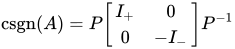


















 고유한 안정화 솔루션이 존재한다는 가정
 안정화되며, 그 솔루션은



 (가) 퇴행
  (가)
(가)