2차 그래프
Biregular graph| 자동화에 의해 정의된 그래프 패밀리 | ||||
|---|---|---|---|---|
| 거리 변환의 | → | 거리 규칙의 | ← | 매우 규칙적인. |
| ↓ | ||||
| 대칭(대칭 변환) | ← | t-변환, t ≥ 2 | 꼬불꼬불한 | |
| ↓ | ||||
| (연결된 경우) 정점 및 에지 변환 | → | 가장자리-변환적이고 규칙적인 | → | 가장자리-변환성 |
| ↓ | ↓ | ↓ | ||
| 정점 변환의 | → | 정칙의 | → | (양립할 경우) 복엽의 |
| ↑ | ||||
| 케이리 그래프 | ← | 무궤도적 | 비대칭의 | |
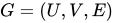
그래프 이론 수학에서, 2차 그래프나[1] 반차형 2차 그래프는[2] 주어진 2차분율의 같은 면에 있는 각각의 정점 2개가 서로 같은 정도를 갖는 2차분율 그래프 =(, , G이다. 의 정점의 정도가 이고 의 정점의 정도가 y y인 경우 그래프는( , ) ( -biregular라고 한다.


 정점의 정도가 y


Rhombic dodecheadron의 그래프는 2각형이다.
예
모든 완전한 초당적 그래프 , b 는( - biregular이다.[3]Rhombic 도데카헤드론은 또 다른 예다; 그것은 (3,4)-광선이다.[4]


정점 카운트
An -biregular graph must satisfy the equation . This follows from a simple double counting argument: the number of endpoints of edges in is V 에서 에지의 끝점 수는 V yV이고 각 에지는 두 숫자에 동일한 양(1개)을 기여한다.


대칭
모든 정기적인 초당적 그래프는 또한 2차원적이다.정점이 아닌 모든 에지 변환 그래프(정점이 분리된 그래프를 사용할 수 없음)는 이선형이어야 한다.[3]특히 모든 에지 변환 그래프는 정규 또는 이선형이다.
구성
기하학적 구성의 Levi 그래프는 2각형이며, 2각형 그래프는 둘레가 최소 6인 경우에만 (추상) 구성의 Levi 그래프다.[5]
참조
- ^ Scheinerman, Edward R.; Ullman, Daniel H. (1997), Fractional graph theory, Wiley-Interscience Series in Discrete Mathematics and Optimization, New York: John Wiley & Sons Inc., p. 137, ISBN 0-471-17864-0, MR 1481157.
- ^ Dehmer, Matthias; Emmert-Streib, Frank (2009), Analysis of Complex Networks: From Biology to Linguistics, John Wiley & Sons, p. 149, ISBN 9783527627998.
- ^ a b Lauri, Josef; Scapellato, Raffaele (2003), Topics in Graph Automorphisms and Reconstruction, London Mathematical Society Student Texts, Cambridge University Press, pp. 20–21, ISBN 9780521529037.
- ^ Réti, Tamás (2012), "On the relationships between the first and second Zagreb indices" (PDF), MATCH Commun. Math. Comput. Chem., 68: 169–188, archived from the original (PDF) on 2017-08-29, retrieved 2012-09-02.
- ^ Gropp, Harald (2007), "VI.7 Configurations", in Colbourn, Charles J.; Dinitz, Jeffrey H. (eds.), Handbook of combinatorial designs, Discrete Mathematics and its Applications (Boca Raton) (Second ed.), Chapman & Hall/CRC, Boca Raton, Florida, pp. 353–355.