
입체복합체
Cubical complex수학에서 입체복합체(입방체 집합체, 카르테시안 콤플렉스라고도[1] 함)는 점, 선분절, 정사각형, 정사각형, 정사각형, 그리고 그 n차원 상극으로 구성된 집합체다.그것들은 위상학적 공간의 동질성 계산에서 단순화 콤플렉스 및 CW 콤플렉스와 유사하게 사용된다.

정의들
기본 간격은 양식의 하위 집합 이다.

![{\displaystyle I=[l,l+1]\quad {\text{or}}\quad I=[l,l]}](https://wikimedia.org/api/rest_v1/media/math/render/svg/76bef99dd86082d70f269a3011b568a6f8cb9709)
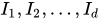
일부 에 대해 기본 큐브 Q}은는) 기본 간격의 유한 제품이다.



여기서 , 2, I 는 기본 간격이다.Equivalently, an elementary cube is any translate of a unit cube embedded in Euclidean space (for some with ).[2] X⊆ {\d}}}는 기본 큐브 조합으로 쓸 수 있는 경우(또는 큐빅 세트) 입체 복합체(또는 큐빅 세트)이다.[3]
![{\displaystyle [0,1]^{n}}](https://wikimedia.org/api/rest_v1/media/math/render/svg/40160923273b7109968df994dca832b91d957bf2)




관련 용어
길이 0의 기본 간격(단일 점 포함)은 퇴행이라고 하며, 길이 1의 간격은 퇴행성이 아니다.큐브의 치수는 의 비감소 구간 수입니다 이 값은 Q Q로 표시된다큐빅 콤플렉스 X의 는 X 에 있는 큐브 중 가장 큰 치수 입니다


If and are elementary cubes and , then is a face of . If is a face of and , then is a proper face of . If is a face of and , then is a facet or primary face of .



대수 위상
대수적 위상에서는 입체복합체가 구체적인 계산에 유용한 경우가 많다.특히 단일한 호몰로지(homology)와 일치하지만 연산 가능한 입체복합체들에 대한 호몰로지(homology)의 정의가 있다.
참고 항목

참조
- ^ Kovalevsky, Vladimir. "Introduction to Digital Topology Lecture Notes". Archived from the original on 2020-02-23. Retrieved November 30, 2021.
- ^ Werman, Michael; Wright, Matthew L. (2016-07-01). "Intrinsic Volumes of Random Cubical Complexes". Discrete & Computational Geometry. 56 (1): 93–113. arXiv:1402.5367. doi:10.1007/s00454-016-9789-z. ISSN 0179-5376.
- ^ Kaczynski, Tomasz; Mischaikow, Konstantin; Mrozek, Marian (2004). Computational Homology. New York: Springer. ISBN 9780387215976. OCLC 55897585.


