
추적 오류
Tracking error재무에서, 추적 오류 또는 능동적 위험은 포트폴리오 관리자가 내린 적극적인 경영 결정에 기인하는 투자 포트폴리오의 위험을 측정하는 척도로, 포트폴리오가 벤치마킹되는 지수를 얼마나 가깝게 따라가는지를 나타낸다. 가장 좋은 척도는 포트폴리오와 지수 수익률 차이의 표준 편차다.
많은 포트폴리오가 벤치마크, 일반적으로 지수로 관리된다. 일부 포트폴리오에서는 거래 전이나 그 밖의 원가가 지수의 수익률(예: 인덱스 펀드)을 정확히 재현할 것으로 예상되며, 다른 포트폴리오에서는 적극적인 수익 창출을 위해 지수에서 약간 벗어나 포트폴리오를 '적극적으로 관리'할 것으로 예상된다. 추적오차는 벤치마크로부터의 편차를 측정한 것이다. 앞서 언급한 인덱스펀드는 추적오차가 0에 가까운 반면, 능동적으로 관리되는 포트폴리오의 추적오차는 일반적으로 더 높을 것이다. 따라서 추적 오류는 시장 이동의 기능에 불과한 위험(수익)을 포함하지 않는다. 특정 주식선택권이나 업종에 따른 위험(수익)과 요인 '베타스'에 더해 시장 타이밍 결정에 따른 위험(수익)도 포함할 수 있다.
포트폴리오 활성 수익률을 포트폴리오 추적 오류로 나누면 위험 조정 성과 척도인 정보 비율이 나온다.
정의
역사적으로 추적오차를 측정하면 '실현' 또는 'ex post' 추적오류라고 한다. 추적 오류를 예측하는 데 모델을 사용할 경우 'ex ante' 추적 오류라고 한다. 사후 추적 오류는 성과 보고에 더 유용한 반면, 사후 추적 오류는 일반적으로 포트폴리오 관리자가 위험을 통제하기 위해 사용한다. 베타(Beta)를 주요 결정요소로 사용하는 단순 지분모형부터 보다 복잡한 다요소 고정소득모형까지 다양한 유형의 전-엔테 추적오류 모델이 존재한다. 포트폴리오의 요인 모델에서 비체계적 위험(즉, 잔차의 표준 편차)을 투자 분야에서는 "추적 오차"라고 부른다. 추적 오류를 계산하는 후자의 방법은 아래 공식을 보완하지만 결과는 다를 수 있다(때로는 2배).
Formulas
The ex-post tracking error formula is the standard deviation of the active returns, given by:
![{\displaystyle TE=\omega ={\sqrt {\operatorname {Var} (r_{p}-r_{b})}}={\sqrt {{E}[(r_{p}-r_{b})^{2}]-({E}[r_{p}-r_{b}])^{2}}}={\sqrt {(w_{p}-w_{b})^{T}\Sigma (w_{p}-w_{b})}}}](https://wikimedia.org/api/rest_v1/media/math/render/svg/fcbdc33801fc0d2e9791f95d3385b8096f049523)
where is the active return, i.e., the difference between the portfolio return and the benchmark return.[1] The optimization problem of maximizing the return, subject to tracking error and linear constraints, may be solved using second-order cone programming:


Interpretation
Under the assumption of normality of returns, an active risk of x per cent would mean that approximately 2/3 of the portfolio’s active returns (one standard deviation from the mean) can be expected to fall between +x and -x per cent of the mean excess return and about 95% of the portfolio's active returns (two standard deviations from the mean) can be expected to fall between +2x and -2x per cent of the mean excess return.
Examples
- Index funds are expected to have minimal tracking errors.
- Inverse exchange-traded funds are designed to perform as the inverse of an index or other benchmark, and thus reflect tracking errors relative to short positions in the underlying index or benchmark.
Index fund creation
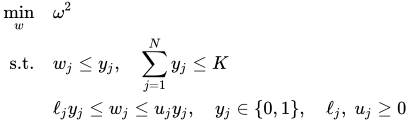
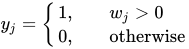
Index funds are expected to minimize the tracking error with respect to the index they are attempting to replicate, and this problem may be solved using standard optimization techniques. To begin, define to be:





References
- ^ Cornuejols, Gerard; Tütüncü, Reha (2007). Optimization Methods in Finance. Mathematics, Finance and Risk. Cambridge University Press. pp. 178–180. ISBN 0521861705.


