위치수 체계
산술 에서 콤플렉스 베이스 시스템 은 라디스 가 가상 의 수(Donald Knuth 가 1955년에[1] [2] 복합수 (S가 제안함)인 위치수 시스템 이다. 1964년[3] 월터 F. 1965년[4] [5] [6] 페니 ).
일반적으로 D {\displaystyle D} 통합 도메인 displaystyle \subset mathb C} } display cdot } 절대값 으로(Archimedi) 하십시오.
위치 번호 시스템 숫자 ∈ {\displaystyle X\in D}
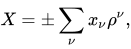
X = ± ∑ ν x ν ρ ν , {\displaystyle X=\pm \sum _{\nu }^{}x_{\nu }\rho ^{\nu }}}} 어디에
ρ ∈ D {\displaystyle \rho \in D} ρ 1 {\displaystyle \rho > ( base ), ν ∈ Z \displaystyle \nu \in \mathb {Z} } 지수(위치 또는 위치), x ν {\displaystyle x_{\nu}} 일반적 x ν ρ {\displaystyle Z \subset } .
카디널리티 R := Z {\ displaystyle := } 분해 수준 이라고 한다
위치 번호 시스템 또는 코딩 시스템 은 한 쌍이다.
⟨ ρ , Z ⟩ \displaystyle \left\langle \rho, Z\right\rangle } radix ρ {\displaystyle \rho } ) 자릿수 displaystyle Z} ( 표준 displaystyle R}
Z R := { 0 , 1 , 2 , … , R − 1 } . {\displaystyle Z_{R}: =\{0,1,2,\dotsc ,{R-1}\}. } 바람직한 것은 다음과 같은 특징이 있는 시스템을 코딩하는 것이다.
Every number in D {\displaystyle D} Z {\displaystyle \mathbb {Z} } Gaussian integers Z [ i ] {\displaystyle \mathbb {Z} [\mathrm {i} ]} Z [ − 1 + i 7 2 ] {\displaystyle \mathbb {Z} [{\tfrac {-1+\mathrm {i} {\sqrt {7}}}{2}}]} uniquely representable as 부호 ±가 있을 수 있는 유한 코드Every number in the field of fractions K := Quot ( D ) {\displaystyle K:=\operatorname {Quot} (D)} completed for the metric given by ⋅ {\displaystyle \cdot } K := R {\displaystyle K:=\mathbb {R} } K := C {\displaystyle K:=\mathbb {C} } ⋅[\ displaystyle \cdot } ν ∞[\displaystyle \cdot X {\displaystyle X} 측정치 는 0이다. 후자는 설정된 Z {\displaystyle Z} 실제 숫자의 경우 ρ {\ displaystyle R= \rho ^{ 2 경우 ρ 2 {\ displaysty R= \rho ^{2}}. 실제 숫자로 이 표기법에서 표준 십진법 부호화 방식은 다음과 같다.
⟨ 10 , Z 10 ⟩ , {\displaystyle \left\langle 10,Z_{10}\right\angle ,} 표준 2진법은
⟨ 2 , Z 2 ⟩ , {\displaystyle \left\langle 2,Z_{2}\right\angle ,} 부정기적 체계가
⟨ − 2 , Z 2 ⟩ , {\displaystyle \left\langle -2,Z_{2}\right\angle ,} 그리고 균형잡힌 3차[2]
⟨ 3 , { − 1 , 0 , 1 } ⟩ . \displaystyle \left\langle 3,\{-1,0,1\}\right\angle .} 이 모든 코딩 시스템은 Z {\ displaystyle \mathb {Z} R {\ displaystyle \mathb {R} .
복잡한 숫자로 복잡한 숫자에 대해 잘 알려진 위치 번호 시스템에는 다음이 포함된다(i {\ displaystyle \mathrm {i} ) 가상 단위 임).
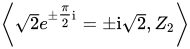
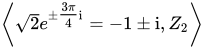
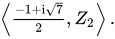
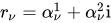
⟨ R R ⟩ {\ displaystyle \left\langle {\ R}, Z_{R}\ right\rangle ± i2 Z displaysty style \reft\reft sqrt{i Z_{2}, [1] } 1955 2 i , Z 4 displaystyle \left\langle \pm 2\mathrm {i},Z_{4}\right\angle }}} [2] 1955년 도널드 크누스가 제안한 쿼터-상상상의 기반 이다. ⟨ 2 e i 2 Z 2 ⟩ displaystyle \left\langle {\sqrac{\pi{2}}:00 }{\tfrac{\pi}}}}}}=\pm \mathrmart{i}{2}}, Z_{2}\rigrandle}}}}}. ⟨ 2 e ± 3 π 4 i = − 1 ± i , Z 2 ⟩ {\displaystyle \left\langle {\sqrt {2}}e^{\pm {\tfrac {3\pi }{4}}\mathrm {i} }=-1\pm \mathrm {i} ,Z_{2}\right\rangle } [3] [5] Base −1 ± i below).⟨ Reiφ, ZR({\displaystyle \left\langle{\sqrt{R}}e^{\mathrm{나는}}\varphi ,Z_{R}\right\rangle},φ =±arccos((− β/(2R)){\displaystyle \varphi=\pm \arccos{(-\beta/(2{\sqrt{R}}))}},β<>분(R, 2R){\displaystyle \beta<>\min(R,2{\sqrt{R}})}과 β{\dis.p laystyle \beta ( displaystyle . β displaystyle beta= 1} 및 displaysty R=2} . [7] ⟨ − 1 + i 7 2 , Z 2 ⟩ . {\displaystyle \left\langle {\tfrac {-1+\mathrm {i}{\sqrt{7}{2}},Z_{2}\오른쪽\angle .}} ⟨ 2 e π 3 i , A 4 := { 0 , 1 , e 2 π 3 i , e − 2 π 3 i } ⟩ {\displaystyle \left\langle 2e^{{\tfrac {\pi }{3}}\mathrm {i} },A_{4}:=\left\{0,1,e^{{\tfrac {2\pi }{3}}\mathrm {i} },e^{-{\tfrac {2\pi }{3}}\mathrm {i} }\right\}\right\rangle } [8] ⟨ − R , A R 2 ⟩ {\displaystyle \left\langle -R,A_{R}^{2}\right\rangle } A R 2 {\displaystyle A_{R}^{2}} r ν = α ν 1 + α ν 2 i {\displaystyle r_{\nu }=\alpha _{\nu }^{1}+\alpha _{\nu }^{2}\mathrm {i} } α ν ∈ Z R {\display 스타일 \alpha _{\nu }^{}\in Z_{R}}, ⟨ − 2 , { 0 , 1 , i , 1 + i } ⟩ . {\displaystyle \left\langle -2,\{0,1,\mathrm {i},1+\mathrm {i}\}\right\angle .} [8] ⟨ , 2 Z 2 ⟩ \reft\langle \rho =\rho _{2}, Z_{2}\ right \angle ρ 2 even 2 짝수 경우 2 ν 1 i . {\displaystyle \rho _{2}={\nu{\tfrac {\nu }{2}}~{\nu{no}}{2}}~{\nu {\nu -1}(-2)^{\tfrac {\nu -1}{2}}~{{{no\텍스트{no\{no\{no}}}}}}}이상{ no. }}}\end{case}} 이진법 복잡한 숫자의 바이너리 코드 시스템, 즉 Z 0 , 1 displaystyle Z_{2}=\{0,1 [9] 아래에는 일부 ⟨ Z 2 ⟩ {\displaystyle \langle rho ,Z_{2}\angle }( -1, 2, -2, i 에 대한 respp. 코드가 열거되어 있다. 표준 바이너리(표지, 첫 번째 줄 필요)와 "부정" 시스템(두 번째 줄)도 비교를 위해 나열된다. 그들은 나
일부 근거와 일부 표현[10] 라딕스 –1 ← 2 ← –2 ← I 쌍둥이와 세쌍둥이 2 –1 10 –10 i 1 ← 0.1 = 1.0 –2 11 110 10 i 1 / 3 0.01 = 1.10 i 2 {\displaystyle \mathrm {i} {\sqrt{2}} 101 10100 100 10.101010100...[11] 1 3 3 i 2 {\ displaystyle {\frac {1}{3}+{\frac {1}{1}}\mathrm {i} {\sqrt{2}}} 0.0011 = 11.1100 − 1 + i 7 2 {\displaystyle {\frac {-1+\mathrm {i} {\sqrt {7}{2}}:} 111 1010 110 11.110001100...[11] 3 i 7 {\ displaystyle {\frac {3+\mathrm {i} {\sqrt{7}{4}}}} 1.011 = 11.101 = 11100.110 ρ 2 {\displaystyle \rho _{2}} 101 10100 100 10 1 / 3 1 / 3 i 0.0011 = 11.1100 –1+i 11101 1100 11100 11 1 / 5 3 / 5 i 0.010 = 11.001 = 1110.100 2i 103 2 102 10.2 1 / 5 2 / 5 i 0.0033 = 1.3003 = 10.0330 = 11.3300
아르키메데스 절대값을 가진 모든 위치 번호 시스템에서와 같이, 여러 개의 표현 을 가진 숫자들이 있다. 그러한 숫자의 예는 표의 오른쪽 열에 표시된다. 그들 모두는 그 위에 가로줄로 표시된 반복으로 분수 를 반복하고 있다.
자릿수 집합이 최소인 경우 해당 숫자 집합의 측정값 은 0이다. 언급된 모든 코딩 시스템이 그렇다.
거의 2진법적인 쿼터-상상 시스템은 비교를 목적으로 하단에 열거되어 있다. 거기서 현실과 상상의 부분이 서로 교차한다.
기준 -1 ± ibase i 1 시스템에서는 정수 부분이 있는 복잡한 숫자가 모두 0이다. 특히 관심 있는 것은 쿼터-상상 베이스 (베이스 2i )와 아래에서 논의한 베이스 -1 ± i 가우스 정수 를 정밀하게 표현하는 데 사용할 수 있다.
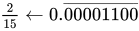
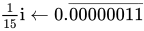
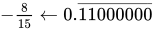
숫자 0 과 1을 사용 -1 ± i는 S에 의해 제안되었다. 1964년[3] 월터 F. 1965년 페니 .[4] [6] 정수의 반올림 영역(즉, 이 시스템에서 표현되는 정수 부분을 공유하는 복잡한 (비정수) 숫자의 집합 {\displaystyle S}) 트위드 라곤(그림 참조)을 갖는다. This set S {\displaystyle S} ∑ k ≥ 1 x k ( i − 1 ) − k {\displaystyle \textstyle \sum _{k\geq 1}x_{k}(\mathrm {i} -1)^{-k}} x k ∈ Z 2 {\displaystyle x_{k}\in Z_{2}} S {\displaystyle S} 1 4 S {\displaystyle {\tfrac {1}{4}}S} S {\displaystyle S} 1 2 S {\displaystyle {\tfrac {1}{\sqrt {2}}}S} ( i − 1 ) S = S ∪ ( S + 1 ) {\displaystyle (\mathrm {i} -1)S=S\cup (S+1)} 중앙의R ⊂ {\displaystyle R\subset S} ) 15 ← 0. 00001100 { "\ displaystyle {\tfrac {2}{15}}}\gets {\overline {00001100 15 ← 0. 00000011 {\ displaystyle {\tfrac {1}{15}}\mathrm {i} \cHB {\overline { 000011}, 15 ← 0. 11000000 ' {\ displaystyle -{\tfrac {8}{15}\caps {\overline {110000}, 15 i ← 0. 00110000 ' {\ displaystyle -{\tfrac {4}{15}}\mathrm {i}\cHB 0. {\overline{001100 S {\displaystyle S} 1 15 [12]
그 결과, 복잡한 직사각형의 주입 이 있다.
[ − 8 15 , 2 15 ] × [ − 4 15 , 1 15 ] i {\displaystyle [-{\tfrac {8}{15}},{\tfrac {2}{15}}\properties [-{\tfrac {4}{15}}},{\tfrac {1}}}\mathrm {i}}}}}} 매핑을 통해 [ 0 , 1 {\displaystyle [0,1)]
∑ k ≥ 1 x k ( i − 1 ) − k ↦ ∑ k ≥ 1 x k b − k {\displaystyle \textstyle \sum_{k\geq 1}x_{k}(\mathrm {i} -1)^{-k}\mapsto \sum _{k\geq 1x_{k}b^{-k}}}}}}} b 2 [\displaystyle b>2} . [13]
게다가, 두 개의 매핑이 있다.
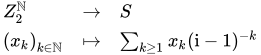
Z 2 N → S ( x k ) k ∈ N ↦ ∑ k ≥ 1 x k ( i − 1 ) − k {\displaystyle {\begin{array}{lll}Z_{2}^{\mathb {N} }&\to &S\\\\\좌측(x_{k}\오른쪽) _{k\in \mathb {N} }&\mapsto &\sum _{k\geq 1}x_{k}(\mathrm {i} -1)^{-k}\end{array}}}}}}}}}} 그리고
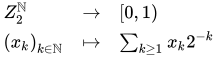
Z 2 N → [ 0 , 1 ) ( x k ) k ∈ N ↦ ∑ k ≥ 1 x k 2 − k {\displaystyle {\begin{array}{lll}Z_{2}^{\mathb {N} }to >[0,1)\\\\\왼쪽(x_{k}\오른쪽) _{k\in \mathb {N} }&\mapsto &\sum _{k\geq 1}x_{k}2^{-k}\end{array}}}}}}}}}} 두 가지 모두 허탈적 (추상적 공간-초기적) 매핑을 발생시킨다.
[ 0 , 1 ) → S \displaystyle [0,1)\qquad \to \qquad S} 그러나 연속성 이 아니므로 공간-변환 곡선 아니다 . 그러나 아주 가까운 친척인 데이비스 크누스 용 은 연속적이고 공간을 채우는 곡선이다.
참고 항목 참조 ^ a b Knuth, D.E. (1960). "An Imaginary Number System". Communications of the ACM . 3 (4): 245–247. doi :10.1145/367177.367233 . ^ a b c Knuth, Donald (1998). "Positional Number Systems". The art of computer programming . Vol. Volume 2 (3rd ed.). Boston: Addison-Wesley. p. 205. ISBN 0-201-89684-2 OCLC 48246681 .^ a b c Khmelnik, S.I. (1964). "Specialized digital computer for operations with complex numbers". Questions of Radio Electronics (in Russian) . XII (2). ^ a b W. Penney, 복잡한 숫자에 대한 "이진" 시스템, JACM 12 (1965) 247-248. ^ a b Jamil, T. (2002). "The complex binary number system". IEEE Potentials . 20 (5): 39–41. doi :10.1109/45.983342 . ^ a b Duda, Jarek (2008-02-24). "Complex base numeral systems". arXiv :0712.1309 math.DS ]. ^ Khmelnik, S.I. (1966). "Positional coding of complex numbers". Questions of Radio Electronics (in Russian) . XII (9). ^ a b Khmelnik, S.I. (2004). Coding of Complex Numbers and Vectors (in Russian) (PDF) . Israel: Mathematics in Computer. ISBN 978-0-557-74692-7 ^ a b Khmelnik, S.I. (2001). Method and system for processing complex numbers ^ 윌리엄 J. 길버트, "복합기반의 산술" 수학 잡지 제57권, 제2권 1984년 3월 ^ a b 무한 비연속 시퀀스 ^ 크누스 1998 페이지 206 ^ b 2 {\displaystyle b=2 ( ) 2 1 0bin dec {\ displaystyle \textstyle ^{-1}=0 1_{\text{bin}}=0. 5_ {\text{dec} ( ∑ k k 0 1빈 deck \\ dech /\ displaystyle \textstyle \sum_{k\geq 2}2^{-k}=0 {1 1}_\overline text{bin}}}}=0 . 1_{\text{bin}}=0. 5_{\text{dec}}} ( i − 1 ) − 1 = − 0.1 bin − 0.1 bin i = − 0.5 dec − 0.5 dec i {\displaystyle \textstyle (\mathrm {i} -1)^{-1}=-0.1_{\text{bin}}-0.1_{\text{bin}}\mathrm {i} =-0.5_{\text{dec}}-0.5_{\text{dec}}\mathrm {i} } ∑ k ≥ 2 ( i − 1 ) − k = 0.1 dec + 0.3 dec i {\ displaystyle \textstyle \sum _{k\geq 2}(\mathrm {i} -1)^{-k}=0. 1_{\text{dec}}+0. 3_{\text{dec}\mathrm {i} }. 외부 링크 

 설정
설정



 (와
(와


![\mathbb{Z } [{\mathrm i}]](https://wikimedia.org/api/rest_v1/media/math/render/svg/b2f7e30b2083c5a1ffb637bd8c9ec111a486cd06)
![\mathbb{Z } [{\tfrac {-1+{\mathrm i}{\sqrt 7}}2}]](https://wikimedia.org/api/rest_v1/media/math/render/svg/80dfac2b49c8473c11bc085b3c02afe60f12cddf)





 (가
(가

















![{\displaystyle [-{\tfrac {8}{15}},{\tfrac {2}{15}}]\times [-{\tfrac {4}{15}},{\tfrac {1}{15}}]\mathrm {i} }](https://wikimedia.org/api/rest_v1/media/math/render/svg/c1169f246ca710e557a9ff51c42d43f199b1100f)
 간격 내에
간격 내에