
오실레이터 표현
Oscillator representation수학에서 오실레이터 표현은 어빙 시걸, 데이비드 셰일, 안드레 웨일 등이 먼저 조사한 공통분모 집단의 투사적 단일 표현이다.표현의 자연스러운 확장은 1988년 로저 하우에 의해 발진기 세미그룹으로 소개된 수축기 세미그룹으로 이어진다.세미그룹들은 다른 수학자들과 물리학자들, 특히 1960년대에 Felix Berezin에 의해 이전에 연구되었다.한 차원에서는 가장 간단한 예가 SU(1,1)에 의해 제시된다.확장된 복잡한 평면에서 뫼비우스의 변형으로 작용하여 단위 원을 불변하게 한다.이 경우, 오실레이터 표현은 SU(1,1)의 이중 커버를 단일체로 표현한 것이며, 오실레이터 세미그룹은 단위 디스크를 자체로 가져가는 뫼비우스 변환에 해당하는 SL(2,C)의 세미그룹 수축 연산자에 의한 표현에 해당한다.
신호까지만 결정된 수축 연산자는 가우스 함수인 커널을 가지고 있다.최소 수준에서 세미그룹은 라이트 콘으로 식별할 수 있는 SU(1,1)의 리 대수에서 원뿔에 의해 설명된다.동일한 프레임워크는 무한한 차원의 아날로그를 포함하여 더 높은 차원의 공감대 그룹에 일반화된다.본 기사는 SU(1,1)에 대한 이론을 상세히 설명하고, 이론이 어떻게 확장될 수 있는지를 요약하고 있다.
과거 개요
베르너 하이젠베르크와 에르윈 슈뢰딩거에 의한 양자역학의 수학적 공식화는 원래 힐베르트 공간의 한없는 자기 적응 연산자들의 관점에서 이루어졌다.포지션과 모멘텀에 해당하는 기본 연산자는 하이젠베르크의 정류 관계를 만족시킨다.고조파 오실레이터를 포함하는 이러한 연산자의 2차 다항식도 정류자 아래에서 닫힌다.
1920년대와 1930년대에 많은 양의 연산자 이론이 개발되어 양자역학에 대한 엄격한 기초를 제공하였다.그 이론의 일부는 주로 헤르만 바일, 마샬 스톤, 존 폰 노이만의 기여를 통해, 운영자의 단일 집단의 관점에서 공식화되었다.결국 이러한 수학적 물리학의 결과는 1933년 노르베르트 비에너(Norbert Wiener)의 강의 노트로부터 시작하여 수학 분석에서 소분되었는데, 그는 화음 발진기에 열 알맹이를 사용하여 푸리에 변환의 특성을 도출했다.
스톤-본 노이만 정리에 공식화된 하이젠베르크 교감 관계의 고유성은 나중에 그룹 대표론, 특히 조지 맥키가 시작한 유도 대표론 내에서 해석되었다.2차 연산자는 그룹 SU(1,1)와 그것의 Lie 대수학의 투사적인 단일 표현으로 이해되었다.어빙 시걸과 데이비드 셰일(David Shale)은 이 구성을 유한하고 무한의 차원으로 하는 공감대 그룹에 일반화했다. 물리학에서는 이것을 흔히 보소닉 정량화(bosonic quantization)라고 부른다. 무한의 차원 공간의 대칭 대수학으로 구성된다.세갈과 셰일은 무한 차원 힐버트 공간의 외부 대수학으로 건설되는 페르미온 양자화 사례도 다루었다.1+1차원의 정합장 이론의 특별한 경우, 두 버전은 소위 "보손-페르미온 서신"을 통해 동등해진다.이는 보소닉과 페르미온 힐버트 공간 사이에 단일 연산자가 있는 분석뿐만 아니라 정점 연산자 알헤브라의 수학적 이론에도 적용된다.정점 연산자 자체는 1960년대 후반에 이론물리학, 특히 끈 이론에서 생겨났다.
안드레 웨일은 이후 p-adic Lie 그룹까지 건설을 확장하여, 특히 세타 함수와 이차적 상호주의에 대한 집단 이론적 설명을 하기 위해 그 사상이 숫자 이론에 어떻게 적용될 수 있는지를 보여주었다.여러 물리학자와 수학자들이 고조파 발진기에 해당하는 열 커널 연산자가 SU(1,1)의 복합화에 연관되어 있음을 관찰하였다. 이는 SL(2,C)의 전부가 아니라 자연 기하학적 조건에 의해 정의된 복잡한 세미그룹이었다.이 세미그룹의 대표 이론과 유한하고 무한한 차원의 일반화는 수학과 이론 물리학 둘 다에 응용이 있다.[1]
SL(2,C)의 세미그룹
그룹:

Gc = SL(2,C)의 부분군이며, 결정인자가 1인 복합 2 x 2 행렬의 그룹이다.G1 = SL(2,R)이면

이는 해당 뫼비우스 변환이 상반신 평면을 유닛 원반 위에, 실선을 유닛 원반 위에 운반하는 케이리 변환이기 때문이다.
그룹 SL(2,R)은 다음에 의해 추상 그룹으로 생성된다.
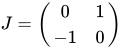
하위 삼각 행렬의 부분군

실제로 벡터의 궤도는

이러한 행렬에 의해 생성된 부분군 아래는 R의2 전체로 쉽게 볼 수 있으며, G에서1 V의 스태빌라이저가 이 부분군 내부에 있다.
(11)의 Lie g {\displaystyle 는 행렬로 구성된다.

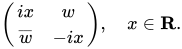
기간c 2 자동형성 σ의 G

와 함께
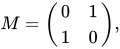
이후 고정 점 부분군 G가 있음
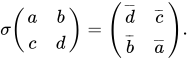
이와 유사하게 동일한 공식은 미량 0의 복잡한 행렬인 G의c Lie 대수 의 기간 2 자동형성을 정의한다.C에 대한 의 표준 기준은 다음과 같다.
 c Lie 대수
따라서 -1 ≤ m, n ≤ 1의 경우
![{\displaystyle [L_{m},L_{n}]=(m-n)L_{m+n}.}](https://wikimedia.org/api/rest_v1/media/math/render/svg/fc889e602613b99d39e0c0bf7b6fc0716e3470c5)
직접 합이 분해되어 있다.

여기서 {은(는) σ의 +1 eigenspace이고 i은(는) –1 eigenspace이다.

의 행렬 X에 형식이 있음
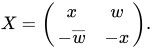
참고:

의 콘 C는 두 가지 조건으로 정의된다.첫 번째는 < 정의상 이 조건은 G에 의한 결합에 의해 보존된다. G가 연결되어 있기 때문에 두 구성 요소는 x > 0과 x < 0 불변성으로 남게 된다.두 번째 조건은 <

![([\displaystyle x<0])](https://wikimedia.org/api/rest_v1/media/math/render/svg/eae2426ff09e1cd53f1658b8949e8dbd0fd8ad04)
Gc 그룹은 뫼비우스가 확장된 복합면에서 변형하여 행동한다.부분군 G는 단위 디스크 D의 자동화로 작용한다.Olshanskii(1981)에 의해 처음 고려된 G의c 세미그룹 H는 기하학적 조건에 의해 정의될 수 있다.

세미그룹은 원뿔 C:[2]의 관점에서 명시적으로 설명할 수 있다.

사실 행렬 X는 G의 원소에 의해 행렬에 결합될 수 있다.
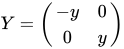
와 함께
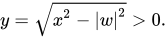
exp Y에 해당하는 뫼비우스 변환은 ez에 z를−2y 보내기 때문에, 오른손은 sem그룹에 놓여 있는 것을 따른다.반대로 g가 H에 놓여 있으면 닫힌 유닛 디스크를 내부의 작은 닫힌 디스크로 운반한다.G의 원소에 의해 결합되면, 작은 원반은 중심 0을 가질 수 있다.그러나 적절한 y에 대해 - Y 요소는 D를 스스로 운반하므로 G에 위치한다.

비슷한 주장은 역시 세미그룹인 H의 폐쇄가 다음과 같이 주어지는 것을 보여준다.

부부관계에 관한 위의 진술에서, 그것은 다음과 같다.

, where
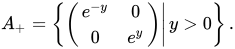
만약
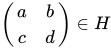
그때
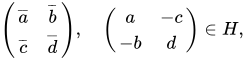
후자는 transpose를 취하여 ±1 항목으로 대각 행렬을 이용하여 얻는다.따라서 H는 또한 다음을 포함한다.
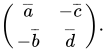
원래 행렬이 SU(1,1)에 있을 경우 역행렬을 제공한다.
H의 모든 요소는 D의 한 점을 고정해야 하며, G의 요소와의 결합에 의해 0이 될 수 있다는 점에 유의함으로써 결합에 대한 추가적인 결과가 뒤따른다.그러면 H의 원소에는 형태가 있다.

그러한 하위 삼각형 행렬의 집합은 H의 하위 그룹 H를0 형성한다.
이후

H의0 모든 행렬은 H의0 행렬 M에 의해 대각 행렬에 결합된다.
마찬가지로 H의 모든 1-모수 세미그룹 S(t)는 D의 동일한 점을 고정하므로 G의 요소에 의해 H의0 1-모수 세미그룹에 결합된다.
H에는0 M행렬이 있어서 다음과 같이 되어 있다.

S0(t) 대각선으로마찬가지로 H에는0 다음과 같은 행렬 N이 있다.

세미그룹 H는0 결정인자 1을 갖는 복잡한 하위 삼각 행렬의 부분군 L을 생성한다(위의 공식은 given 0으로 표시).그것의 Lie 대수학은 형태의 행렬로 구성되어 있다.
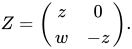
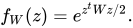
특히 < 및 > 1 \z > 1 w. {\displaystylere z 2}} w .}인 경우에만 하나의 매개 변수 sem그룹 exp tZ가 모든 t > 0에 대해0 H에 놓여 있다.

이는 H에 대한 기준 또는 공식에서 직접 나온 것이다.

지수지도는 이 경우 L그룹 전체에서 추월적이기는 하지만, 이 경우 추월적이지 않은 것으로 알려져 있다.이것은 Squaring 연산이 H에서 수행되지 않기 때문에 뒤따른다.실제로 원소의 사각형은 원소가 0을 고치는 경우에만 0을 고치기 때문에 H로0 이를 증명하기에 충분하다.α < 1과 함께 α를 취한다.

a = α일 경우2

와 함께
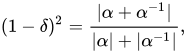
그 다음 행렬

H에0 제곱근은 없다. 제곱근은 형태를 가질 것이기 때문이다.
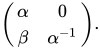
다른 한편으로는

닫힌 세미그룹 {\은(는) SL(2,C)에서 최대값이다.[3][4][5][6][7]
 (는) SL(2,C)에서 최대값이다.
이론 물리학에 의해 동기 부여된 연산을 사용하여, 페라라 외 연구진(1973)은 일련의 불평등을 통해 정의된세미그룹 를 도입했다.압축 세미그룹으로 되지 않은 H 을(를) 사용하여 H의 최대성을 설정했으며 압축 세미그룹으로 정의하면 새로운 부분 변환 을(를) 의)에 추가하면 어떤 일이 발생하는지 확인하는 것으로 최대성이 감소한다 증거의 발상은 두 디스크 과 의 위치를 고려하는 데 달려 있다 주요 사례에서 한 디스크는 다른 디스크를 포함하거나 분리한다. 간단한 경우 g 은(는) 스케일 변환의 역행 또는 )=- / z g 어느 g 과 은 1의 열린 인접성을 생성하므로 SL(2,C) 전체가 생성된다.


Later Lawson (1998) gave another more direct way to prove maximality by first showing that there is a g in S sending D onto the disk Dc, z > 1. In fact if then there is a small disk D1 in D such that xD1 lies in Dc.그리고 H의 일부 H의 경우1 D = HD.마찬가지로 yxD1 = 일부 y의 경우 Dc. so g = yxh는 S에 있고 D를 D로c 보낸다.따라서2 g는 유닛 디스크 D를 고정하므로 SU(1,1)에 위치한다.그래서 g는−1 S에 누워있다.만약 t가 H에 있다면 tgD는 gD를 포함한다.따라서 - - g g{\ so−1 t는 S에 있으므로 S는 1의 개방된 인접성을 포함한다.따라서 S = SL(2,C)이다.

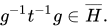 −1 t는 S에 있으므로 S는 1의 개방된 인접성을 포함한다.따라서 S = SL(2,C)이다.
 정확히 동일한 주장이 R과n 오픈 세미그룹에 대한 Möbius 변환에 작용하여 폐쇄된 단위 구 x ≤ 1을 오픈 단위 구 x < 1로 가져간다.폐쇄는 모든 뫼비우스 변혁의 그룹에서 가장 적절한 세미그룹이다.n = 1일 때, 폐쇄는 닫힌 간격[–1,1]을 자체로 가져가는 실선의 뫼비우스 변환에 해당한다.[8]
세미그룹 H와 그것의 폐쇄는 G로부터 물려받은 추가적인 구조를 가지고 있는데, 즉, G에서의 뒤집힘은 H와 그것의 폐쇄의 반정형성으로 확장되며, 이것은 exp C와 그것의 폐쇄의 요소들을 고정시킨다.을 위해
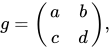
반동형성은 에 의해 주어진다.
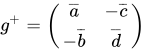
그리고 SL(2,C)의 반동형성으로 확장된다.
유사하게 반정형주의
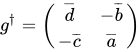
G1 불변성을 남기고 exp C와1 그 폐쇄에 원소를 고정하기 때문에 G에서1 sem그룹에 대한 유사한 특성을 가지고 있다.
하이젠베르크와 웨일과의 교감 관계
을(를) R에 있는 슈워츠 함수의 공간이 되도록 한다.R의 사각형 통합 함수의 힐버트 공간2 L(R)에 밀도가 높다.양자역학의 용어에 따라 "모멘텀" 연산자 P와 "위치" 연산자 Q를 S 에 정의한다.


그곳의 운영자들은 하이젠베르크 통신 관계를 만족시킨다.

P와 Q는 모두2 L(R)에서 S{\{\에 있는 내부 제품에 대한 자가 적응이다.
{\ 및 L2(R)에 대해 다음과 같은 두 개의 단일 매개 변수 그룹 U와 V(t)를 정의할 수 있다

정의에 따라

에 대해 정식으로.


하나의 파라미터 그룹 U와 V가 Weyl commutation relation relation relationship을 만족한다는 정의에서 바로 나온다.

L2(R)에서 U와 V의 실현을 슈뢰딩거 대표라고 한다.
푸리에 변환
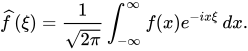
자연 위상에 대해 의 연속 지도를 자체로 정의한다.
등고선 통합에 의해 함수가 표시됨
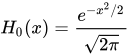
푸리에의 변형이 그것만의 것이다.
한편, 부품별로 통합하거나 적분하에서의 차별화,

{의 연산자가 다음에 의해 정의됨
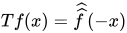
Q(및 P)와 통근하다.다른 한편으로는

그리고 그 이후로

에 위치하며 그 뒤를 따른다.

그래서
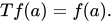
이는 푸리에 반전 공식을 의미한다.
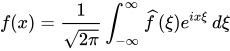
그리고 푸리에 변환이 의 이형성임을 보여준다.
푸비니의 정리로는

반전 공식과 결합할 경우 이는 푸리에 변환이 내부 제품을 보존한다는 것을 의미한다.
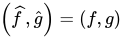
S 의 등위계를 자체로 정의한다.
밀도에 의해 그것은 Planchrel의 정리에 의해 주장된 L2(R) 상의 단일 운영자로 확장된다.
스톤-본 노이만 정리
U(s)와 V(t)가 Weyl commutation 관계를 충족하는 Hilbert 공간 {의 단일 매개 변수 그룹이라고 가정하십시오.

( , ) ( R×) , {\은(으)로[10][11] 한다.


그리고 다음 으로H {\{\{H}에 대한 경계 연산자를 정의하십시오

그러면
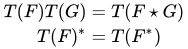
어디에
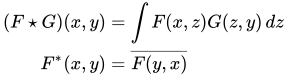
연산자 T(F)는 중요한 비감소 특성을 가지고 있다. 모든 벡터 T(F)ξ의 선형 범위는 에 밀도가 있다
실제로 fds와 gdt가 콤팩트한 지원으로 확률측정을 정의한다면, 얼룩진 연산자는

만족시키다

측정값이 0으로 감소할 경우 강한 측정 시스템 위상에 수렴한다.
U(f)V(g)는 T(F) 형태를 가지기 때문에 비기존성이 따른다.
이(가) L2(R)에 대한 슈뢰딩거 표현일 때 연산자 T(F)는

슈워츠 함수인 커널이 부여한 연산자에 대한 사실이기 때문에 U와 V가 슈뢰딩거 표현에 대해 이해할 수 없는 공동 작용을 하는 것은 이 공식에서 비롯된다.구체적인 설명은 선형 표준 변환에 의해 제공된다.
반대로 에 대한 Weyl 정류 관계를 나타내는 것으로 볼 때 커널 연산자의 *-알지브라에 대한 비감소적 표현을 발생시킨다.그러나 그러한 모든 표현은 위와 같이 각 사본에 대한 작용과 함께2 L(R) 사본의 직교적 직접 합계에 있다.이것은 N × N 행렬의 표현이 C에N 대한 표준 표시의 직접 합계에 있다는 기본적인 사실의 간단한 일반화다.매트릭스 단위를 사용하는 증거는 무한 차원에서도 동등하게 잘 작동한다.
단일 매개 변수 그룹 U와 V는 각 구성 요소를 불변하게 하여 슈뢰딩거 표현에 대한 표준 작용을 유도한다.
특히 이것은 스톤-본 노이만(Stone-von Neumann)의 정리를 암시한다: 슈뢰딩거(Shrödinger) 표현은 힐버트 공간에 있는 Weyl commutation 관계의 독특한 불가해한 표현이다.
SL(2,R)의 오실레이터 표현
Weyl commutation 관계를 만족하는 U와 V를 고려하여 정의하십시오.

그러면

그래서 W는 R의2 투사적인 단일 표현을 정의하고 cocycle은 다음과 같다.

여기서 = + i =( x, ) 및 B는 R에2 주어진 공통점 형식이다.


스톤-본 노이만 정리에 의해, 이 고치에 해당하는 독특한 불가해한 표현이 있다.
따라서 g가 형식 B, 즉 SL(2,R)의 요소를 보존하는 R의2 자동형이라면 L2(R)에 공분산 관계를 만족하는 단일 itary(g)가 있다.

슈르의 보조정리자에 의해 단일하수체 π(g)는 ζ = 1의 스칼라 ζ에 의해 최대 곱셈까지 고유하므로, π은 SL(2,R)의 투영적 단일 표현을 정의한다.
이것은 슈뢰딩거 표현에 대한 재확정성만을 사용하여 직접 설정할 수 있다.무reducibility는 운영자들이 그 사실에 대한 직접적인 결과였다.
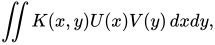
K a Schwartz 함수는 정확히 Schwartz 함수를 가진 커널에 의해 주어진 연산자와 일치한다.
이들은 힐버트-슈미트 연산자의 공간에 밀집되어 있는데, 유한한 순위 연산자를 포함하고 있기 때문에 이해할 수 없는 행동을 한다.
π의 존재는 슈뢰딩거 대표성의 불가해성만을 사용하여 증명할 수 있다.운영자는 다음과 같은 표지에 따라 고유하다.

SL(2,R)의 투영적 표현을 위한 2-Cocycle이 ±1의 값을 취하도록 한다.
실제로, 그룹 SL(2,R)은 양식의 행렬에 의해 생성된다.

그리고 다음과 같은 연산자가 위의 공분산 관계를 만족하는지 직접 확인할 수 있다.

발생기 g는i 그룹 SL(2,R)을 고유하게 지정하는 다음과 같은 Bruhat 관계를 만족한다.[12]

이러한 관계는 해당 운영자가 표식까지 만족한다는 것을 직접 계산하여 확인할 수 있으며, 이는 코키클이 ±1 값을 취한다는 것을 확립한다.
SL(2,R)의 이중 커버로서 메타폴리트 집단의 명시적 구성을 이용한 보다 개념적인 설명이 있다.[13]SL(2,R)은 상반면 H에서 Möbius 변환에 의해 작용한다. 더욱이 다음과 같은 경우
그때
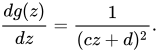
함수

1과 1의 관계를 만족시키다.

각 g에 대해, 함수 m(g,z)은 H에 비바니싱이므로 가능한 두 개의 홀로모르픽 제곱근을 가지고 있다.메타폴틱 그룹은 그룹으로 정의된다.

정의상 SL(2,R)의 이중 커버로 연결된다.곱하기:

어디에

따라서 메타폴로지 그룹의 요소 g에 대해서는 1-코클 관계를 만족하는 고유하게 결정된 함수 m(g,z)1/2이 있다.
> z인 경우

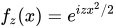
이러한 함수는 에 의해 생성되는 SL(2,R)의 단일 궤도에 위치한다.
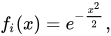
sl(2,R)의 g에 대해 그 이후.

보다 구체적으로 g가 Mp(2,R)에 있는 경우

실제로, 만약 이것이 g와 h를 유지한다면, 그것은 또한 그들의 제품을 유지한다.반면 g에t g형식이i 있고 이들이 발전기인지 쉽게 확인할 수 있다.
이것은 메타폴리트 집단의 일반적인 단일적 표현을 정의한다.
요소(1,–1)는 L2(R)에서 –1만큼 곱하기 역할을 하며, 여기서부터 SL(2,R)의 코코클은 ±1 값만 취한다.
마슬로프 지수
Lion & Vergne(1980년)에서 설명한 바와 같이, ±1 값을 취하면서 메타폴틱 표현과 관련된 SL(2,R)의 2-Cocycle은 Maslov 지수에 의해 결정된다.
평면에서 세 개의 0이 아닌 벡터 u, v, w가 주어질 때, 그들의 마슬로프 지수 (, , ) 은 정의한 R에서3 2차 형태의 서명으로 정의된다.


Maslov 인덱스의 속성:
- 벡터에 의해 확장되는 1차원 하위 공간에 따라 다름
- 그것은 SL(2,R)에 따라 불변한다.
- 그것은 그 주장을 교대하고 있다. 즉, 두 개의 주장이 상호 교환될 경우 그 기호가 바뀐다.
- 두 개의 서브스페이스가 일치하면 사라진다.
- 값 –1, 0 및 +1: u와 v가 B(u,v) = 1과 w = au + bv를 만족하면 매슬로프 지수는 if ab = 0이며, 그렇지 않으면 ab의 부호를 뺀 값과 같다.

0이 아닌 벡터 u를0 선택하면 함수가

SL(2,R)에 2-cocycle을 정의하고, 단결의 8번째 뿌리에 값을 부여한다.
2-Cocycle의 수정은 메타폴릭 코코클과 연결된 ±1의 값을 가진 2-Cocycle을 정의하는 데 사용될 수 있다.[14]
실제로 0이 아닌 벡터 u, 평면에서 v가 주어진 경우 f(u,v)를 다음과 같이 정의한다.
- u와 v가 비례하지 않으면 b(u,v)의 부호를 곱한다.
- u = λv일 경우 λ의 기호
만약

그때

메타폴리트 표현에서 대표자 π(g)를 선택할 수 있도록 한다.

여기서 2-256 Ω은

와 함께
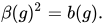
홀로모르픽 포크 공간
Holomorphic Fock space (also known as the Segal–Bargmann space) is defined to be the vector space of holomorphic functions f(z) on C with

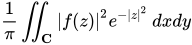
finite. It has inner product

is a Hilbert space with orthonormal basis
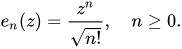
Moreover, the power series expansion of a holomorphic function in gives its expansion with respect to this basis.[15] Thus for z in C
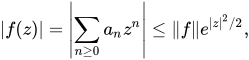
so that evaluation at z is gives a continuous linear functional on In fact

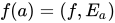
where[16]

Thus in particular is a reproducing kernel Hilbert space.
For f in and z in C define

Then

so this gives a unitary representation of the Weyl commutation relations.[17] Now

It follows that the representation is irreducible.

Indeed, any function orthogonal to all the Ea must vanish, so that their linear span is dense in .
If P is an orthogonal projection commuting with W(z), let f = PE0. Then

The only holomorphic function satisfying this condition is the constant function. So

with λ = 0 or 1. Since E0 is cyclic, it follows that P = 0 or I.
By the Stone–von Neumann theorem there is a unitary operator from L2(R) onto , unique up to multiplication by a scalar, intertwining the two representations of the Weyl commutation relations. By Schur's lemma and the Gelfand–Naimark construction, the matrix coefficient of any vector determines the vector up to a scalar multiple. Since the matrix coefficients of F = E0 and f = H0 are equal, it follows that the unitary is uniquely determined by the properties


and

Hence for f in L2(R)

so that

where
![{\displaystyle B(z,t)=\exp[-z^{2}-t^{2}/2+zt].}](https://wikimedia.org/api/rest_v1/media/math/render/svg/5cfe6d62ec71a3ac408770247a7842646d66de61)
The operator is called the Segal–Bargmann transform[18] and B is called the Bargmann kernel.[19]
The adjoint of is given by the formula:

Fock model
The action of SU(1,1) on holomorphic Fock space was described by Bargmann (1970) and Itzykson (1967).
The metaplectic double cover of SU(1,1) can be constructed explicitly as pairs (g, γ) with
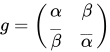
and

If g = g1g2, then
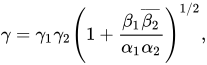
using the power series expansion of (1 + z)1/2 for z < 1.
The metaplectic representation is a unitary representation π(g, γ) of this group satisfying the covariance relations

where

Since is a reproducing kernel Hilbert space, any bounded operator T on it corresponds to a kernel given by a power series of its two arguments. In fact if

and F in , then

The covariance relations and analyticity of the kernel imply that for S = π(g, γ),

for some constant C. Direct calculation shows that

leads to an ordinary representation of the double cover.[20]
Coherent states can again be defined as the orbit of E0 under the metaplectic group.
For w complex, set
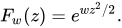
Then if and only if w < 1. In particular F0 = 1 = E0. Moreover,


where
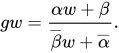
Similarly the functions zFw lie in and form an orbit of the metaplectic group:
=({\overline {\alpha }}+{\overline {\beta }}w)^{-3/2}zF_{gw}(z).}](https://wikimedia.org/api/rest_v1/media/math/render/svg/d3afc2dd88448a4772ff510a3e652a9d169508e9)
Since (Fw, E0) = 1, the matrix coefficient of the function E0 = 1 is given by[21]

Disk model
The projective representation of SL(2,R) on L2(R) or on break up as a direct sum of two irreducible representations, corresponding to even and odd functions of x or z. The two representations can be realized on Hilbert spaces of holomorphic functions on the unit disk; or, using the Cayley transform, on the upper half plane.[22][23]
The even functions correspond to holomorphic functions F+ for which

is finite; and the odd functions to holomorphic functions F– for which

is finite. The polarized forms of these expressions define the inner products.
The action of the metaplectic group is given by

Irreducibility of these representations is established in a standard way.[24] Each representation breaks up as a direct sum of one dimensional eigenspaces of the rotation group each of which is generated by a C∞ vector for the whole group. It follows that any closed invariant subspace is generated by the algebraic direct sum of eigenspaces it contains and that this sum is invariant under the infinitesimal action of the Lie algebra . On the other hand, that action is irreducible.
The isomorphism with even and odd functions in can be proved using the Gelfand–Naimark construction since the matrix coefficients associated to 1 and z in the corresponding representations are proportional. Itzykson (1967) gave another method starting from the maps


from the even and odd parts to functions on the unit disk. These maps intertwine the actions of the metaplectic group given above and send zn to a multiple of wn. Stipulating that U± should be unitary determines the inner products on functions on the disk, which can expressed in the form above.[25]
Although in these representations the operator L0 has positive spectrum—the feature that distinguishes the holomorphic discrete series representations of SU(1,1)—the representations do not lie in the discrete series of the metaplectic group. Indeed, Kashiwara & Vergne (1978) noted that the matrix coefficients are not square integrable, although their third power is.[26]
Harmonic oscillator and Hermite functions
Consider the following subspace of L2(R):
![{\displaystyle {\mathcal {H}}=\left\{f\in L^{2}(\mathbf {R} )\left|f(x)=p(x)e^{-{\frac {x^{2}}{2}}},p(x)\in \mathbf {R} [x]\right.\right\}.}](https://wikimedia.org/api/rest_v1/media/math/render/svg/4f819e50bcc5233a960e3daf42aae76c987bc389)
The operators
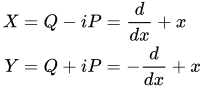
act on X is called the annihilation operator and Y the creation operator. They satisfy

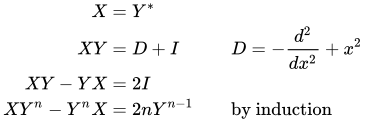
Define the functions
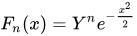
We claim they are the eigenfunctions of the harmonic oscillator, D. To prove this we use the commutation relations above:
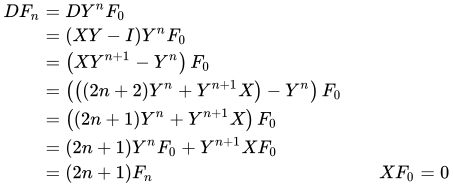
Next we have:

This is known for n = 0 and the commutation relation above yields

The nth Hermite function is defined by

pn is called the nth Hermite polynomial.
Let
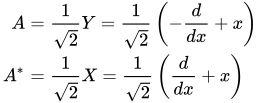
Thus

The operators P, Q or equivalently A, A* act irreducibly on by a standard argument.[27][28]
Indeed, under the unitary isomorphism with holomorphic Fock space can be identified with C[z], the space of polynomials in z, with
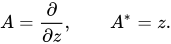
If a subspace invariant under A and A* contains a non-zero polynomial p(z), then, applying a power of A*, it contains a non-zero constant; applying then a power of A, it contains all zn.
Under the isomorphism Fn is sent to a multiple of zn and the operator D is given by

Let

so that
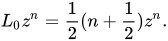
In the terminology of physics A, A* give a single boson and L0 is the energy operator. It is diagonalizable with eigenvalues 1/2, 1, 3/2, ...., each of multiplicity one. Such a representation is called a positive energy representation.
Moreover,
![{\displaystyle [L_{0},A]=-{1 \over 2}A,[L_{0},A^{*}]={1 \over 2}A^{*},}](https://wikimedia.org/api/rest_v1/media/math/render/svg/93373898723f0e8ed7ac49703545596e99198243)
so that the Lie bracket with L0 defines a derivation of the Lie algebra spanned by A, A* and I. Adjoining L0 gives the semidirect product. The infinitesimal version of the Stone–von Neumann theorem states that the above representation on C[z] is the unique irreducible positive energy representation of this Lie algebra with L0 = A*A + 1/2. For A lowers energy and A* raises energy. So any lowest energy vector v is annihilated by A and the module is exhausted by the powers of A* applied to v. It is thus a non-zero quotient of C[z] and hence can be identified with it by irreducibility.
Let
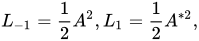
so that
![{\displaystyle [L_{-1},A]=0,\,\,\,[L_{-1},A^{*}]=A,\,\,\,[L_{1},A]=-A^{*},\,\,\,[L_{1},A^{*}]=0.}](https://wikimedia.org/api/rest_v1/media/math/render/svg/d8d087f2feb2c5ab72da5bd32a40e62512f25a08)
These operators satisfy:
![{\displaystyle [L_{m},L_{n}]=(m-n)L_{m+n}}](https://wikimedia.org/api/rest_v1/media/math/render/svg/d9afc439bf146a4940309cba9ef58dc50eaff07c)
and act by derivations on the Lie algebra spanned by A, A* and I.
They are the infinitesimal operators corresponding to the metaplectic representation of SU(1,1).
The functions Fn are defined by

It follows that the Hermite functions are the orthonormal basis obtained by applying the Gram-Schmidt orthonormalization process to the basis xn exp -x2/2 of .
The completeness of the Hermite functions follows from the fact that the Bargmann transform is unitary and carries the orthonormal basis en(z) of holomorphic Fock space onto the Hn(x).
The heat operator for the harmonic oscillator is the operator on L2(R) defined as the diagonal operator

It corresponds to the heat kernel given by Mehler's formula:
![K_{t}(x,y)\equiv \sum _{{n\geq 0}}e^{{-(2n+1)t}}H_{n}(x)H_{n}(y)=(4\pi t)^{{-{1 \over 2}}}\left({2t \over \sinh 2t}\right)^{{1 \over 2}}\exp \left(-{1 \over 4t}\left[{2t \over \tanh 2t}(x^{2}+y^{2})-{2t \over \sinh 2t}(2xy)\right]\right).](https://wikimedia.org/api/rest_v1/media/math/render/svg/2fb8dcd4232bad6140cd466612bbbf30b24dfc72)
This follows from the formula

To prove this formula note that if s = σ2, then by Taylor's formula

Thus Fσ,x lies in holomorphic Fock space and

an inner product that can be computed directly.
Wiener (1933, pp. 51–67) establishes Mehler's formula directly and uses a classical argument to prove that
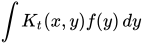
tends to f in L2(R) as t decreases to 0. This shows the completeness of the Hermite functions and also, since
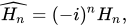
can be used to derive the properties of the Fourier transform.
There are other elementary methods for proving the completeness of the Hermite functions, for example using Fourier series.[29]
Sobolev spaces
The Sobolev spaces Hs, sometimes called Hermite-Sobolev spaces, are defined to be the completions of with respect to the norms
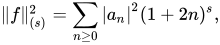
where
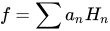
is the expansion of f in Hermite functions.[30]
Thus

The Sobolev spaces are Hilbert spaces. Moreover, Hs and H–s are in duality under the pairing
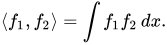
For s ≥ 0,

for some positive constant Cs.
Indeed, such an inequality can be checked for creation and annihilation operators acting on Hermite functions Hn and this implies the general inequality.[31]
It follows for arbitrary s by duality.
Consequently, for a quadratic polynomial R in P and Q

The Sobolev inequality holds for f in Hs with s > 1/2:

for any k ≥ 0.
Indeed, the result for general k follows from the case k = 0 applied to Qkf.
For k = 0 the Fourier inversion formula
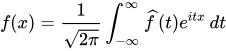
implies

If s < t, the diagonal form of D, shows that the inclusion of Ht in Hs is compact (Rellich's lemma).
It follows from Sobolev's inequality that the intersection of the spaces Hs is . Functions in are characterized by the rapid decay of their Hermite coefficients an.
Standard arguments show that each Sobolev space is invariant under the operators W(z) and the metaplectic group.[32] Indeed, it is enough to check invariance when g is sufficiently close to the identity. In that case

with D + A an isomorphism from to


It follows that

If then


where the derivatives lie in

Similarly the partial derivatives of total degree k of U(s)V(t)f lie in Sobolev spaces of order s–k/2.
Consequently, a monomial in P and Q of order 2k applied to f lies in Hs–k and can be expressed as a linear combination of partial derivatives of U(s)V(t)f of degree ≤ 2k evaluated at 0.
Smooth vectors
The smooth vectors for the Weyl commutation relations are those u in L2(R) such that the map
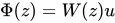
is smooth. By the uniform boundedness theorem, this is equivalent to the requirement that each matrix coefficient (W(z)u,v) be smooth.
A vector is smooth if and only it lies in .[33] Sufficiency is clear. For necessity, smoothness implies that the partial derivatives of W(z)u lie in L2(R) and hence also Dku for all positive k. Hence u lies in the intersection of the Hk, so in .
It follows that smooth vectors are also smooth for the metaplectic group.
Moreover, a vector is in if and only if it is a smooth vector for the rotation subgroup of SU(1,1).
Analytic vectors
If Π(t) is a one parameter unitary group and for f in
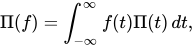
then the vectors Π(f)ξ form a dense set of smooth vectors for Π.
In fact taking
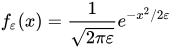
the vectors v = Π(fε)ξ converge to ξ as ε decreases to 0 and
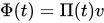
is an analytic function of t that extends to an entire function on C.
The vector is called an entire vector for Π.
The wave operator associated to the harmonic oscillator is defined by
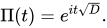
The operator is diagonal with the Hermite functions Hn as eigenfunctions:
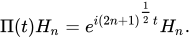
Since it commutes with D, it preserves the Sobolev spaces.
The analytic vectors constructed above can be rewritten in terms of the Hermite semigroup as

The fact that v is an entire vector for Π is equivalent to the summability condition
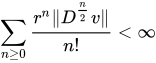
for all r > 0.
Any such vector is also an entire vector for U(s)V(t), that is the map

defined on R2 extends to an analytic map on C2.
This reduces to the power series estimate

So these form a dense set of entire vectors for U(s)V(t); this can also be checked directly using Mehler's formula.
The spaces of smooth and entire vectors for U(s)V(t) are each by definition invariant under the action of the metaplectic group as well as the Hermite semigroup.
Let

be the analytic continuation of the operators W(x,y) from R2 to C2 such that

Then W leaves the space of entire vectors invariant and satisfies

Moreover, for g in SL(2,R)

using the natural action of SL(2,R) on C2.
Formally

Oscillator semigroup
There is a natural double cover of the Olshanski semigroup H, and its closure that extends the double cover of SU(1,1) corresponding to the metaplectic group. It is given by pairs (g, γ) where g is an element of H or its closure
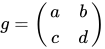
and γ is a square root of a.
Such a choice determines a unique branch of
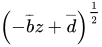
for z < 1.
The unitary operators π(g) for g in SL(2,R) satisfy

for u in C2.
An element g of the complexification SL(2,C) is said to implementable if there is a bounded operator T such that it and its adjoint leave the space of entire vectors for W invariant, both have dense images and satisfy the covariance relations

for u in C2. The implementing operator T is uniquely determined up to multiplication by a non-zero scalar.
The implementable elements form a semigroup, containing SL(2,R). Since the representation has positive energy, the bounded compact self-adjoint operators
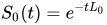
for t > 0 implement the group elements in exp C1.
It follows that all elements of the Olshanski semigroup and its closure are implemented.
Maximality of the Olshanki semigroup implies that no other elements of SL(2,C) are implemented. Indeed, otherwise every element of SL(2,C) would be implemented by a bounded operator, which would contradict the non-invertibility of the operators S0(t) for t > 0.
In the Schrödinger representation the operators S0(t) for t > 0 are given by Mehler's formula. They are contraction operators, positive and in every Schatten class. Moreover, they leave invariant each of the Sobolev spaces. The same formula is true for by analytic continuation.

It can be seen directly in the Fock model that the implementing operators can be chosen so that they define an ordinary representation of the double cover of H constructed above. The corresponding semigroup of contraction operators is called the oscillator semigroup. The extended oscillator semigroup is obtained by taking the semidirect product with the operators W(u). These operators lie in every Schatten class and leave invariant the Sobolev spaces and the space of entire vectors for W.
The decomposition
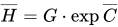
corresponds at the operator level to the polar decomposition of bounded operators.
Moreover, since any matrix in H is conjugate to a diagonal matrix by elements in H or H−1, every operator in the oscillator semigroup is quasi-similar to an operator S0(t) with . In particular it has the same spectrum consisting of simple eigenvalues.

In the Fock model, if the element g of the Olshanki semigroup H corresponds to the matrix

the corresponding operator is given by

where

and γ is a square root of a. Operators π(g,γ) for g in the semigroup H are exactly those that are Hilbert–Schmidt operators and correspond to kernels of the form

for which the complex symmetric matrix

has operator norm strictly less than one.
Operators in the extended oscillator semigroup are given by similar expressions with additional linear terms in z and w appearing in the exponential.
In the disk model for the two irreducible components of the metaplectic representation, the corresponding operators are given by

It is also possible to give an explicit formula for the contraction operators corresponding to g in H in the Schrödinger representation, It was by this formula that Howe (1988) introduced the oscillator semigroup as an explicit family of operators on L2(R).[34]
In fact consider the Siegel upper half plane consisting of symmetric complex 2x2 matrices with positive definite real part:
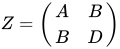
and define the kernel

with corresponding operator

for f in L2(R).
Then direct computation gives

where

Moreover,

where
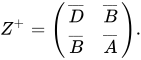
By Mehler's formula for

with

The oscillator semigroup is obtained by taking only matrices with B ≠ 0. From the above, this condition is closed under composition.
A normalized operator can be defined by
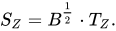
The choice of a square root determines a double cover.
In this case SZ corresponds to the element

of the Olshankii semigroup H.
Moreover, SZ is a strict contraction:

It follows also that

Weyl calculus
For a function a(x,y) on R2 = C, let

So

where

Defining in general

the product of two such operators is given by the formula

where the twisted convolution or Moyal product is given by

The smoothing operators correspond to W(F) or ψ(a) with F or a Schwartz functions on R2. The corresponding operators T have kernels that are Schwartz functions. They carry each Sobolev space into the Schwartz functions. Moreover, every bounded operator on L2 (R) having this property has this form.
For the operators ψ(a) the Moyal product translates into the Weyl symbolic calculus. Indeed, if the Fourier transforms of a and b have compact support than

where

This follows because in this case b must extend to an entire function on C2 by the Paley-Wiener theorem.
This calculus can be extended to a broad class of symbols, but the simplest corresponds to convolution by a class of functions or distributions that all have the form T + S where T is a distribution of compact with singular support concentrated at 0 and where S is a Schwartz function. This class contains the operators P, Q as well as D1/2 and D−1/2 where D is the harmonic oscillator.
The mth order symbols Sm are given by smooth functions a satisfying

for all α and Ψm consists of all operators ψ(a) for such a.
If a is in Sm and χ is a smooth function of compact support equal to 1 near 0, then

with T and S as above.
These operators preserve the Schwartz functions and satisfy;
![{\displaystyle \Psi ^{m}\cdot \Psi ^{m}\subseteq \Psi ^{m+n},\,\,\,\,[\Psi ^{m},\Psi ^{n}]\subseteq \Psi ^{m+n-2}.}](https://wikimedia.org/api/rest_v1/media/math/render/svg/48f800388874845d72ac941035e99e197e980a65)
The operators P and Q lie in Ψ1 and D lies in Ψ2.
Properties:
- A zeroth order symbol defines a bounded operator on L2(R).
- D−1 lies in Ψ−2
- If R = R* is smoothing, then D + R has a complete set of eigenvectors fn in with (D + R)fn = λnfn and λn tends to ≈ as n tends to ≈.
- D1/2 lies in Ψ1 and hence D−1/2 lies in Ψ−1, since D−1/2 = D1/2 ·D−1
- Ψ−1 consists of compact operators, Ψ−s consists of trace-class operators for s > 1 and Ψk carries Hm into Hm–k.
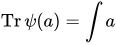
The proof of boundedness of Howe (1980) is particularly simple: if
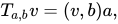
then
![{\displaystyle T_{W(z)a,b}=e^{|z|^{2}/2}[W(z)T_{a,E_{0}}W(z)^{-1}T_{E_{0},b}],}](https://wikimedia.org/api/rest_v1/media/math/render/svg/a7157b9c802a35ef1079a4bd65eaf32a11e5a7ba)
where the bracketed operator has norm less than . So if F is supported in z ≤ R, then


The property of D−1 is proved by taking

with
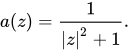
Then R = I – DS lies in Ψ−1, so that

lies in Ψ−2 and T = DA – I is smoothing. Hence

lies in Ψ−2 since D−1 T is smoothing.
The property for D1/2 is established similarly by constructing B in Ψ1/2 with real symbol such that D – B4 is a smoothing operator. Using the holomorphic functional calculus it can be checked that D1/2 – B2 is a smoothing operator.
The boundedness result above was used by Howe (1980) to establish the more general inequality of Alberto Calderón and Remi Vaillancourt for pseudodifferential operators. An alternative proof that applies more generally to Fourier integral operators was given by Howe (1988). He showed that such operators can be expressed as integrals over the oscillator semigroup and then estimated using the Cotlar-Stein lemma.[35]
Applications and generalizations
Theory for finite abelian groups
Weil (1964) noted that the formalism of the Stone–von Neumann theorem and the oscillator representation of the symplectic group extends from the real numbers R to any locally compact abelian group. A particularly simple example is provided by finite abelian groups, where the proofs are either elementary or simplifications of the proofs for R.[36][37]
Let A be a finite abelian group, written additively, and let Q be a non-degenerate quadratic form on A with values in T. Thus

is a symmetric bilinear form on A that is non-degenerate, so permits an identification between A and its dual group A* = Hom (A, T).
Let be the space of complex-valued functions on A with inner product

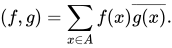
Define operators on V by

for x, y in A. Then U(x) and V(y) are unitary representations of A on V satisfying the commutation relations

This action is irreducible and is the unique such irreducible representation of these relations.
Let G = A × A and for z = (x, y) in G set

Then

where

a non-degenerate alternating bilinear form on G. The uniqueness result above implies that if W'(z) is another family of unitaries giving a projective representation of G such that

then there is a unitary U, unique up to a phase, such that

for some λ(z) in T.
In particular if g is an automorphism of G preserving B, then there is an essentially unique unitary π(g) such that

The group of all such automorphisms is called the symplectic group for B and π gives a projective representation of G on V.
The group SL(2.Z) naturally acts on G = A x A by symplectic automorphisms. It is generated by the matrices

If Z = –I, then Z is central and

These automorphisms of G are implemented on V by the following operators:

It follows that

where μ lies in T. Direct calculation shows that μ is given by the Gauss sum
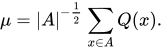
Transformation laws for theta functions
The metaplectic group was defined as the group

The coherent state
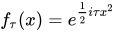
defines a holomorphic map of H into L2(R) satisfying

This is in fact a holomorphic map into each Sobolev space Hk and hence also .

On the other hand, in (in fact in H–1) there is a finite-dimensional space of distributions invariant under SL(2,Z) and isomorphic to the N-dimensional oscillator representation on where A = Z/NZ.


In fact let m > 0 and set N = 2m. Let

The operators U(x), V(y) with x and y in M all commute and have a finite-dimensional subspace of fixed vectors formed by the distributions
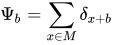
with b in M1, where
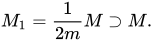
The sum defining Ψb converges in and depends only on the class of b in M1/M. On the other hand, the operators U(x) and V(y) with 'x, y in M1 commute with all the corresponding operators for M. So M1 leaves the subspace V0 spanned by the Ψb invariant. Hence the group A = M1 acts on V0. This action can immediately be identified with the action on V for the N-dimensional oscillator representation associated with A, since


Since the operators π(R) and π(S) normalise the two sets of operators U and V corresponding to M and M1, it follows that they leave V0 invariant and on V0 must be constant multiples of the operators associated with the oscillator representation of A. In fact they coincide. From R this is immediate from the definitions, which show that

For S it follows from the Poisson summation formula and the commutation properties with the operators U)x) and V(y). The Poisson summation is proved classically as follows.[38]
For a > 0 and f in let
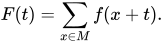
F is a smooth function on R with period a:

The theory of Fourier series shows that
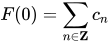
with the sum absolutely convergent and the Fourier coefficients given by

Hence
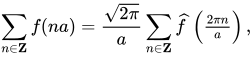
the usual Poisson summation formula.
This formula shows that S acts as follows

and so agrees exactly with formula for the oscillator representation on A.
Identifying A with Z/2mZ, with
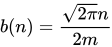
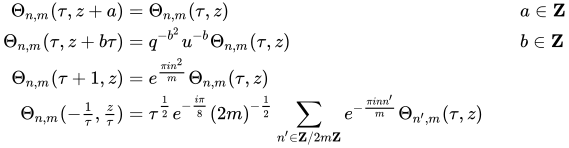
assigned to an integer n modulo 2m, the theta functions can be defined directly as matrix coefficients:[39]

For τ in H and z in C set

so that q < 1. The theta functions agree with the standard classical formulas for the Jacobi-Riemann theta functions:
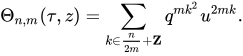
By definition they define holomorphic functions on H × C. The covariance properties of the function fτ and the distribution Ψb lead immediately to the following transformation laws:
Derivation of law of quadratic reciprocity
Because the operators π(S), π (R) and π(J) on L2(R) restrict to the corresponding operators on V0 for any choice of m, signs of cocycles can be determined by taking m = 1. In this case the representation is 2-dimensional and the relation

on L2(R) can be checked directly on V0.
But in this case
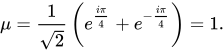
The relation can also be checked directly by applying both sides to the ground state exp -x2/2.
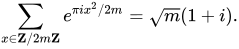
Consequently, it follows that for m ≥ 1 the Gauss sum can be evaluated:[40]
For m odd, define
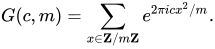
If m is odd, then, splitting the previous sum up into two parts, it follows that G(1,m) equals m1/2 if m is congruent to 1 mod 4 and equals i m1/2 otherwise. If p is an odd prime and c is not divisible by p, this implies
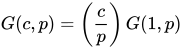
where is the Legendre symbol equal to 1 if c is a square mod p and –1 otherwise. Moreover, if p and q are distinct odd primes, then


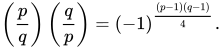
From the formula for G(1,p) and this relation, the law of quadratic reciprocity follows:
Theory in higher dimensions
The theory of the oscillator representation can be extended from R to Rn with the group SL(2,R) replaced by the symplectic group Sp(2n,R). The results can be proved either by straightforward generalisations from the one-dimensional case as in Folland (1989) or by using the fact that the n-dimensional case is a tensor product of n one-dimensional cases, reflecting the decomposition:

Let be the space of Schwartz functions on Rn, a dense subspace of L2(Rn). For s, t in Rn, define U(s) and V(t) on and L2(R) by

From the definition U and V satisfy the Weyl commutation relation

As before this is called the Schrödinger representation.
The Fourier transform is defined on by


shows that the Fourier transform is an isomorphism of onto itself extending to a unitary mapping of L2(Rn) onto itself (Plancherel's theorem).
The Stone–von Neumann theorem asserts that the Schrödinger representation is irreducible and is the unique irreducible representation of the commutation relations: any other representation is a direct sum of copies of this representation.
If U and V satisfying the Weyl commutation relations, define

Then

so that W defines a projective unitary representation of R2n with cocycle given by
where and B is the symplectic form on R2n given by

The symplectic group Sp (2n,R) is defined to be group of automorphisms g of R2n preserving the form B. It follows from the Stone–von Neumann theorem that for each such g there is a unitary π(g) on L2(R) satisfying the covariance relation
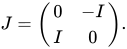
By Schur's lemma the unitary π(g) is unique up to multiplication by a scalar ζ with ζ = 1, so that π defines a projective unitary representation of Sp(n). Representatives can be chosen for π(g), unique up to a sign, which show that the 2-cocycle for the projective representation of Sp(2n,R) takes values ±1. In fact elements of the group Sp(n,R) are given by 2n × 2n real matrices g satisfying

where
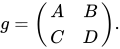
Sp(2n,R) is generated by matrices of the form

and the operators

satisfy the covariance relations above. This gives an ordinary unitary representation of the metaplectic group, a double cover of Sp(2n,R). Indeed, Sp(n,R) acts by Möbius transformations on the generalised Siegel upper half plane Hn consisting of symmetric complex n × n matrices Z with strictly imaginary part by

if
The function

satisfies the 1-cocycle relation

The metaplectic group Mp(2n,R) is defined as the group

and is a connected double covering group of Sp(2n,R).
If , then it defines a coherent state

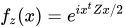
in L2, lying in a single orbit of Sp(2n) generated by
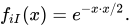
If g lies in Mp(2n,R) then

defines an ordinary unitary representation of the metaplectic group, from which it follows that the cocycle on Sp(2n,R) takes only values ±1.
Holomorphic Fock space is the Hilbert space of holomorphic functions f(z) on Cn with finite norm

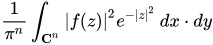
inner product

and orthonormal basis
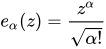
for α a multinomial. For f in and z in Cn, the operators

define an irreducible unitary representation of the Weyl commutation relations. By the Stone–von Neumann theorem there is a unitary operator from L2(Rn) onto intertwining the two representations. It is given by the Bargmann transform

where
![{\displaystyle B(z,t)=\exp[-z\cdot z-t\cdot t/2+z\cdot t].}](https://wikimedia.org/api/rest_v1/media/math/render/svg/101f91aa17392005abe32f05d47b4ec88cfb5a1f)
Its adjoint is given by the formula:


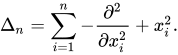
Sobolev spaces, smooth and analytic vectors can be defined as in the one-dimensional case using the sum of n copies of the harmonic oscillator
The Weyl calculus similarly extends to the n-dimensional case.
The complexification Sp(2n,C) of the symplectic group is defined by the same relation, but allowing the matrices A, B, C and D to be complex. The subsemigroup of group elements that take the Siegel upper half plane into itself has a natural double cover. The representations of Mp(2n,R) on L2(Rn) and extend naturally to a representation of this semigroup by contraction operators defined by kernels, which generalise the one-dimensional case (taking determinants where necessary). The action of Mp(2n,R) on coherent states applies equally well to operators in this larger semigroup.[41]
As in the 1-dimensional case, where the group SL(2,R) has a counterpart SU(1,1) through the Cayley transform with the upper half plane replaced by the unit disc, the symplectic group has a complex counterpart. Indeed, if C is the unitary matrix
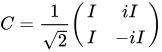
then C Sp(2n) C−1 is the group of all matrices
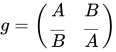
such that

or equivalently

where
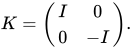
The Siegel generalized disk Dn is defined as the set of complex symmetric n x n matrices W with operator norm less than 1.
It consist precisely of Cayley transforms of points Z in the Siegel generalized upper half plane:

Elements g act on Dn

and, as in the one dimensional case this action is transitive. The stabilizer subgroup of 0 consists of matrices with A unitary and B = 0.
For W in Dn the metaplectic coherent states in holomorphic Fock space are defined by
The inner product of two such states is given by

Moreover, the metaplectic representation π satisfies

The closed linear span of these states gives the even part of holomorphic Fock space . The embedding of Sp(2n) in Sp(2(n+1)) and the compatible identification


lead to an action on the whole of . It can be verified directly that it is compatible with the action of the operators W(z).[42]
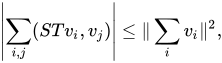
Since the complex semigroup has as Shilov boundary the symplectic group, the fact that this representation has a well-defined contractive extension to the semigroup follows from the maximum modulus principle and the fact that the semigroup operators are closed under adjoints. Indeed, it suffices to check, for two such operators S, T and vectors vi proportional to metaplectic coherent states, that
which follows because the sum depends holomorphically on S and T, which are unitary on the boundary.
Index theorems for Toeplitz operators
Let S denote the unit sphere in Cn and define the Hardy space H2(S) be the closure in L2(S) of the restriction of polynomials in the coordinates z1, ..., zn. Let P be the projection onto Hardy space. It is known that if m(f) denotes multiplication by a continuous function f on S, then the commutator [P,m(f)] is compact. Consequently, defining the Toeplitz operator by

on Hardy space, it follows that T(fg) – T(f)T(g) is compact for continuous f and g. The same holds if f and g are matrix-valued functions (so that the corresponding Toeplitz operators are matrices of operators on H2(S)). In particular if f is a function on S taking values in invertible matrices, then

are compact and hence T(f) is a Fredholm operator with an index defined as

The index has been computed using the methods of K-theory by Coburn (1973) and coincides up to a sign with the degree of f as a continuous mapping from S into the general linear group.
Helton & Howe (1975) gave an analytic way to establish this index theorem, simplied later by Howe. Their proof relies on the fact if f is smooth then the index is given by the formula of McKean and Singer:[43]

Howe (1980) noticed that there was a natural unitary isomorphism between H2(S) and L2(Rn) carrying the Toeplitz operators

onto the operators
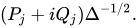
These are examples of zeroth order operators constructed within the Weyl calculus. The traces in the McKean-Singer formula can be computed directly using the Weyl calculus, leading to another proof of the index theorem.[44] This method of proving index theorems was generalised by Alain Connes within the framework of cyclic cohomology.[45]
Theory in infinite dimensions
The theory of the oscillator representation in infinite dimensions is due to Irving Segal and David Shale.[46] Graeme Segal used it to give a mathematically rigorous construction of projective representations of loop groups and the group of diffeomorphisms of the circle. At an infinitesimal level the construction of the representations of the Lie algebras, in this case the affine Kac–Moody algebra and the Virasoro algebra, was already known to physicists, through dual resonance theory and later string theory. Only the simplest case will be considered here, involving the loop group LU(1) of smooth maps of the circle into U(1) = T. The oscillator semigroup, developed independently by Neretin and Segal, allows contraction operators to be defined for the semigroup of univalent holomorphic maps of the unit disc into itself, extending the unitary operators corresponding to diffeomorphisms of the circle. When applied to the subgroup SU(1,1) of the diffeomorphism group, this gives a generalization of the oscillator representation on L2(R) and its extension to the Olshanskii semigroup.
The representation of commutation on Fock space is generalized to infinite dimensions by replacing Cn (or its dual space) by an arbitrary complex Hilbert space H. The symmetric group Sk acts on H⊗k. Sk(H) is defined to be the fixed point subspace of Sk and the symmetric algebra is the algebraic direct sum

It has a natural inner product inherited from H⊗k:

Taking the components Sk(H) to be mutually orthogonal, the symmetric Fock space S(H) is defined to be the Hilbert space completion of this direct sum.
For ξ in H define the coherent state eξ by
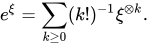
It follows that their linear span is dense in S(H), that the coherent states corresponding to n distinct vectors are linearly independent and that
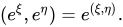
When H is finite-dimensional, S(H) can naturally be identified with holomorphic Fock space for H*, since in the standard way Sk(H) are just homogeneous polynomials of degree k on H* and the inner products match up. Moreover, S(H) has functorial properties. Most importantly

A similar result hold for finite orthogonal direct sums and extends to infinite orthogonal direct sums, using von Neumman's definition of the infinite tensor product with 1 the reference unit vector in S0(Hi). Any contraction operator between Hilbert spaces induces a contraction operator between the corresponding symmetric Fock spaces in a functorial way.
A unitary operator on S(H) is uniquely determined by it values on coherent states. Moreover, for any assignment vξ such that
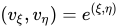
there is a unique unitary operator U on S(H) such that

As in the finite-dimensional case, this allows the unitary operators W(x) to be defined for x in H:

It follows immediately from the finite-dimensional case that these operators are unitary and satisfy

In particular the Weyl commutation relations are satisfied:

Taking an orthonormal basis en of H, S(H) can be written as an infinite tensor product of the S(C en). The irreducibility of W on each of these spaces implies the irreducibility of W on the whole of S(H). W is called the complex wave representation.
To define the symplectic group in infinite dimensions let HR be the underlying real vector space of H with the symplectic form

and real inner product

The complex structure is then defined by the orthogonal operator

so that

A bounded invertible operator real linear operator T on HR lies in the symplectic group if it and its inverse preserve B. This is equivalent to the conditions:

The operator T is said to be implementable on S(H) provided there is a unitary π(T) such that

The implementable operators form a subgroup of the symplectic group, the restricted symplectic group. By Schur's lemma, π(T) is uniquely determined up to a scalar in T, so π gives a projective unitary representation of this subgroup.
The Segal-Shale quantization criterion states that T is implementable, i.e. lies in the restricted symplectic group, if and only if the commutator TJ – JT is a Hilbert–Schmidt operator.
Unlike the finite-dimensional case where a lifting π could be chosen so that it was multiplicative up to a sign, this is not possible in the infinite-dimensional case. (This can be seen directly using the example of the projective representation of the diffeomorphism group of the circle constructed below.)
The projective representation of the restricted symplectic group can be constructed directly on coherent states as in the finite-dimensional case.[47]
In fact, choosing a real Hilbert subspace of H of which H is a complexification, for any operator T on H a complex conjugate of T is also defined. Then the infinite-dimensional analogue of SU(1,1) consists of invertible bounded operators
satisfying gKg* = K (or equivalently the same relations as in the finite-dimensional case). These belong to the restricted symplectic group if and only if B is a Hilbert–Schmidt operator. This group acts transitively on the infinite-dimensional analogue D≈ of the Seigel generalized unit disk consisting of Hilbert–Schmidt operators W that are symmetric with operator norm less than 1 via the formula

Again the stabilizer subgroup of 0 consists of g with A unitary and B = 0. The metaplectic coherent states fW can be defined as before and their inner product is given by the same formula, using the Fredholm determinant:

Define unit vectors by

and set

where μ(ζ) = ζ/ ζ . As before this defines a projective representation and, if g3 = g1g2, the cocycle is given by
![{\displaystyle {\omega (g_{1},g_{2})=\mu [\det(A_{3}(A_{1}A_{2})^{-1})^{-{\frac {1}{2}}}].}}](https://wikimedia.org/api/rest_v1/media/math/render/svg/6ac9c1c388e964aa41bc2e5e44bce24a4e5c4abd)
This representation extends by analytic continuation to define contraction operators for the complex semigroup by the same analytic continuation argument as in the finite-dimensional case. It can also be shown that they are strict contractions.
Example Let HR be the real Hilbert space consisting of real-valued functions on the circle with mean 0
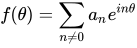
and for which
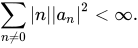
The inner product is given by

An orthogonal basis is given by the function sin(nθ) and cos(nθ) for n > 0. The Hilbert transform on the circle defined by

defines a complex structure on HR. J can also be written

where sign n = ±1 denotes the sign of n. The corresponding symplectic form is proportional to
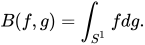
In particular if φ is an orientation-preserving diffeomorphism of the circle and

then Tφ is implementable.[48]
The operators W(f) with f smooth correspond to a subgroup of the loop group LT invariant under the diffeomorphism group of the circle. The infinitesimal operators corresponding to the vector fields
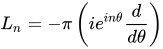
can be computed explicitly. They satisfy the Virasoro relations
![{\displaystyle {[L_{m},L_{n}]=(m-n)L_{m+n}+{m^{3}-m \over 12}\delta _{m+n,0}.}}](https://wikimedia.org/api/rest_v1/media/math/render/svg/08676c7b65acf1aef7b8b5c1b568db981f1afdda)
In particular they cannor be adjusted by addition of scalar operators to remove the second term on the right hand side. This shows that the cocycle on the restricted symplectic group is not equivalent to one taking only the values ±1.
See also
Notes
- ^ Folland 1989
- ^ Hilgert & Neeb 1993, pp. 59–60
- ^ Hilgert & Neeb 1993, pp. 250–253
- ^ Lawson 1998, pp. 146–147
- ^ Ferrara et al. 1973
- ^ Lawson 2011, p. 140
- ^ Helgason 1978
- ^ See: Lawson 1998 and Hilgert & Neeb 1993, pp. 48–56
- ^ Hörmander 1983, pp. 160–163
- ^ Folland 1989, pp. 35–36
- ^ von Neumann 1929
- ^ Lang 1985, p. 209
- ^ Pressley & Segal 1986
- ^ Lion & Vergne 1980, pp. 73–83
- ^ Folland 1989
- ^ Hall 2013, pp. 299–300
- ^ Hall 2013, pp. 297–299
- ^ Hall 2013, pp. 300–301
- ^ Folland 1989
- ^ Folland 1989, pp. 181–184
- ^ He 2007
- ^ Itzykson 1967
- ^ Folland 1989
- ^ Folland 1989, p. 94
- ^ Folland (1989, pp. 210–215)
- ^ He 2007
- ^ Howe & Tan 1992
- ^ Kac & Raina 1987
- ^ Igusa 1972
- ^ Sohrab 1981
- ^ Goodman & Wallach 1984
- ^ Goodman & Wallach 1984
- ^ Goodman 1969
- ^ Folland 1989, pp. 223–255
- ^ Folland 1989, pp. 121–129
- ^ Mumford, Nori & Norman 2006
- ^ Igusa 1972
- ^ Hörmander 1983, pp. 178–179
- ^ See:
- ^ Lion & Vergne 1980, pp. 149–161
- ^ Folland 1989
- ^ Segal 1981, pp. 315–320
- ^ Hörmander 1985, p. 188
- ^ See:
- Helton & Howe 1975
- Hörmander 1985, Chapter XIX
- ^ Connes 1990
- ^ See:
- ^ Segal 1981, pp. 315–320
- ^ See:
References
- Baez, J. C.; Segal, I. E.; Zhou, Z.-F.; Kon, Mark A. (1992), "Introduction to algebraic and constructive quantum field theory", Physics Today, Princeton University Press, 46 (12): 43, Bibcode:1993PhT....46l..43B, doi:10.1063/1.2809125, ISBN 0-691-08546-3, S2CID 120693408
- Bargmann, V. (1970), Group representations on Hilbert spaces of analytic functions, Analytic methods in mathematical physics, Gordon and Breach, pp. 27–63
- Berg, M. C. (2000), The Fourier-analytic proof of quadratic reciprocity, Pure and Applied Mathematics, Wiley-Interscience, ISBN 0-471-35830-4
- Brunet, M.; Kramer, P. (1980), "Complex extension of the representation of the symplectic group associated with the canonical commutation relations", Reports on Mathematical Physics, 17 (2): 205–215, Bibcode:1980RpMP...17..205B, doi:10.1016/0034-4877(80)90063-4
- Đokovic, D. Z.; Hofmann, K.-H. (1997), "The surjectivity question for the exponential function of real Lie groups: a status report", Journal of Lie Theory, 7: 171–199
- Coburn, L. A. (1973), "Singular integral operators and Toeplitz operators on odd spheres", Indiana University Mathematics Journal, 23 (5): 433–439, doi:10.1512/iumj.1974.23.23036
- Connes, A. (1990), Géométrie non commutative, InterEditions, ISBN 2-7296-0284-4
- Ferrara, S.; Mattiolia, G.; Rossic, G.; Toller, M. (1973), "Semi-group approach to multiperipheral dynamics", Nuclear Physics B, 53 (2): 366–394, Bibcode:1973NuPhB..53..366F, doi:10.1016/0550-3213(73)90451-3
- Folland, G. B. (1989), Harmonic analysis in phase space, Annals of Mathematics Studies, vol. 122, Princeton University Press, ISBN 9780691085289
- Goddard, Peter; Olive, David (1988), Kac-Moody and Virasoro Algebras: A Reprint Volume for Physicists, Advanced series in mathematical physics, vol. 3, World Scientific, ISBN 9789971504205
- Goodman, R. (1969), "Analytic and entire vectors for representations of Lie groups", Transactions of the American Mathematical Society, 143: 55–76, doi:10.1090/s0002-9947-1969-0248285-6
- Goodman, R.; Wallach, N. R. (1984), "Structure and unitary cocycle representations of loop groups and the group of diffeomorphisms of the circle", Journal für die Reine und Angewandte Mathematik, 347: 69–133
- Hall, B. C. (2013), Quantum Theory for Mathematicians, Springer
- He, H. (2007), "Functions on symmetric spaces and oscillator representation", Journal of Functional Analysis, 244 (2): 536–564, doi:10.1016/j.jfa.2006.11.008
- Helton, J. W.; Howe, R. E. (1975), "Traces of commutators of integral operators", Acta Mathematica, 135: 271–305, doi:10.1007/bf02392022
- Helgason, Sigurdur (1978), Differential geometry, Lie groups, and symmetric spaces, Academic Press, ISBN 978-0-8218-2848-9
- Hilgert, J.; Neeb, K.-H. (1993), Lie semigroups and their applications, Lecture Notes in Mathematics, vol. 1552, Springer-Verlag, ISBN 0387569545
- Hille, E. (1940), "Contributions to the theory of Hermitian series. II. The representation problem", Transactions of the American Mathematical Society, 47: 80–94, doi:10.1090/s0002-9947-1940-0000871-3
- Hörmander, Lars (1983), Analysis of Partial Differential Operators I, Springer-Verlag, ISBN 3-540-12104-8
- Hörmander, Lars (1985), Analysis of Partial Differential Operators III, Springer-Verlag, ISBN 3-540-13828-5
- Howe, R. (1980), "Quantum mechanics and partial differential equations", Journal of Functional Analysis, 38 (2): 188–254, doi:10.1016/0022-1236(80)90064-6
- Howe, R. (1988), "The Oscillator Semigroup", Proceedings of Symposia in Pure Mathematics, American Mathematical Society, 48: 61–132, doi:10.1090/pspum/048/974332, ISBN 9780821814826
- Howe, R.; Tan, Eng-Chye (1992), Non-abelian harmonic analysis: applications of SL(2,R), Universitext, Springer-Verlag, ISBN 0387977686
- Igusa, J. (1972), Theta functions, Die Grundlehren der mathematischen Wissenschaften, vol. 194, Springer-Verlag
- Itzykson, C. (1967), "Remarks on boson commutation rules", Communications in Mathematical Physics, 4 (2): 92–122, Bibcode:1967CMaPh...4...92I, doi:10.1007/bf01645755, S2CID 121928828
- Kashiwara, M.; Vergne, M. (1978), "On the Segal–Shale–Weil representations and harmonic polynomials", Inventiones Mathematicae, 44: 1–47, Bibcode:1978InMat..44....1K, doi:10.1007/bf01389900, S2CID 121545402
- Kac, V.G.; Raina, A.K. (1987), Bombay lectures on highest weight representations, World Scientific, ISBN 9971503956
- Kac, V.G. (1990), Infinite dimensional Lie algebras (3rd ed.), Cambridge University Press, ISBN 0521466938
- Kramer, P.; Moshinsky, M.; Seligman, T. H. (1975), Complex extensions of canonical transformations and quantum mechanics, Group Theory and its Applications, vol. 3, Academic Press
- Lang, S. (1985), SL2(R), Graduate Texts in Mathematics, vol. 105, Springer-Verlag, ISBN 0-387-96198-4
- Lawson, J. D. (1998), "Semigroups in Möbius and Lorentzian geometry", Geometriae Dedicata, 70 (2): 139–180, doi:10.1023/a:1004906126006, S2CID 116687780
- Lawson, J. D. (2011), "Semigroups of Olshanski type", in Hofmann, K. H.; Lawson, J. D.; Vinberg, E. B. (eds.), Semigroups in Algebra, Geometry and Analysis, Walter de Gruyter, pp. 121–158, ISBN 9783110885583
- Lion, G.; Vergne, M. (1980), The Weil representation, Maslov index and theta series, Progress in Mathematics, vol. 6, Birkhäuser, ISBN 3-7643-3007-4
- Mackey, G. W. (1989), Unitary group representations in physics, probability, and number theory (2nd ed.), Addison-Wesley, ISBN 0-201-51009-X
- Mumford, D.; Nori, M.; Norman, P. (2006), Tata Lectures on Theta III, Progress in mathematics, Springer, ISBN 0817645705
- Neretin, Y. A. (1996), Categories of symmetries and infinite-dimensional groups, London Mathematical Society Monographs, vol. 16, Oxford University Press, ISBN 0-19-851186-8
- von Neumann, J. (1932), "Ueber Einen Satz Von Herrn M. H. Stone", Annals of Mathematics, 33 (3): 567–573, doi:10.2307/1968535, JSTOR 1968535
- Olshanskii, G. I. (1981), "Invariant cones in Lie algebras, Lie semigroups and the holomorphic discrete series", Functional Analysis and Its Applications, 15 (4): 275–285, doi:10.1007/bf01106156, S2CID 121254166
- Pressley, A.; Segal, G. B. (1986), Loop groups, Oxford Mathematical Monographs, Oxford University Press, ISBN 0-19-853535-X
- Segal, G. B. (1981), "Unitary representations of some infinite-dimensional groups", Communications in Mathematical Physics, 80 (3): 301–342, Bibcode:1981CMaPh..80..301S, doi:10.1007/bf01208274, S2CID 121367853
- Sohrab, H. H. (1981), "The C∗-algebra of the n-dimensional harmonic oscillator", Manuscripta Mathematica, 34: 45–70, doi:10.1007/bf01168709, S2CID 119837229
- Thangavelu, S. (1993), Lectures on Hermite and Laguerre expansions, Mathematical Notes, vol. 42, Princeton University Press, ISBN 0-691-00048-4
- Weil, A. (1964), "Sur certains groupes d'opérateurs unitaires", Acta Mathematica, 111: 143–211, doi:10.1007/BF02391012
- Wiener, N. (1933), The Fourier integral and certain of its applications (1988 reprint of the 1933 edition), Cambridge University Press, ISBN 0-521-35884-1
- Yoshida, H. (1992), "Remarks on metaplectic representations of SL(2)", Journal of the Mathematical Society of Japan, 44 (3): 351–373, doi:10.2969/jmsj/04430351