
Algebra of physical space
 | This article includes a list of references, related reading or external links, but its sources remain unclear because it lacks inline citations. (March 2021) |
In physics, the algebra of physical space (APS) is the use of the Clifford or geometric algebra Cl3,0(R) of the three-dimensional Euclidean space as a model for (3+1)-dimensional spacetime, representing a point in spacetime via a paravector (3-dimensional vector plus a 1-dimensional scalar).
The Clifford algebra Cl3,0(R) has a faithful representation, generated by Pauli matrices, on the spin representation C2; further, Cl3,0(R) is isomorphic to the even subalgebra Cl[0]
3,1(R) of the Clifford algebra Cl3,1(R).
APS can be used to construct a compact, unified and geometrical formalism for both classical and quantum mechanics.
APS should not be confused with spacetime algebra (STA), which concerns the Clifford algebra Cl1,3(R) of the four-dimensional Minkowski spacetime.
Special relativity
Spacetime position paravector
In APS, the spacetime position is represented as the paravector

where the time is given by the scalar part x0 = t, and e1, e2, e3 are the standard basis for position space. Throughout, units such that c = 1 are used, called natural units. In the Pauli matrix representation, the unit basis vectors are replaced by the Pauli matrices and the scalar part by the identity matrix. This means that the Pauli matrix representation of the space-time position is

Lorentz transformations and rotors
The restricted Lorentz transformations that preserve the direction of time and include rotations and boosts can be performed by an exponentiation of the spacetime rotation biparavector W

In the matrix representation the Lorentz rotor is seen to form an instance of the SL(2,C) group (special linear group of degree 2 over the complex numbers), which is the double cover of the Lorentz group. The unimodularity of the Lorentz rotor is translated in the following condition in terms of the product of the Lorentz rotor with its Clifford conjugation

This Lorentz rotor can be always decomposed in two factors, one Hermitian B = B†, and the other unitary R† = R−1, such that

The unitary element R is called a rotor because this encodes rotations, and the Hermitian element B encodes boosts.
Four-velocity paravector
The four-velocity, also called proper velocity, is defined as the derivative of the spacetime position paravector with respect to proper time τ:
![{\displaystyle u={\frac {dx}{d\tau }}={\frac {dx^{0}}{d\tau }}+{\frac {d}{d\tau }}(x^{1}\mathbf {e} _{1}+x^{2}\mathbf {e} _{2}+x^{3}\mathbf {e} _{3})={\frac {dx^{0}}{d\tau }}\left[1+{\frac {d}{dx^{0}}}(x^{1}\mathbf {e} _{1}+x^{2}\mathbf {e} _{2}+x^{3}\mathbf {e} _{3})\right].}](https://wikimedia.org/api/rest_v1/media/math/render/svg/967f348960bee074906ea34dd868523aeb51c88d)
This expression can be brought to a more compact form by defining the ordinary velocity as

and recalling the definition of the gamma factor:
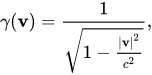
so that the proper velocity is more compactly:

The proper velocity is a positive unimodular paravector, which implies the following condition in terms of the Clifford conjugation

The proper velocity transforms under the action of the Lorentz rotor L as

Four-momentum paravector
The four-momentum in APS can be obtained by multiplying the proper velocity with the mass as


Classical electrodynamics
The electromagnetic field, potential and current
The electromagnetic field is represented as a bi-paravector F:


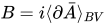
The source of the field F is the electromagnetic four-current:




 (는)
(는) The electromagnetic field is covariant under Lorentz transformations according to the law

Maxwell's equations and the Lorentz force
The Maxwell equations can be expressed in a single equation:

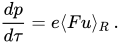
The Lorentz force equation takes the form
Electromagnetic Lagrangian
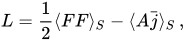
The electromagnetic Lagrangian is
Relativistic quantum mechanics
The Dirac equation, for an electrically charged particle of mass m and charge e, takes the form:

Classical spinor
The differential equation of the Lorentz rotor that is consistent with the Lorentz force is
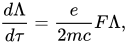

 (를) 찾기 위해 통합될 수 있다.
See also
- Paravector
- Multivector
- wikibooks:Physics in the Language of Geometric Algebra. An Approach with the Algebra of Physical Space
- Dirac equation in the algebra of physical space
- Algebra
References
Textbooks
- Baylis, William (2002). Electrodynamics: A Modern Geometric Approach (2nd ed.). ISBN 0-8176-4025-8.
- Baylis, William, ed. (1999) [1996]. Clifford (Geometric) Algebras: with applications to physics, mathematics, and engineering. Springer. ISBN 978-0-8176-3868-9.
- Doran, Chris; Lasenby, Anthony (2007) [2003]. Geometric Algebra for Physicists. Cambridge University Press. ISBN 978-1-139-64314-6.
- Hestenes, David (1999). New Foundations for Classical Mechanics (2nd ed.). Kluwer. ISBN 0-7923-5514-8.
Articles
- Baylis, W E (2004). "Relativity in introductory physics". Canadian Journal of Physics. 82 (11): 853–873. arXiv:physics/0406158. Bibcode:2004CaJPh..82..853B. doi:10.1139/p04-058. S2CID 35027499.
- Baylis, W E; Jones, G (7 January 1989). "The Pauli algebra approach to special relativity". Journal of Physics A: Mathematical and General. 22 (1): 1–15. Bibcode:1989JPhA...22....1B. doi:10.1088/0305-4470/22/1/008.
- Baylis, W. E. (1 March 1992). "Classical eigenspinors and the Dirac equation". Physical Review A. 45 (7): 4293–4302. Bibcode:1992PhRvA..45.4293B. doi:10.1103/physreva.45.4293. PMID 9907503.
- Baylis, W. E.; Yao, Y. (1 July 1999). "Relativistic dynamics of charges in electromagnetic fields: An eigenspinor approach". Physical Review A. 60 (2): 785–795. Bibcode:1999PhRvA..60..785B. doi:10.1103/physreva.60.785.
Number systems | |
|---|---|
| Countable sets | |
| Composition algebras |
|
| 분할 종류들 | |
| 기타 하이퍼 복합체 | |
| 기타유형 | |


