확률론 에서 역가우스 분포 (Wald 분포 라고도 함)는 (0,920)를 지지하는 연속 확률 분포 의 2-모수 계열이다.null
확률밀도함수 는 다음과 같다.
f ( x ; μ , λ ) = λ 2 π x 3 생략하다 ( − λ ( x − μ ) 2 2 μ 2 x ) {\displaystyle f(x;\mu ,\bigda )={\sqrt {}{{2\pi x^{3}}}}\exp {\biggl (}-{{\frac {\biggl)(}-{\frac {\mu )^{2\x}}}}}}}}}}}}}}}}}}}}}}}}}}}}}}}}}}}}}}}* x > 0의 경우, 여기서 μ 0 {\displaystyle \mu >0} and {\displaystyle da >0} [1] null
역 가우스 분포는 가우스 분포와 유사한 여러 특성을 가지고 있다. 이름은 오해의 소지가 있을 수 있는데, 가우스안은 정해진 시간에 브라운 운동 레벨 을 기술하는 반면, 역 가우스안은 긍정적인 표류를 가진 브라운 운동이 고정된 양수 수준에 도달하는 시간의 분포를 기술한다. null
누적 생성 함수(특성 함수의 로그)는 가우스 랜덤 변수의 누적 생성 함수의 역이다. null
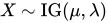
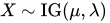
랜덤 변수 X 가 평균 μ와 형상 파라미터 parameter으로 가우스 분포를 역분산한다는 것을 나타내기 위해 X IG ( μ , ){\ displaystyle X\sim \operatorname {IG}(\mu ,\lambda )\,\} (!}).
특성. 단일 매개변수 양식 역가우스 분포의 확률밀도함수(pdf)는 다음과 같은 단일 매개변수 형태를 가진다.
f ( x ; μ , μ 2 ) = μ 2 π x 3 생략하다 ( − ( x − μ ) 2 2 x ) . {\displaystyle f(x;\mu ,\mu ^{2})={\frac {2\pi x^{3}}}\exp {\biggl (}-{{\frac {(x-\mu )^{2x}{\biggr )}. } 이 형태에서 분포의 평균 E ] Var {\displaystyle \mathb {E}[X]={\text{Var}(X . }
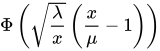
또한 단일 모수 역가우스 분포의 누적분포함수(cdf)는 다음과 같은 방법으로 표준 정규 분포와 관련이 있다.
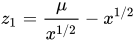
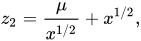
PR ( X < x ) = Φ ( z 1 ) + e μ Φ ( z 2 ) , 을 위해 0 < x ≤ μ , PR ( X > x ) = Φ ( − z 1 ) − e μ Φ ( z 2 ) , 을 위해 x ≥ μ . {\displaystyle {\begin{aligned}\Pr(X<x)&=\Phi (z_{1})+e^{\mu }\Phi (z_{2}),&{\text{for}}&\quad 0<x\leq \mu ,\\\Pr(X>x)&=\Phi (-z_{1})-e^{\mu }\Phi (z_{2}),&{\text{for}}&\quad x\geq \mu .\end{aligned}}} where z 1 = μ x 1 / 2 − x 1 / 2 {\displaystyle z_{1}={\frac {\mu }{x^{1/2}}}-x^{1/2}} z 2 = μ x 1 / 2 + x 1 / 2 , {\displaystyle z_{2}={\frac {\mu }{x^{1/2}}}+x^{1/2},} Φ {\displaystyle \Phi } 변수 z 1 {\ displaystyle z_{1}, z 2 {\ displaystyle z_{2 z 2 1 2 4μ . {\displaysty z_{2}^{2}=z_{1}^{2}+4\mu .}
단일 파라미터 양식에서 MGF는
M ( t ) = 생략하다 [ μ ( 1 − 1 − 2 t ) ] . {\displaystyle M(t)=\exp[\mu(1-{\sqrt{1-2t}). } An inverse Gaussian distribution in double parameter form f ( x ; μ , λ ) {\displaystyle f(x;\mu ,\lambda )} f ( y ; μ 0 , μ 0 2 ) {\displaystyle f(y;\mu _{0},\mu _{0}^{2})} y = μ 2 x λ , {\displaystyle y={\frac {\mu ^{2}x}{\lambda }},} μ 0 μ μd displaystyle \mu _{0}=\mu ^{3}/\muda .}
역가우스 분포의 표준 형식은
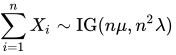
f ( x ; 1 , 1 ) = 1 2 π x 3 생략하다 ( − ( x − 1 ) 2 2 x ) . {\displaystyle f(x;1,1)={\frac {1}{\sqrt{2\pi x^{3}}}}\exp {\biggl (}-{\frac {(x-1)^{2x}{\biggr )}. } 합계 X 에i IG μ 0 w i λ w i {\ displaystyle \operatorname {IG}(\mu _{0}w_{i}^{2 , i = 1, 2, ..., n 에 대한 분포가 모두 독립된 경우, 그 다음, X 에i 독립 된 경우,
S = ∑ i = 1 n X i ∼ IG ( μ 0 ∑ w i , λ 0 ( ∑ w i ) 2 ) . {\displaystyle S=\sum _{i=1}^{n}X_{i}\sim \operatorname { IG} \left(\mu _{0}\sum w_{i},\lambda _{0}\left(\sum w_{i}\right)^{2}\right). } 참고:
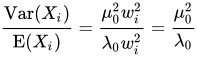
VAR ( X i ) E ( X i ) = μ 0 2 w i 2 λ 0 w i 2 = μ 0 2 λ 0 {\displaystyle {\frac {\operatorname {Var}(X_{i}){\operatorname {E}(X_{i}) }}}={\frac{\mu _{0}^{2}w_{i}^{2}}:{\flada _{0}w_{i}^{2}}={\frac {\mu _{0}^{0}}}}{0}}:{0}}}:{0}}}}}}}}}}}}}}}}}}}}}}}}}}}}}}}}}}}}}}}}}:} 모든 나 에겐 일정하다. 이것은 합산을 위해 필요한 조건 이다. 그렇지 않으면 S 는 역 가우스 분포가 아닐 것이다. null
스케일링 어떤 t > 0에 대해서도 그것은 다음을 지탱한다.
X ∼ IG ( μ , λ ) ⇒ t X ∼ IG ( t μ , t λ ) . {\displaystyle X\sim \operatorname {IG}(\mu ,\lambda )\,\,\,\,\,\,\,\,\,\,\,\,\,\,\,\,\,\,\X\sim\\\\operatorname {IG}(t\mu ,t\mu ,t\\\\\\\\\\mu ,t\\\\\\\\\\\\\\\\\\\\\\\\\\\\ } 지수군 역가우스 분포는 자연적 모수 -³/(2μ2 ) 및 -³/2와 자연 통계 X 와 1 /X를 갖는 2-모수 지수 계열 이다. null
브라운 운동과의 관계 확률적 공정 X 는t
X 0 = 0 {\displaystyle X_{0}=0\quad } X t = ν t + σ W t {\displaystyle X_{t}=\nu t+\sigma W_{t}\quad \quad \quad } 여기서 W 는t 브라운 운동 이다. 즉, X 는t ν {\displaystyle \nu >0} .
그런 다음 X 에t α {\displaystyle \alpha >0} 대한 첫 번째 통과 시간 은 반 가우스파에 따라 분포한다.
T α = 바 조로 { t > 0 ∣ X t = α } ∼ IG ( α ν , ( α σ ) 2 ) = α σ 2 π x 3 생략하다 ( − ( α − ν x ) 2 2 σ 2 x ) {\displaystyle T_{\alpha }=\inf\{t}0\mid X_{t}=\alpha \}\sim \operatorname { IG} \left({\frac {\alpha }{\nu }},\left({\frac {\alpha }{\sigma }}\right)^{2}\right)={\frac {\alpha }{\sigma {\sqrt {2\pi x^{3}}}}}\exp {\biggl (}-{\frac {(\alpha -\nu x)^{2}}{2\sigma ^{2}x}}{\biggr )}} 즉
P ( T α ∈ ( T , T + d T ) ) = α σ 2 π T 3 생략하다 ( − ( α − ν T ) 2 2 σ 2 T ) d T {\displaystyle P(T_{\alpha }\in (T,T+dT)) ={\frac {\alpha }{\sigma {2\pi T^{3}}}\exp {\biggl (}-{{-{\frac {(\alpha -\nu T)^{2}}:{2\sigma ^{2} T}{\biggr )}d T} (cf. Schrödinger[2] [3] [4] null
첫 번째 통행시간 분포의 유도
다음과 같이 정의된{\displaystyle \nu } X t {\ displaystyle X_{t}
X t = ν t + σ W t , X ( 0 ) = x 0 {\displaystyle X_{t}=\nu t+\sigma W_{t},\quad X(0)=x_{0}}}} 그리고 공정이 첫 번째 통과 시간으로 알려진 장벽 α displaystyle \alpha {0}} 대한 확률밀도함수 를 찾기를 원한다고 가정하자. 확률 분포 p t x ){\displaystyle p(t,x)} Fokker-Planck 방정식 은 다음과
∂ p ∂ t + ν ∂ p ∂ x = 1 2 σ 2 ∂ 2 p ∂ x 2 , { p ( 0 , x ) = δ ( x − x 0 ) p ( t , α ) = 0 {\displaystyle {\partial p \over {\partial t}}+\nu {\partial p \over {\partial x}}={1 \over {2}}\sigma ^{2}{\partial ^{2}p \over {\partial x^{2}}},\quad {\begin{cases}p(0,x)&=\delta (x-x_{0})\\p(t,\alpha )&=0\end{cases}}} 여기서 Δ {\displaystyle \delta (\cdot )} Dirac 델타 함수 다. 이것 조건 t α {\displaystyle p(t,\alpha )=0} 경계 값 문제 (BVP) 영상의 방법 으로 해결할 수 있다.초기 조건에 따라 φ t x {\displaystyle \varphi (t,x 해결책 은 다음과 같다.
φ ( t , x ) = 1 2 π σ 2 t 생략하다 [ − ( x − x 0 − ν t ) 2 2 σ 2 t ] {\displaystyle \varphi(t,x)={1\over {\sqrt {2\pi \pi \{2}t}}\exp \left[-{{(x-x_{0}-\nu t)^{2}t}}}{2\rigma \right]}}} 점 m {\displaystyle m} ( 정의 m>\alpha }. . 이는 초기 조건이 다음과 같이 강화되어야 함을 의미한다.
p ( 0 , x ) = δ ( x − x 0 ) − A δ ( x − m ) {\displaystyle p(0,x)=\delta(x-x_{0})-A\delta(x-m)} 여기 {\displaystyle A} BVP의 선형성 때문에 이 초기 조건을 가진 Fokker-Planck 방정식의 해결책은 다음과 같다.
p ( t , x ) = 1 2 π σ 2 t { 생략하다 [ − ( x − x 0 − ν t ) 2 2 σ 2 t ] − A 생략하다 [ − ( x − m − ν t ) 2 2 σ 2 t ] } {\displaystyle p(t,x)={1 \over {\sqrt {2\pi \sigma ^{2}t}}}\left\{\exp \left[-{(x-x_{0}-\nu t)^{2} \over {2\sigma ^{2}t}}\right]-A\exp \left[-{(x-m-\nu t)^{2} \over {2\sigma ^{2}t}}\right]\right\}} 이제 A . 완전 흡수 경계 조건은 다음을 의미한다.
( α − x 0 − ν t ) 2 = − 2 σ 2 t 통나무를 하다 A + ( α − m − ν t ) 2 {\displaystyle(\alpha -x_{0}-\nu t)^{2}=-2\sigma ^{2}t\log A+(\alpha -m-\nu t)^{2}} At p ( 0 , α ) {\displaystyle p(0,\alpha )} ( α − x 0 ) 2 = ( α − m ) 2 ⟹ m = 2 α − x 0 {\displaystyle (\alpha -x_{0})^{2}=(\alpha -m)^{2}\implies m=2\alpha -x_{0}}
A = e 2 ν ( α − x 0 ) / σ 2 {\displaystyle A=e^{2\nu(\alpha -x_{0})/\sigma ^{2}} 따라서 BVP에 대한 전체 해결책은 다음과 같다.
p ( t , x ) = 1 2 π σ 2 t { 생략하다 [ − ( x − x 0 − ν t ) 2 2 σ 2 t ] − e 2 ν ( α − x 0 ) / σ 2 생략하다 [ − ( x + x 0 − 2 α − ν t ) 2 2 σ 2 t ] } {\displaystyle p(t,x)={1 \over {\sqrt {2\pi \sigma ^{2}t}}}\left\{\exp \left[-{(x-x_{0}-\nu t)^{2} \over {2\sigma ^{2}t}}\right]-e^{2\nu (\alpha -x_{0})/\sigma ^{2}}\exp \left[-{(x+x_{0}-2\alpha -\nu t)^{2} \over {2\sigma ^{2}t}}\right]\right\}} 이제 전체 확률밀도함수를 갖게 되었으므로, 첫 번째 통과시간 분포 t ){\displaystyle f(t)} . 가장 간단한 경로는 먼저 생존 함수 {\displaystyle S(t
S ( t ) = ∫ − ∞ α p ( t , x ) d x = Φ ( α − x 0 − ν t σ t ) − e 2 ν ( α − x 0 ) / σ 2 Φ ( − α + x 0 − ν t σ t ) {\displaystyle {\begin}S(t)&=\int _{-\infit }^{\p(t,x)dx\&=\\\\\\\\ Phi \left({\alpha -x_{0}-\nu t \over {\sigma {\sqrt{t}}}\i1\e^{2\nu(\alpha -x_{0})/\sigma ^{2}}\\ Phi \left({-\alpha +x_{0}-\nu t \over {\sigma {\sqrt{t}}\오른쪽)\end{aigned}}} 여기서 φ ⋅ {\displaystyle \Phi (\cdot )} 정규 분포 의 누적 분포 함수 다 생존 함수는 브라운 운동 프로세스가 어느 순간 t {\displaystyle t} α {\displaystyle \alpha } . f t ){\displaystystyle (t)}
f ( t ) = − d S d t = ( α − x 0 ) 2 π σ 2 t 3 e − ( α − x 0 − ν t ) 2 / 2 σ 2 t {\displaystyle {\begin{aligned}f(t)&=-{dS \over {dt}}\\&={(\alpha -x_{0}) \over {\sqrt {2\pi \sigma ^{2}t^{3}}}}e^{-(\alpha -x_{0}-\nu t)^{2}/2\sigma ^{2}t}\end{aligned}}} x 0 0 {\displaystyle x_{0}=0} (
f ( t ) = α 2 π σ 2 t 3 e − ( α − ν t ) 2 / 2 σ 2 t ∼ IG [ α ν , ( α σ ) 2 ] {\displaystyle f(t)={\displaystyle \over {\sqrt {2\pi \pi \ ^ma ^{3}}e^{2}^{2}/2\nu t)^{2}t}\sim {\text} IG}}\왼쪽[{\alpha \over{\nu }}},\왼쪽({\alpha \over {\sigma }}\오른쪽)^{2}\오른쪽]}}
드리프트가 0일 때 위와 같은 일반적인 특별한 경우는 브라운의 운동이 표류하지 않을 때 발생한다. 이 경우 매개변수 μ 는 무한대 경향이 있으며, 고정 레벨 α 에 대한 첫 번째 통과 시간은 확률 밀도 함수를 가진다.
f ( x ; 0 , ( α σ ) 2 ) = α σ 2 π x 3 생략하다 ( − α 2 2 σ 2 x ) {\displaystyle f\lift(x;0,\left\frac {}{\pi }}\right)={\fract{2\pi x^{3}}}}} exp \frac{2\pi ^{2}\fracma ^{2}xx}}}}}}}}}}}}}}}}}}}}}}} (또한 바첼리어[5] : 74 [6] : 39 이것은파라미터 α α 2 {\ displaystyle c=\left({\frac {\alpha }{\sigma }}}}^{\sigma }}}}}, μ 0 {\displaystyle \mu =0 레비 분포 다.
최대우도 모델 where
X i ∼ IG ( μ , λ w i ) , i = 1 , 2 , … , n {\displaystyle X_{i}\심 \operatorname {IG}(\mu ,\lambda w_{i})\,\,\,\,\,\,i=1,2,\ldots,n} 모든 것을 알고 i μ , μ )를 알 수 없고, 모든 X 가i
L ( μ , λ ) = ( λ 2 π ) n 2 ( ∏ i = 1 n w i X i 3 ) 1 2 생략하다 ( λ μ ∑ i = 1 n w i − λ 2 μ 2 ∑ i = 1 n w i X i − λ 2 ∑ i = 1 n w i 1 X i ) . {\displaystyle L(\mu ,\lambda )=\left({\frac {\lambda }{2\pi }}\right)^{\frac {n}{2}}\left(\prod _{i=1}^{n}{\frac {w_{i}}{X_{i}^{3}}}\right)^{\frac {1}{2}}\exp \left({\frac {\lambda }{\mu }}\sum _{i=1}^{n}w_{i}-{\frac {\lambda }{2\mu ^{2}}}\sum _{i=1}^{n}w_{i}X_{i}-{\frac {\lambda }{2}}\sum _{i=1}^{n}w_{i}{\frac {1}{X_{i}}}\right). } 우도 방정식을 풀면 다음과 같은 최대우도 추정치가 산출된다.
μ ^ = ∑ i = 1 n w i X i ∑ i = 1 n w i , 1 λ ^ = 1 n ∑ i = 1 n w i ( 1 X i − 1 μ ^ ) . {\displaystyle {\widehat {\mu }}={\frac {\sum _{i=1}^{n}w_{i}X_{i}}{\sum _{i=1}^{n}w_{i}}},\,\,\,\,\,\,\,\,{\frac {1}{\widehat {\lambda }}}={\frac {1}{n}}\sum _{i=1}^{n}w_{i}\left({\frac {1}{X_{i}}}-{\frac {1}{\widehat {\mu }}}\right). } μ ^ {\ displaystyle {\widehat {\mu } λ^ displaystyle widehat {\prowidda
μ ^ ∼ IG ( μ , λ ∑ i = 1 n w i ) , n λ ^ ∼ 1 λ χ n − 1 2 . {\displaystyle {\widehat {\mu}\sim \chostname { IG} \left(\mu ,\lambda \sum _{i=1}^{n1}w_{i}\right),\qquad {\frac {n}{\widehat{\lambda }}}}}\sim {\frac {1}{n-1}^{n1}{2}. } 반가우스 분포에서 표본 추출 다음과 같은 알고리즘을 사용할 수 있다.[7] null
평균이 0이고 표준 편차가 1인 정규 분포에서 랜덤 변수 생성
ν ∼ N ( 0 , 1 ) . [\displaystyle \displaystyle \nu \sim N(0,1)] } 값을 제곱하다
y = ν 2 {\displaystyle \displaystyle y=\nu ^{2}} 그리고 관계를 이용한다.
x = μ + μ 2 y 2 λ − μ 2 λ 4 μ λ y + μ 2 y 2 . {\displaystyle x=\mu +{\frac {\2}y}{2\fracda }-{{\frac {\mu}{2\dada }}}{\sqrt {4\mu \e+\mu ^{2}y^}}}}}}. } 0과 1 사이의 균일한 분포에서 샘플링된 또 다른 랜덤 변수 생성
z ∼ U ( 0 , 1 ) . [\displaystyle \displaystyle z\sim U(0,1)] } z μμμ {\ displaystyle z\leq {\frac {}{\ 경우 displaystyle \displaystyle (를) μ x {\displaystystyle {\\frac ^{ x}{x}. }
Java 의 샘플 코드:
공중의 곱절로 하다 가우스 역 ( 곱절로 하다 뮤 , 곱절로 하다 람다 ) { 무작위 랜드 = 새로운 무작위 (); 곱절로 하다 v = 랜드 . 넥스트가우스어 (); // 평균이 0이고 표준 편차가 1인 정규 분포로부터 표본 추출 곱절로 하다 y = v * v ; 곱절로 하다 x = 뮤 + ( 뮤 * 뮤 * y ) / ( 2 * 람다 ) - ( 뮤 / ( 2 * 람다 )) * 수학 . sqrt ( 4 * 뮤 * 람다 * y + 뮤 * 뮤 * y * y ); 곱절로 하다 시험하다 = 랜드 . 넥스트더블 (); // 0과 1 사이의 균일한 분포에서 추출한 표본 만일 ( 시험하다 <= ( 뮤 ) / ( 뮤 + x )) 돌아오다 x ; 다른 돌아오다 ( 뮤 * 뮤 ) / x ; } Matplotlib 및 NumPy를 사용하여 Python을 사용한 월드 분포 그리고 매트릭리브 와 NumPy 를 사용하여 파이썬 에서 월드 분포를 플로팅하려면:
수입하다 매플리브 피플롯 로서 plt 수입하다 불결한 로서 np h = plt . 히스 ( np . 무작위의 . 갈다 ( 3 , 2 , 100000 ), 통에 담다 = 200 , 밀도 = 진실의 ) plt . 보여 주다 () 관련 분포 If X ∼ IG ( μ , λ ) {\displaystyle X\sim \operatorname {IG} (\mu ,\lambda )} k X ∼ IG ( k μ , k λ ) {\displaystyle kX\sim \operatorname {IG} (k\mu ,k\lambda )} k > 0. {\displaystyle k>0. } [1] If X i ∼ IG ( μ , λ ) {\displaystyle X_{i}\sim \operatorname {IG} (\mu ,\lambda )\,} ∑ i = 1 n X i ∼ IG ( n μ , n 2 λ ) {\displaystyle \sum _{i=1}^{n}X_{i}\sim \operatorname {IG} (n\mu ,n^{2}\lambda )\,} If X i ∼ IG ( μ , λ ) {\displaystyle X_{i}\sim \operatorname {IG} (\mu ,\lambda )\,} i = 1 , … , n {\displaystyle i=1,\ldots ,n\,} X ¯ ∼ IG ( μ , n λ ) {\displaystyle {\bar {X}}\sim \operatorname {IG} (\mu ,n\lambda )\,} If X i ∼ IG ( μ i , 2 μ i 2 ) {\displaystyle X_{i}\sim \operatorname {IG} (\mu _{i},2\mu _{i}^{2})\,} ∑ i = 1 n X i ∼ IG ( ∑ i = 1 n μ i , 2 ( ∑ i = 1 n μ i ) 2 ) {\displaystyle \sum _{i=1}^{n}X_{i}\sim \operatorname { IG} \left(\sum \sum _{i=1}^{n}\mu _{i=1}\left(\sum _{i=1}^{n}\mu _{i}\right)\,} If X ∼ IG ( μ , λ ) {\displaystyle X\sim \operatorname {IG} (\mu ,\lambda )} λ ( X − μ ) 2 / μ 2 X ∼ χ 2 ( 1 ) {\displaystyle \lambda (X-\mu )^{2}/\mu ^{2}X\sim \chi ^{2}(1)} [8] 역 가우스 분포(Wald 분포)와 지수 분포(전 Wald 분포)의 콘볼루션은 심리학에서 응답 시간의 모델로 사용되며,[9] [10] null
역사 이 분포는 한 주식이 처음으로 특정 가격에 도달하는 시점에 루이 바첼리 에[5] [6] 1915년 에르윈 슈뢰딩거 와[2] 마리안 대 스몰루코프스키 에[3] . 재생 모델 분야에서 그것은 1940년에 그것을 설명한 Hugo Hadwiger 의 뒤를 이어 Hadwiger 기능으로 알려져 있다.[11] 아브라함 월드 는 이 분포를 순차 확률비 시험에서 표본의 제한적 형태로 1944년에[12] 역가우스라는 이름은 1945년 모리스 트위디 에 의해 제안되었다.[13] 트위디는 1956년과[14] [15] [16] 1978년 Peoples와 Chhikara가 배포를 광범위하게 검토했다.[4] null
숫자 계산 및 소프트웨어 확률밀도함수에 대한 단순한 공식에도 불구하고, 역가우스 분포에 대한 수치확률 계산은 그럼에도 불구하고 모든 매개변수 값에 대한 부동소수점 산술에서 완전한 기계 정확도를 달성하기 위해 특별한 주의를 요한다.[17] 역 가우스 분포의 함수는 rmutil,[18] [19] [20] [21] [22] [23] 프로그래밍 언어 에 제공된다.[24] null
참고 항목 참조 ^ a b Chhikara, Raj S.; Folks, J. Leroy (1989), The Inverse Gaussian Distribution: Theory, Methodology and Applications , New York, NY, USA: Marcel Dekker, Inc, ISBN 0-8247-7997-5 ^ a b Schrödinger, Erwin (1915), "Zur Theorie der Fall- und Steigversuche an Teilchen mit Brownscher Bewegung" [On the Theory of Fall- and Rise Experiments on Particles with Brownian Motion], Physikalische Zeitschrift 16 (16): 289–295 ^ a b Smoluchowski, Marian (1915), "Notiz über die Berechnung der Brownschen Molekularbewegung bei der Ehrenhaft-Millikanschen Versuchsanordnung" [Note on the Calculation of Brownian Molecular Motion in the Ehrenhaft-Millikan Experimental Set-up], Physikalische Zeitschrift (in German), 16 (17/18): 318–321 ^ a b Folks, J. Leroy; Chhikara, Raj S. (1978), "The Inverse Gaussian Distribution and Its Statistical Application—A Review", Journal of the Royal Statistical Society 40 (3): 263–275, doi :10.1111/j.2517-6161.1978.tb01039.x , JSTOR 2984691 ^ a b Bachelier, Louis (1900), "Théorie de la spéculation" [The Theory of Speculation] (PDF) , Ann. Sci. Éc. Norm. Supér. doi :10.24033/asens.476 ^ a b Bachelier, Louis (1900), "The Theory of Speculation" , Ann. Sci. Éc. Norm. Supér. , Serie 3, 17: 21–89 (Engl. translation by David R. May, 2011), doi :10.24033/asens.476 ^ Michael, John R.; Schucany, William R.; Haas, Roy W. (1976), "Generating Random Variates Using Transformations with Multiple Roots", The American Statistician 30 (2): 88–90, doi :10.1080/00031305.1976.10479147 , JSTOR 2683801 ^ Shuster, J. (1968). "On the inverse Gaussian distribution function". Journal of the American Statistical Association . 63 (4): 1514–1516. doi :10.1080/01621459.1968.10480942 . ^ Schwarz, Wolfgang (2001), "The ex-Wald distribution as a descriptive model of response times", Behavior Research Methods, Instruments, and Computers , 33 (4): 457–469, doi :10.3758/bf03195403 PMID 11816448 ^ Palmer, E. M.; Horowitz, T. S.; Torralba, A.; Wolfe, J. M. (2011). "What are the shapes of response time distributions in visual search?" . Journal of Experimental Psychology: Human Perception and Performance . 37 (1): 58–71. doi :10.1037/a0020747 . PMC 3062635 PMID 21090905 . ^ Hadwiger, H. (1940). "Eine analytische Reproduktionsfunktion für biologische Gesamtheiten". Skandinavisk Aktuarietidskrijt 7 (3–4): 101–113. doi :10.1080/03461238.1940.10404802 . ^ Wald, Abraham (1944), "On Cumulative Sums of Random Variables", Annals of Mathematical Statistics 15 (3): 283–296, doi :10.1214/aoms/1177731235 JSTOR 2236250 ^ Tweedie, M. C. K. (1945). "Inverse Statistical Variates" . Nature 155 (3937): 453. Bibcode :1945Natur.155..453T . doi :10.1038/155453a0 S2CID 4113244 . ^ Tweedie, M. C. K. (1956). "Some Statistical Properties of Inverse Gaussian Distributions". Virginia Journal of Science . New Series. 7 (3): 160–165. ^ Tweedie, M. C. K. (1957). "Statistical Properties of Inverse Gaussian Distributions I" . Annals of Mathematical Statistics . 28 (2): 362–377. doi :10.1214/aoms/1177706964 JSTOR 2237158 . ^ Tweedie, M. C. K. (1957). "Statistical Properties of Inverse Gaussian Distributions II". Annals of Mathematical Statistics . 28 (3): 696–705. doi :10.1214/aoms/1177706881 . JSTOR 2237229 . ^ Giner, Göknur; Smyth, Gordon (August 2016). "statmod: Probability Calculations for the Inverse Gaussian Distribution" . The R Journal 8 (1): 339–351. arXiv :1603.06687 doi :10.32614/RJ-2016-024 ^ Lindsey, James (2013-09-09). "rmutil: Utilities for Nonlinear Regression and Repeated Measurements Models" . ^ Swihart, Bruce; Lindsey, James (2019-03-04). "rmutil: Utilities for Nonlinear Regression and Repeated Measurements Models" . ^ Wheeler, Robert (2016-09-23). "SuppDists: Supplementary Distributions" . ^ Pouzat, Christophe (2015-02-19). "STAR: Spike Train Analysis with R" . ^ Gjessing, Hakon K. (2014-03-29). "Threshold regression that fits the (randomized drift) inverse Gaussian distribution to survival data" . ^ Hall, Byron; Hall, Martina; Statisticat, LLC; Brown, Eric; Hermanson, Richard; Charpentier, Emmanuel; Heck, Daniel; Laurent, Stephane; Gronau, Quentin F.; Singmann, Henrik (2014-03-29). "LaplacesDemon: Complete Environment for Bayesian Inference" . ^ Giner, Göknur; Smyth, Gordon (2017-06-18). "statmod: Statistical Modeling" . 추가 읽기 외부 링크
이산형 일변도의
연속 일변도의
의 지지를 받고 있는. 경계 간격 의 지지를 받고 있는. 반무한 간격을 두고 지지의 대체로 실선 지지하여 누구의 타입이 다른가.
혼합 일변도의
다변량 (공동) 방향 퇴보하다 그리고 단수 가족들



![{\displaystyle {\sqrt {\frac {\lambda }{2\pi x^{3}}}}\exp \left[-{\frac {\lambda (x-\mu )^{2}}{2\mu ^{2}x}}\right]}](https://wikimedia.org/api/rest_v1/media/math/render/svg/1aa826bd14dafa233ecf825205556f3fd63f4036)

 (는)
(는) ![{\displaystyle \operatorname {E} [X]=\mu }](https://wikimedia.org/api/rest_v1/media/math/render/svg/9e19f2ee2d8e606b7b96a6667b3e8cd403851b53)
![{\displaystyle \operatorname {E} [{\frac {1}{X}}]={\frac {1}{\mu }}+{\frac {1}{\lambda }}}](https://wikimedia.org/api/rest_v1/media/math/render/svg/1e36ffbc215910090ddcde7459852222b5fefc46)
![\mu \left[\left(1+{\frac {9\mu ^{2}}{4\lambda ^{2}}}\right)^{\frac {1}{2}}-{\frac {3\mu }{2\lambda }}\right]](https://wikimedia.org/api/rest_v1/media/math/render/svg/faccc6b138a2e92276195b63131d43ff17aca2c3)
![{\displaystyle \operatorname {Var} [X]={\frac {\mu ^{3}}{\lambda }}}](https://wikimedia.org/api/rest_v1/media/math/render/svg/2ef3cb89b672f779526e832cc744119392bd3a7c)
![{\displaystyle \operatorname {Var} [{\frac {1}{X}}]={\frac {1}{\mu \lambda }}+{\frac {2}{\lambda ^{2}}}}](https://wikimedia.org/api/rest_v1/media/math/render/svg/96cc7549c1f05926a4ab710648ea7171149ae760)


![{\displaystyle \exp \left[{{\frac {\lambda }{\mu }}\left(1-{\sqrt {1-{\frac {2\mu ^{2}t}{\lambda }}}}\right)}\right]}](https://wikimedia.org/api/rest_v1/media/math/render/svg/85fd70a416cd4eca18b79cc2056182488e50b6e4)
![{\displaystyle \exp \left[{{\frac {\lambda }{\mu }}\left(1-{\sqrt {1-{\frac {2\mu ^{2}\mathrm {i} t}{\lambda }}}}\right)}\right]}](https://wikimedia.org/api/rest_v1/media/math/render/svg/74fb6c22f7b30c53d82f1d548fa13fc4384e4749)


![{\displaystyle \mathbb {E} [X]={\text{Var}}(X).}](https://wikimedia.org/api/rest_v1/media/math/render/svg/fe30c52f6b7d912e6f754456b46f7d58ad4cf7a5)



![{\displaystyle M(t)=\exp[\mu (1-{\sqrt {1-2t}})].}](https://wikimedia.org/api/rest_v1/media/math/render/svg/ae6080ed21f32de632d3783d40b151ec12192381)









 t 의한 고정 레벨









![{\displaystyle \varphi (t,x)={1 \over {\sqrt {2\pi \sigma ^{2}t}}}\exp \left[-{(x-x_{0}-\nu t)^{2} \over {2\sigma ^{2}t}}\right]}](https://wikimedia.org/api/rest_v1/media/math/render/svg/4cbc3d37009e3df657cf10626e3ac610e886b612)



 (는) 상수다.BVP의 선형성 때문에 이 초기 조건을 가진 Fokker-Planck 방정식의 해결책은 다음과 같다.
![{\displaystyle p(t,x)={1 \over {\sqrt {2\pi \sigma ^{2}t}}}\left\{\exp \left[-{(x-x_{0}-\nu t)^{2} \over {2\sigma ^{2}t}}\right]-A\exp \left[-{(x-m-\nu t)^{2} \over {2\sigma ^{2}t}}\right]\right\}}](https://wikimedia.org/api/rest_v1/media/math/render/svg/3c6de71603d6b58902d5041f7f411cbe9e89bd1b)




![{\displaystyle p(t,x)={1 \over {\sqrt {2\pi \sigma ^{2}t}}}\left\{\exp \left[-{(x-x_{0}-\nu t)^{2} \over {2\sigma ^{2}t}}\right]-e^{2\nu (\alpha -x_{0})/\sigma ^{2}}\exp \left[-{(x+x_{0}-2\alpha -\nu t)^{2} \over {2\sigma ^{2}t}}\right]\right\}}](https://wikimedia.org/api/rest_v1/media/math/render/svg/3908c9c70eea2d98524cf0852c7599dc4ab823bd)


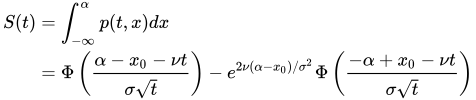
 .생존 함수는 브라운 운동 프로세스가 어느 순간 t
  장벽
장벽 
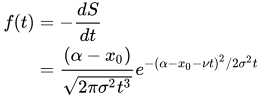

![{\displaystyle f(t)={\alpha \over {\sqrt {2\pi \sigma ^{2}t^{3}}}}e^{-(\alpha -\nu t)^{2}/2\sigma ^{2}t}\sim {\text{IG}}\left[{\alpha \over {\nu }},\left({\alpha \over {\sigma }}\right)^{2}\right]}](https://wikimedia.org/api/rest_v1/media/math/render/svg/e4a067af1e7148d854eabb348d311e4baf500edb)






 (와)
(와)